
After nearly 330 years of formation and development, the Bien Hoa - Dong Nai region is identified not only by street and place names recorded in administrative documents, but also by names that exist only in everyday life and have been passed down from one generation to another.
Names such as: Gate 1, Gate 2, Vuon Mit T-Junction, Lac Cuong Intersection and Lo Lu Ferry Terminal often originated from a landscape feature, structure or factory that once existed. Over time, the landscape and structures have changed, but these names have remained.
 |
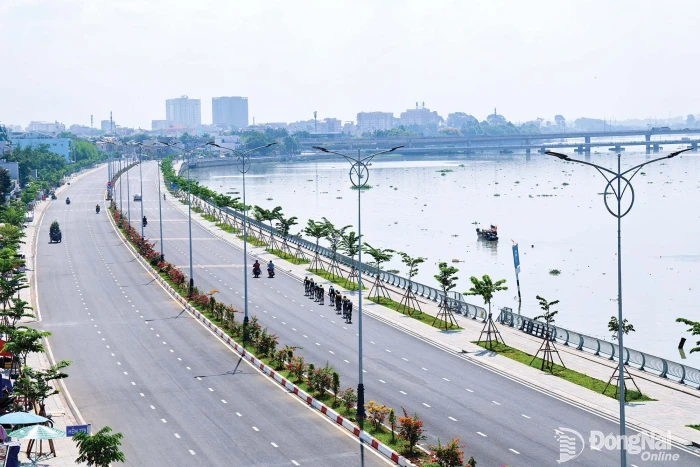
| Tran Bien Ward strives to create a green, clean and beautiful urban environment. Photo: Cong Nghia |
Strange yet familiar names
Gate 1, Gate 2, Vuon Mit T-Junction or Lac Cuong Intersection may not be easy to find on today’s map. But for longtime residents of Bien Hoa, these are extremely familiar place names.
Gate 1 and Gate 2 are colloquial names for the entrances to Bien Hoa Military Airbase. Gate 1 is located on Nguyen Ai Quoc Street, near the area of Bien Hoa Airbase Victory Monument. This area is also known as A42 Gate because an A42 aircraft repair workshop once operated nearby and was later developed into A42 Factory. The name A42 subsequently came to be used to refer to several nearby locations, including the victory monument, restaurants and residential areas.
“The names Gate 1 and Gate 2 have remained deeply rooted in the memories of Bien Hoa residents despite having been around for more than half a century”, said Le Thi Hong Loan, a native of Ben Tre Province who lived in Bien Hoa for many years.
In central Bien Hoa, Thanh T-Junction, or Thanh Ken, is a place name associated with the ancient Bien Hoa Citadel, located at the intersection of Phan Dinh Phung and Phan Chu Trinh streets. The citadel became known as Thanh Ken because military activities once took place there, with bugles used to signal the time and for guard duties. The sound of bugles belongs to the past, but the name Thanh Ken is still mentioned by many older residents as a familiar place name of both old and present-day Bien Hoa.
The area in front of what is now the Dong Nai City Investment, Trade and Tourism Promotion Center was once known as Vuon Mit T-Junction. According to Master Tran Quang Toai, Chairman of the Dong Nai Association of Historical Sciences, there was once a large, lush jackfruit orchard here. Based on this landscape feature, local residents gave the area a name to make it easier to identify and distinguish it from other junctions. Over time, the orchard disappeared, streets were expanded and many new structures emerged, but the name Vuon Mit T-Junction has continued to be passed down in everyday conversation.
From Vuon Mit T-Junction to National Highway 1 is a large intersection commonly known as Vincom Intersection, named after the nearby shopping center. But for people who have lived in Bien Hoa for many years, the area once had another name: Lac Cuong Junction, which became Lac Cuong Intersection after Vo Thi Sau Street was built. The name originated from a shoe manufacturing factory located nearby.
Similarly, May Cua T-Junction, at the intersection of Pham Van Thuan and Nguyen Van Hoa streets, is also a place name originating from a production facility that once stood there. The sawmill disappeared long ago, but its name continues to be used as a landmark for giving directions.
In addition to the place names mentioned above, there is Lo Lu Ferry Terminal, associated with the traditional craft of making jars, pots and other pottery products; and Don Market, whose name is associated with an area where a military outpost once stood.
A “memory map” of Bien Hoa residents
What is interesting about tracing Bien Hoa's old place names is that behind almost every name there is a story. Some originated from geographical features and landscapes, such as Vuon Mit and Ben Go; some are associated with waterway transportation, such as Lo Lu Ferry Terminal and Kho Ferry Terminal; some originated from production activities, such as May Cua Factory, Lac Cuong and Bien Hoa 1 Industrial Complex; while others are associated with military and historical structures, such as A42 Gate, Thanh T-Junction and Don Market.
For people who have lived in Bien Hoa for decades, these place names are more than simply ways of identifying locations. They are also markers of time, helping people envision a city that has changed from a three-way junction into a four-way intersection, from a repair workshop into a factory, and from a ferry terminal into a bridge.
Nguyen Van Son, 76, who currently lives in Tran Bien Ward, still clearly remembers the name May Cua T-Junction. According to Son, when he was a child, whenever adults said, “go to May Cua T-Junction”, he immediately knew where they meant. “Later, the factory disappeared and the roads changed, but my generation and our children still mention that name”, Son said.
For nearly 80-year-old Nguyen Van Nghia, who currently lives in Bien Hoa Ward, memories of Lo Lu Ferry Terminal remain vivid. He recalled that Bien Hoa once had many ferry terminals. These were not only places where people crossed the river but were also associated with the livelihoods of many families, including trading, fishing and transporting materials. Therefore, mentioning Lo Lu means recalling memories of trade, occupations and the lives of many people along the Dong Nai River.
Many place names were created from the existence of nearby landscapes and structures but have survived much longer. Factories have disappeared, ferry services have ceased and orchards have vanished, but the names once associated with those places remain in everyday conversations and in the memories of local residents.
Bien Hoa today is vastly different from the Bien Hoa of several decades ago. The former central area of Bien Hoa City is now also known as Tran Bien Ward. Many roads have been widened, new structures have emerged and the pace of urban life has accelerated. Yet in the stories of local residents, one can still hear old names here and there: Gate 1, Thanh Ken, Vuon Mit, May Cua, Lo Lu... These simple names contribute to the historical depth of a region that has passed through more than three centuries.
By Ban Mai - Translated by Diec Quyen, Thu Ha


Thông tin bạn đọc
Đóng Lưu thông tin