
Amid the rapid development of the Fourth Industrial Revolution, building an aerotropolis around Long Thanh International Airport requires a flexible development strategy capable of adapting to changing circumstances and guiding spatial planning.
An aerotropolis has two core components: an airport city located within the airport's boundaries and an airport-oriented urban area extending beyond the airport perimeter.
The "nucleus" driving Dong Nai toward a new national growth pole
Under current plans, Long Thanh Airport is expected to handle 100 million passengers and 5 million tonnes of cargo annually. It will be Vietnam's largest airport and is envisioned as a major international aviation hub for the region and Vietnam.
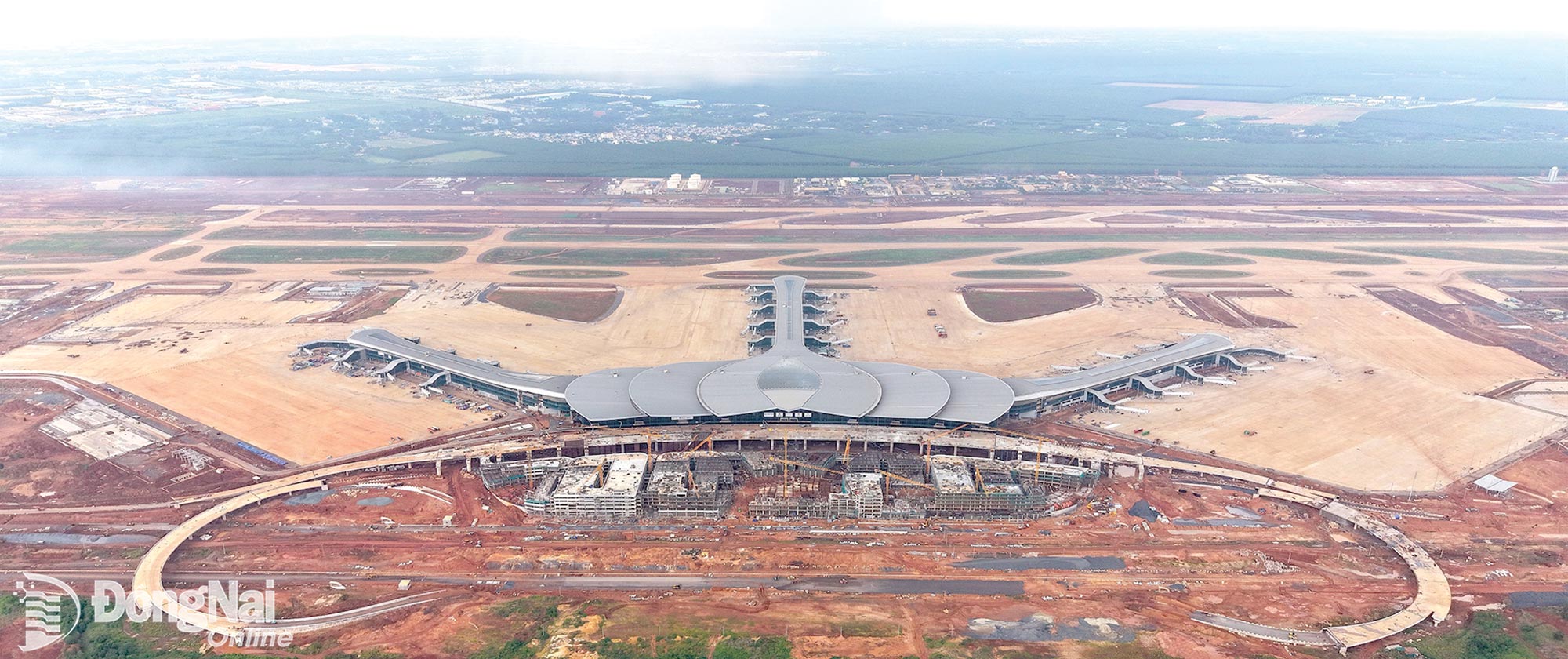 |
| Long Thanh Airport serves as the nucleus driving Dong Nai City’s emergence as a new national growth pole. |
Beyond addressing air transportation needs, Long Thanh Airport is expected to provide a once-in-a-century economic boost, helping restructure the economy and raise the profile of Dong Nai City and Vietnam as a whole.
According to Master of Urban Management Phan Thi An, Deputy Director of the Center for Urban and Rural Architecture and Planning, National Institute of Architecture under the Ministry of Construction, once Long Thanh Airport becomes operational, it will be more than just an airport. It will facilitate the formation of an airport city, transforming Dong Nai City into an international-scale logistics and services center.
To turn the growth momentum generated by Long Thanh Airport into reality, Dong Nai City is currently developing plans for an airport urban model and a free trade zone (FTZ) linked to the airport. Under its development strategy, the city has identified the Long Thanh Airport urban area and the Dong Nai River corridor as two new key growth-driving areas.
Professor John D. Kasarda of the University of North Carolina at Chapel Hill and Director of the Aerotropolis Institute China, said Long Thanh Airport would serve as the “nucleus” driving Dong Nai City’s emergence as a new growth pole for Vietnam.
A flexible development strategy is essential
Of the two core components of an aerotropolis, the airport city will comprise aviation, logistics and commercial facilities, creating a multimodal, multifunctional airport city at the center. The aerotropolis, meanwhile, will include connecting corridors, clusters of mutually supportive businesses and aviation-oriented industries, with access to the airport and other key urban transportation infrastructure.
A successful aerotropolis requires a harmonious combination of infrastructure, commercial real estate and Government policies. Key factors include attracting high-quality investment and talent, promoting trade in high-value goods and services to enhance the competitiveness of the city and metropolitan area, creating jobs and driving economic growth.
In terms of development, an aerotropolis is built around several key pillars: expanding airlines and flight routes; developing business clusters; attracting talent; and creating a livable, 4.0-era aviation city.
According to Professor John D. Kasarda, to successfully develop an aerotropolis around Long Thanh Airport, Dong Nai City needs to establish policies and provide the necessary technical and social infrastructure to develop high-tech industries linked to aviation, including digital technology, electronics and semiconductors, and biotechnology. In particular, the city needs policies and conditions needed to attract internationally qualified, high-skilled workers.
"Local authorities need to fully understand the principles of aerotropolis development and ensure effective linkages between the airport and business, service, industrial and urban activities."
Professor John D. Kasarda, University of North Carolina at Chapel Hill and Director of the Aerotropolis Institute China
"This is a critical prerequisite for attracting multinational corporations to invest and do business, thereby creating an aviation-linked economic ecosystem," Professor Kasarda said.
More importantly, Dong Nai City needs to develop a clear development strategy that identifies its economic model before establishing a spatial development plan. A specific strategy will provide the foundation for turning planning concepts into reality. As investment trends are changing rapidly under the impact of the Fourth Industrial Revolution, plans can quickly become outdated and rigid. Against this backdrop, having a flexible development strategy that can adapt to real-world circumstances is of critical importance.
By Pham Tung - Translated by Mai Nga, Thu Ha


Thông tin bạn đọc
Đóng Lưu thông tin