
Dong Nai City is entering a new phase of development, with expanded development space, major investment in strategic infrastructure and continued growth in industry and urbanization. Long Thanh International Airport, a key new growth driver, is also expected to begin operations soon. As unprecedented opportunities emerge, the city is making it clear that economic growth must go hand in hand with environmental protection, efficient use of resources and a better quality of life.
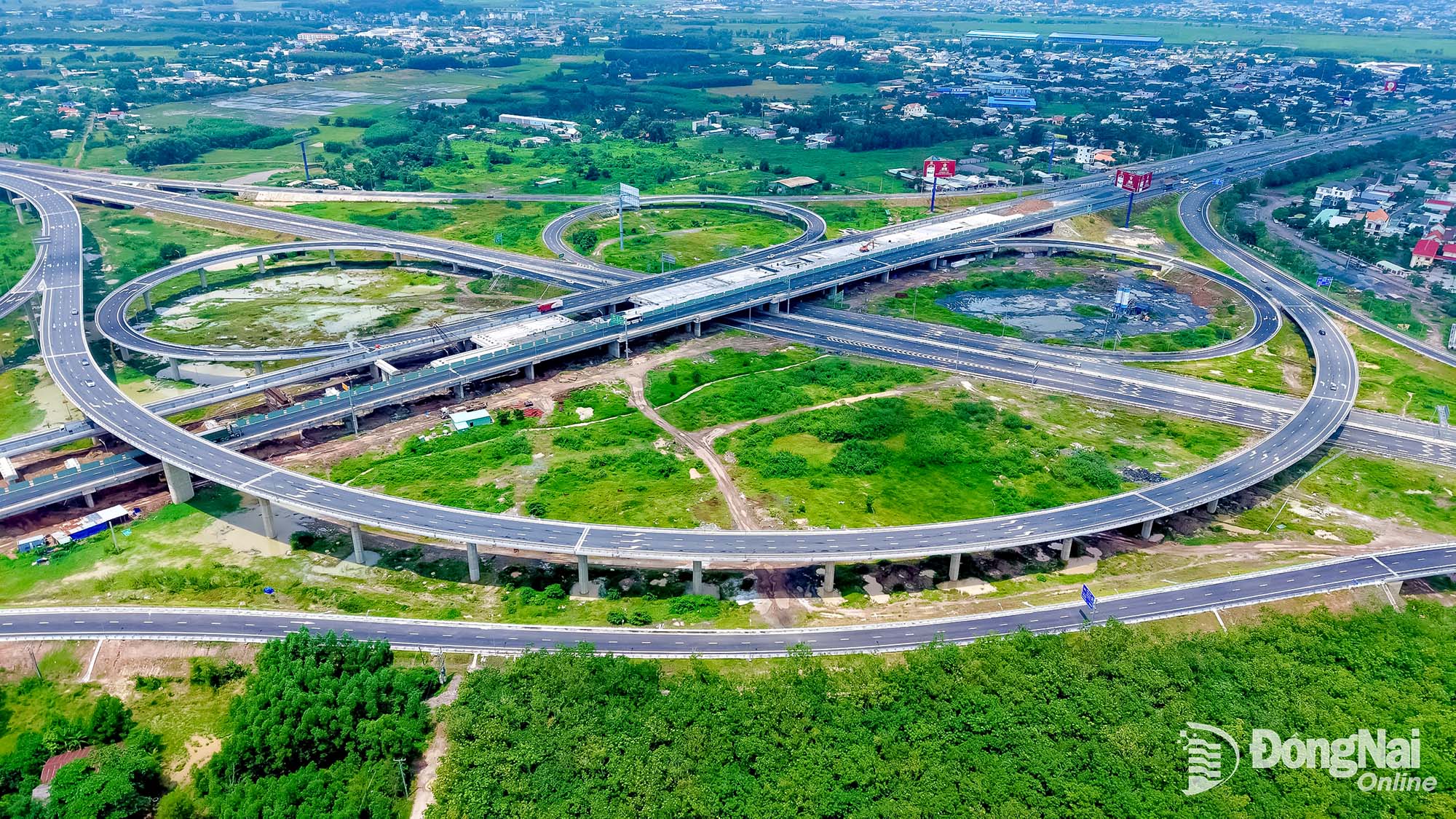 |
| Dong Nai's strategic transport infrastructure. Photo: Cong Nghia |
From protecting forests and conserving water resources to developing eco-industrial parks and green urban areas, and promoting clean energy, Dong Nai is placing “green” development at the heart of its growth model. Through these efforts, the city aims to build a modern, civilized and sustainable urban area that offers a high quality of life.
Green development at the heart of every policy decision
One of Dong Nai's key advantages is its vast natural area, providing a valuable green foundation in the country's most dynamic economic region. Despite rapid urbanization and industrialization, the city still has more than 370,000 hectares of forest, with forest coverage reaching 25.25 percent, exceeding the target set by the Resolution of the 1st Dong Nai Party Congress for the 2025-2030 period.
The city's biosphere reserves, national parks, nature and cultural reserves, together with green spaces in urban areas, provide an important ecological foundation for development.
Nguyen Tuan Anh, Vice Chairman of the Dong Nai City People's Committee, said forest protection in Dong Nai must go hand in hand with economic development. Forests are valuable not only for their natural resources but also for their landscapes, biodiversity, carbon sequestration capacity and ecosystem services. The city will therefore strengthen forest management and protection while sustainably tapping into the economic and environmental value of forest resources to support green growth.
Alongside forests, the city's rivers and lakes, particularly the Dong Nai River - the longest inland river in the country - are vital resources for development. Surface water supports production, daily life and power generation, while also helping ensure water security and strengthen resilience to climate change.
To protect this resource, Dong Nai has proactively tightened controls over groundwater extraction to prevent land subsidence, drought, resource depletion and deterioration in water quality. At the same time, it is stepping up control of pollution sources, particularly in upstream areas, river basins and around reservoirs.
If forests and water resources provide the ecological foundation, green industry is emerging as a driving force for the new growth model. With 44 industrial parks (IPs) currently in operation, Dong Nai is seeking to shift from a growth model heavily reliant on land, labor and natural resources to one driven by technology, productivity, innovation and efficient resource use.
With a natural area of more than 12,700 sq.km, Dong Nai currently has the largest land area among localities in southern Vietnam and ranks first among cities nationwide. This provides a strategic foundation for sustainable expansion of urban, industrial, logistics and agricultural development.
Pham Viet Phuong, Deputy Head in charge of the Dong Nai Industrial Parks and Economic Zones Authority, said Dong Nai has consistently maintained that it will not sacrifice the environment for economic growth alone. To date, 43 of the 44 operating IPs have completed and commissioned centralized wastewater treatment systems. The city is implementing a carbon reduction scheme through 2030, with a vision to 2050, while working to transform existing IPs into green and eco-industrial parks.
New IP projects around Long Thanh International Airport are being developed with a focus on green and smart growth. Nguyen Tuan Anh, Deputy General Director of KN Holdings in Dong Nai, said the company is prioritizing investment in high-tech projects, aviation-supporting industries, precision engineering and smart logistics. The IPs will use renewable energy for part of their production needs to reduce emissions and enhance their appeal to a new generation of investors.
The green agenda is also being incorporated into urban planning and development, transport, energy and agriculture as a guiding principle. This approach is expected to create new growth momentum while improving quality of life and preserving natural assets for future generations.
Growth with quality of life at its core
Dong Nai has entered an entirely new stage of development after adopting the two-tier local administration model and becoming the country's seventh city. The challenge, therefore, is to achieve rapid yet sustainable growth, with economic development going hand in hand with environmental protection and improvements in quality of life.
In planning its development space, Dong Nai is pursuing an open, multi-layered and polycentric urban structure, supported by multidirectional and multimodal transport infrastructure. It is also developing smart and green urban areas that can adapt to climate change. Natural resources, including land, minerals, water and forests, are being protected and used sustainably.
At the same time, the city is shifting toward a growth model driven by science and technology, innovation and digital transformation. Technology is expected to help reduce reliance on resource extraction, improve energy efficiency, optimize production and increase added value. Dong Nai is also developing the digital, data, green and circular economies, capitalizing on its advantages as an airport city and national logistics hub.
Speaking at the “Building eco- and smart IPs - A driver of investment attraction and green economic development in the Southeastern region” forum held in August 2026, Mickael Driol, General Director of Mekong Partners and Chairman of the Sourcing Committee of the French Chamber of Commerce and Industry in Vietnam (CCIFV), said Dong Nai and the Southeastern region are at the forefront of Vietnam's transition toward green industry.
According to Mickael Driol, Dong Nai enjoys a unique advantage by combining a high concentration of industrial activity, convenient access to seaports and an established manufacturing ecosystem. Few localities in Southeast Asia possess such a combination. Building on these advantages, Dong Nai has an opportunity to become a benchmark for developing industrial ecosystems that meet international standards. To seize this opportunity, the city needs to ensure a stable energy supply, improve data transparency, strengthen coordination in governance, implement policies flexibly and develop a skilled workforce.
Nguyen Kim Long, Standing Vice Chairman of the Dong Nai City People's Committee, said the city's consistent view is that development must be rapid but sustainable, with economic growth going hand in hand with social progress, environmental protection and improved quality of life.
Accordingly, the city will focus on building green, smart and modern urban areas while preserving their distinct identities; developing the green and circular economies; strengthening resource management and pollution control; and adapting to climate change. It will also prioritize investment in social infrastructure, particularly housing for workers, social housing, cultural facilities, healthcare, education and public spaces, so that residents, especially workers, can benefit more fully from the city's development.
Ultimately, the goal of green growth goes beyond economic growth rates or the size of the economy. It is about creating a safe and clean living environment where people can find jobs and housing, access essential services, and enjoy spaces for recreation, community activities and cultural life. This reflects the principle that people remain at the center of development.
By making green development a consideration in every policy decision, investment project and urban space, Dong Nai is laying the groundwork for rapid, high-quality and sustainable growth. The city is also moving toward a more civilized, modern and livable future, where development is measured not only by economic performance but also by the happiness of its residents.
By B.Mai – Translated by M.Nguyet, Thu Ha


Thông tin bạn đọc
Đóng Lưu thông tin