
Located along National Highway 20, a vital transport corridor directly linking the Southeast key economic region with the Central Highlands and Da Lat city (Lam Dong province), Tan Phu plays an important role as a major trade gateway of Dong Nai.
Leveraging its outstanding advantages and dynamic development in trade and services, Tan Phu is gradually asserting a new position as a vibrant growth pole in the Eastern part of Dong Nai province.
 |
| Bordering several localities, including Ta Lai, Nam Cat Tien, Phu Lam, and Lam Dong province, Tan Phu is steadily emerging as a key connectivity hub in the region. Photo: Tien Khang. |
With a natural area of more than 105.8 sq.km and a population of over 77,000, Tan Phu commune possesses the essential conditions to develop into a satellite urban area in the near future.
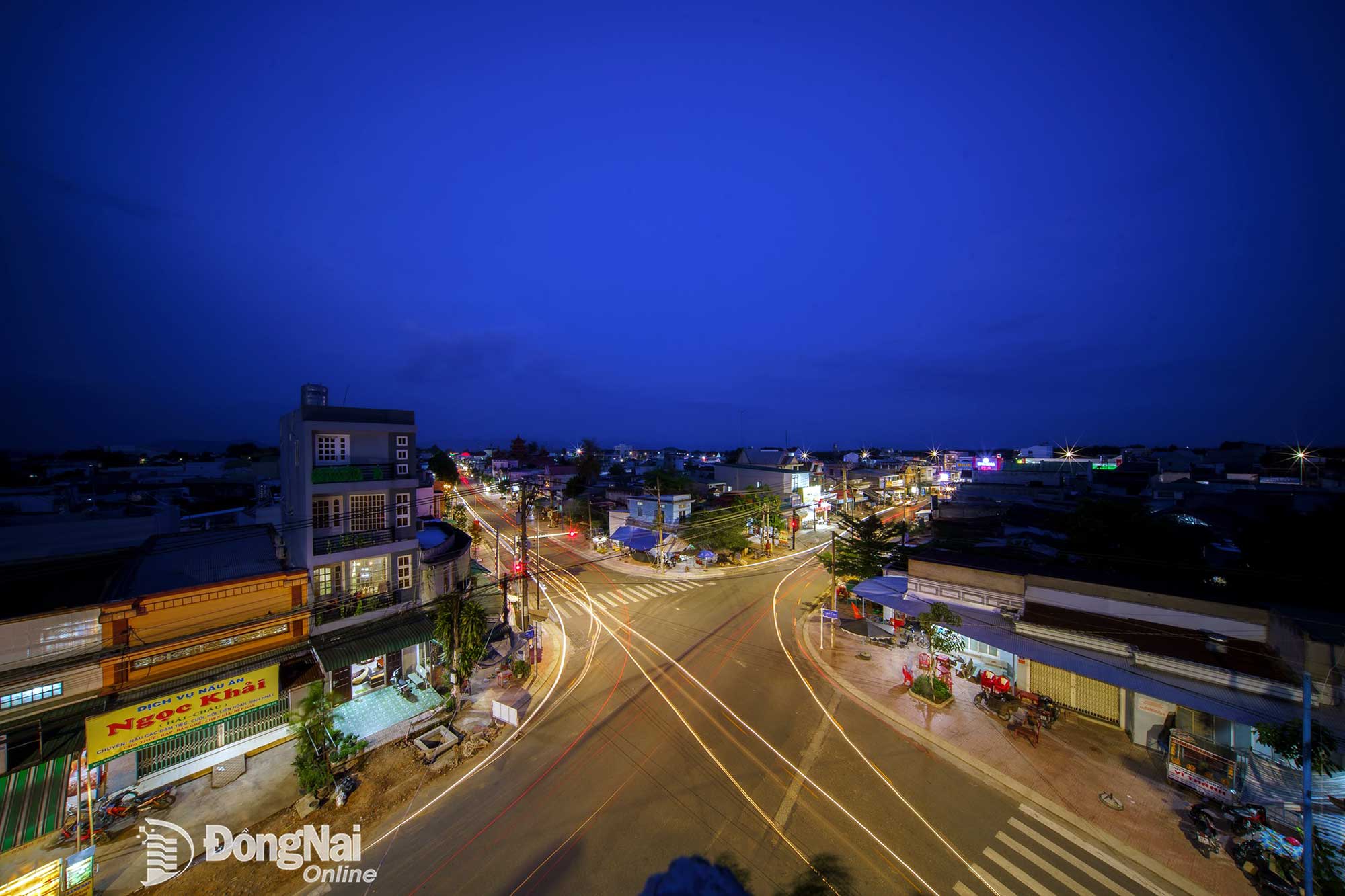 |
| Tan Phu commune center at night. Photo: Tien Khang |
One of Tan Phu’s major advantages lies in its transport infrastructure, which includes key routes such as National Highway 20, the Dau Giay–Tan Phu Expressway, and Provincial Road 774B. Notably, National Highway 20 runs through the area for approximately 10km, forming part of the key tourism route linking Ho Chi Minh City and Da Lat.
 |
| The central market of Tan Phu remains bustling with activity. Photo: Tien Khang |
Beyond its transport strengths, Tan Phu boasts relatively well-developed infrastructure, including a bus station, vibrant marketplaces, and an efficiently operating industrial park, providing a solid foundation for future urban development.
 |
| The urban landscape of Tan Phu is becoming increasingly distinct. Photo: Tien Khang |
Tan Phu’s urban profile is becoming increasingly distinct, with a series of projects including resettlement areas, residential-commercial-service zones, industrial parks, and public parks. These projects not only expand urban space but also improve local residents' quality of life.
 |
| Sunrise over Gia Ty forest in Tan Phu commune. Photo: Tien Khang |
 |
| Visitors explore Bat Cave in Phu Loc 18 hamlet, Tan Phu commune. Photo: Tien Khang |
Alongside industrial and urban development, Tan Phu is effectively tapping into its tourism potential, contributing to diversifying services and attracting more visitors.
 |
| Farmers in Tan Phu tend to green-skin pomelo orchards. Photo: Tien Khang |
 |
| Freshwater giant prawn farming in Tra Co 13 hamlet is expanding rapidly, delivering high economic efficiency. Photo: Tien Khang |
Tan Phu has a large area of agricultural land. This feature provides favorable conditions for the development of livestock farming, aquaculture, and high-value fruit crops such as durian, pomelo, and rambutan.
 |
| Farmers harvest rice using combine harvesters in Tan Phu. Photo: Le Lam |
In recent years, Tan Phu’s economic structure has shifted markedly, with a gradual decline in agriculture and rapid growth in trade, services, industry, and handicrafts. At present, the industry–construction and trade–service sectors account for 72.51% of the local economy. Tan Phu is home to a 54-hectare industrial park and is implementing Phase 2 expansion, which will bring the total area to around 300 hectares.
Per capita income reached VND86 million in 2025. Economic activities are becoming increasingly vibrant, reflecting the strong momentum of a locality undergoing urbanization.
 |
| Local authorities and residents have worked together to improve and beautify the urban landscape. Photo: Tien Khang |
Behind these changes is the persistent effort of the local Party organization, the authorities, and the people. Each steady step taken today is the foundation for bigger goals in the future.
 |
| Tan Phu residents actively engage in physical exercise and sports. Photo: Tien Khang |
With its advantages in location, infrastructure, and socio-economic growth momentum, Tan Phu is poised to seize major opportunities to break through and become a ward in the near future. This transformation is not only an administrative transition, but also proof of this land's determined development journey.
By T.Khang, V.Chinh – Translated by M.Nguyet, Minho


Thông tin bạn đọc
Đóng Lưu thông tin