
Completing the intra-provincial transport connection system, primarily through road and railway systems, is an urgent requirement for Dong Nai to fully exploit and promote its potential and advantages in the context of the province's new development position.
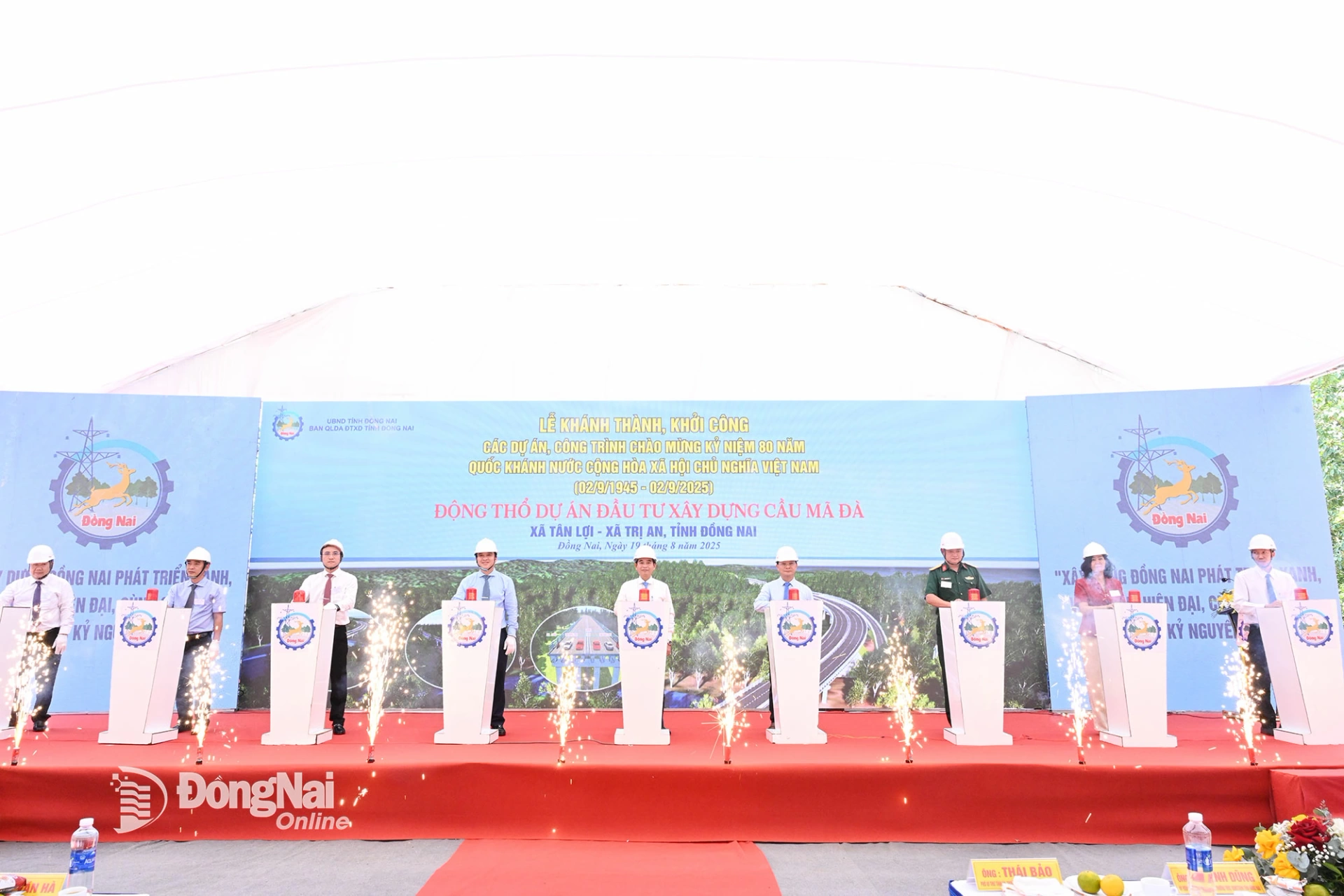 |
| Leaders of Dong Nai province, representatives of the construction unit and investors press the button to commence the Ma Da Bridge Construction Project. Photo: Trung Quang |
One connecting transport axis is not enough
Dong Nai province is currently one of the localities with a large area and population scale nationwide. At the same time, it holds a strategically important position, playing a central role in connecting the Southeastern region with the Central Highlands and the Central Coast.
Within the province, Dong Nai has many strengths in raw materials and land funds for industrial, logistics, and urban development. These are favorable conditions for Dong Nai province to realize its aspiration for double-digit economic growth in the coming years.
However, according to Dr. Tran Du Lich, Member of the National Monetary Policy Advisory Council and the Socio-Economic Advisory Group of Dong Nai province, to fully leverage its development pillars, Dong Nai must adopt breakthrough development strategies. The first of these is the completion of its connecting transport system, starting with intra-provincial links.
Comrade Vo Tan Duc, Deputy Secretary of the Provincial Party Committee and Chairman of the Provincial People's Committee, stated that Dong Nai will soon be equipped with a full range of transport modes. Notably, the province is home to Long Thanh International Airport, Hoa Lu International Border Gate, the North–South Railway, and key seaports, including Phuoc An, Go Dau, and Phu Huu. These are favorable conditions for the province to make a "breakthrough in development."
However, Chairman Vo Tan Duc also noted that alongside these advantages and opportunities, there remain limitations that must be addressed and challenges that need to be resolved, chief among them is transport connectivity, both inter-regional and within the province.
In reality, there is currently no direct connecting transport route between the northern and southern parts of the province. Traffic between the two areas still has to go through routes in Ho Chi Minh City. Therefore, to form a direct connecting transport route between the northern and southern parts of the province, Dong Nai is implementing investment in the project of the connecting route from Dong Xoai to Ring Road 4 - Ho Chi Minh City via Provincial Road 753, Ma Da Bridge, and the route connecting Ma Da Bridge to Ring Road 4 - Ho Chi Minh City.
According to Assoc. Prof. Dr. Tran Quang Phu, Vice Rector of Ho Chi Minh City University of Transport, notes that having only one connecting transport axis between the northern and southern parts of Dong Nai province is insufficient.
On August 19, 2025, Dong Nai province broke ground on the Ma Da Bridge Construction Project. The project’s starting point connects to Provincial Road 753 in Tan Loi commune, Dong Nai province, and its endpoint lies on a trail within the Dong Nai Nature and Culture Reserve, Tri An commune, Dong Nai province.
Prioritizing road and railway connections
Assoc. Prof. Dr. Tran Quang Phu stated: For the project of the connecting route from Dong Xoai to Ring Road 4 - Ho Chi Minh City via Provincial Road 753, Ma Da Bridge, the route connecting Ma Da Bridge to Ring Road 4 - Ho Chi Minh City, to accommodate traffic flow, it is necessary to consider investing in an urban expressway scale. "Expressways will not have intersections with other routes, thus ensuring traffic flow," Tran Quang Phu suggested.
 |
| The project to upgrade and expand Provincial Road 753, along with the construction of the Ma Da Bridge connecting to Long Thanh Airport and Cai Mep - Thi Vai Port, is currently being carried out by Dong Nai. Photo: Pham Tung |
In addition to this route, Assoc. Dr. Tran Quang Phu proposed investing in and establishing new transport corridors and connecting axes, such as developing an additional Ring Road 5 - Ho Chi Minh City to link Ho Chi Minh City, Dong Nai, and Tay Ninh via National Highways 56 and 56B; and Ring Road 6 - Ho Chi Minh City, following the alignment of Provincial Roads 761, 776, and 765. At the same time, Dong Nai should propose to the Ministry of Construction and coordinate with Lam Dong province to invest in upgrading National Highway 55B, thereby creating a north-south axis that connects the eastern part of Dong Nai.
Additionally, according to Assoc. Prof. Dr. Tran Quang Phu, Dong Nai urgently needs to establish a connection between industrial parks in the northern part of the province and Phuoc An Port in the south. This connection is intended to serve goods transportation; therefore, relying solely on road networks would result in low transport efficiency. As such, it is necessary to develop a railway link between these two areas. Assoc. Prof. Dr. Tran Quang Phu suggested that the corridor of the route connecting Dong Xoai to Ring Road 4 - Ho Chi Minh City via Provincial Road 753 and Ma Da Bridge, as well as the route linking Ma Da Bridge to Ring Road 4 - Ho Chi Minh City, could be utilized for investment in building this railway line.
Meanwhile, Dr. Tran Du Lich noted that to complete the intra-provincial transportation network, Dong Nai must coordinate efforts and expedite the completion of Ring Roads 3 and 4 - Ho Chi Minh City. At the same time, a railway line connecting Hoa Lu International Border Gate to the Cai Mep – Thi Vai Port cluster must be constructed to form a clear and efficient development corridor.
By Pham Tung – Translated by Mai Nga, Minho


Thông tin bạn đọc
Đóng Lưu thông tin