Most animal husbandry zones in Dong Nai province, the country’s livestock hub, lack infrastructure and many household farms do not have enough money to move into the zones, according to local officials.
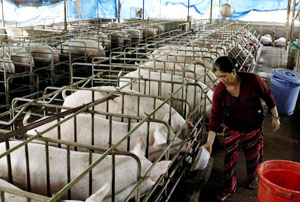 |
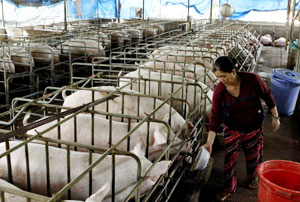
| An animal husbandry zone in Xuan Dinh commune, Xuan Loc district, Dong Nai. A lack of infrastructure and financing has hindered the development of the zones established in the province. |
Most animal husbandry zones in Dong Nai province, the country’s livestock hub, lack infrastructure and many household farms do not have enough money to move into the zones, according to local officials.
In 2008, the province’s People’s Committee approved a plan to develop 139 animal husbandry zones with a total area of nearly 16,000ha since nearly half of all livestock farms were small and scattered.
Dong Nai, which has around 1.2 million pigs and 10 million chickens, became the country’s first province to create such zones.
But so far there are only 370 farms operating in 48 of the 139 zones, according to the Department of Agriculture and Rural Development.
Of them only 41 are new farms, with the others existing since before the establishment of the zones.
A further 1,500 farms, not including household-run farms, are situated outside the zones.
Nguyen Van Hung, who has a pig farm with more than 1,000 animals in a zone in Thong Nhat district’s Quang Trung commune, has had to use his ploughing machine to generate power for his farm for the past three years because the zone does not have electricity.
“Many household livestock farmers felt glad when the plan was approved,” he said, “but since there is no power many have not been interested in setting up farms.”
The zones are located far from residential areas and roads leading to them have not been built in time.
More than half of the zones do not have roads or power, a factor that has prevented authorities from attracting household farms.
Cost has also been a factor. Setting up a farm in these zones requires a large amount of money, something that is difficult for household farmers to raise.
The department estimates that an investment of around VND20 billion (almost US$1 million) is needed to set up a farm with 10,000 pigs, and VND 7.5 billion for 50,000 chickens.
There are no incentives or support policies for farmers seeking to move into one of the zones.
Nguyen Van Thuan of Gia Rai town said while the concept of creating such zones was sound, household farmers cannot afford the cost of moving into them.
The price of land in the zones is also a dissuading factor for many. It now costs more than VND500 million a hectare, 20-30 per cent up since the zoning plan was approved, Thuan said.
He raises pigs in a residential area and will be forced to move to one of the zones. Thuan worried while asking: “My family survives on our 200 pigs. If my family stops raising them, how will we live?”
Phan Minh Bau, the department’s deputy director, admitted there are problems with the development of the zones, saying progress is still slow and not properly co-ordinated.
His department would urge the People’s Committee to improve infrastructure in the zones and adopt policies to support farms to move into them, he revealed.
It would also seek investment from other sources, including domestic and foreign investors.
Of the 139 zones, Dong Nai has chosen the 108ha Tay Bach Lam zone in Thong Nhat district’s Gia Tan 2 commune as a model.
Tay Bach Lam functions efficiently as do farms there.
Tran Van Luong, for instance, earns a profit of VND1.5 billion a year from his farm which has 15,000 chickens and 1,000 pigs since moving in four years ago.
The other 27 farms in Tay Bach Lam too earn an average annual profit of more than VND1 billion.
Luong said: “[Having] concentrated animal husbandry zones is the right policy. The 28 farms in Tay Bach Lam have received assistance from authorities.”
District officials have assisted by providing farming techniques and setting up the Tay Bach Lam animal husbandry co-operation group in the zone, he said.
The occupants have supported each other by sharing farming techniques and even funds, and the zone has had no disease outbreaks in the four years since it was set up, he said.
“Its environment is well protected,” he added.
(Source: VNS)