
Thanh Son is an agricultural commune, with farmland accounting for more than 80% of its natural area. The locality has established specialized growing areas for fruit trees and rice, each covering tens of hectares. Farmers are proactively applying science and technology to safe production practices to meet the standards of export markets.
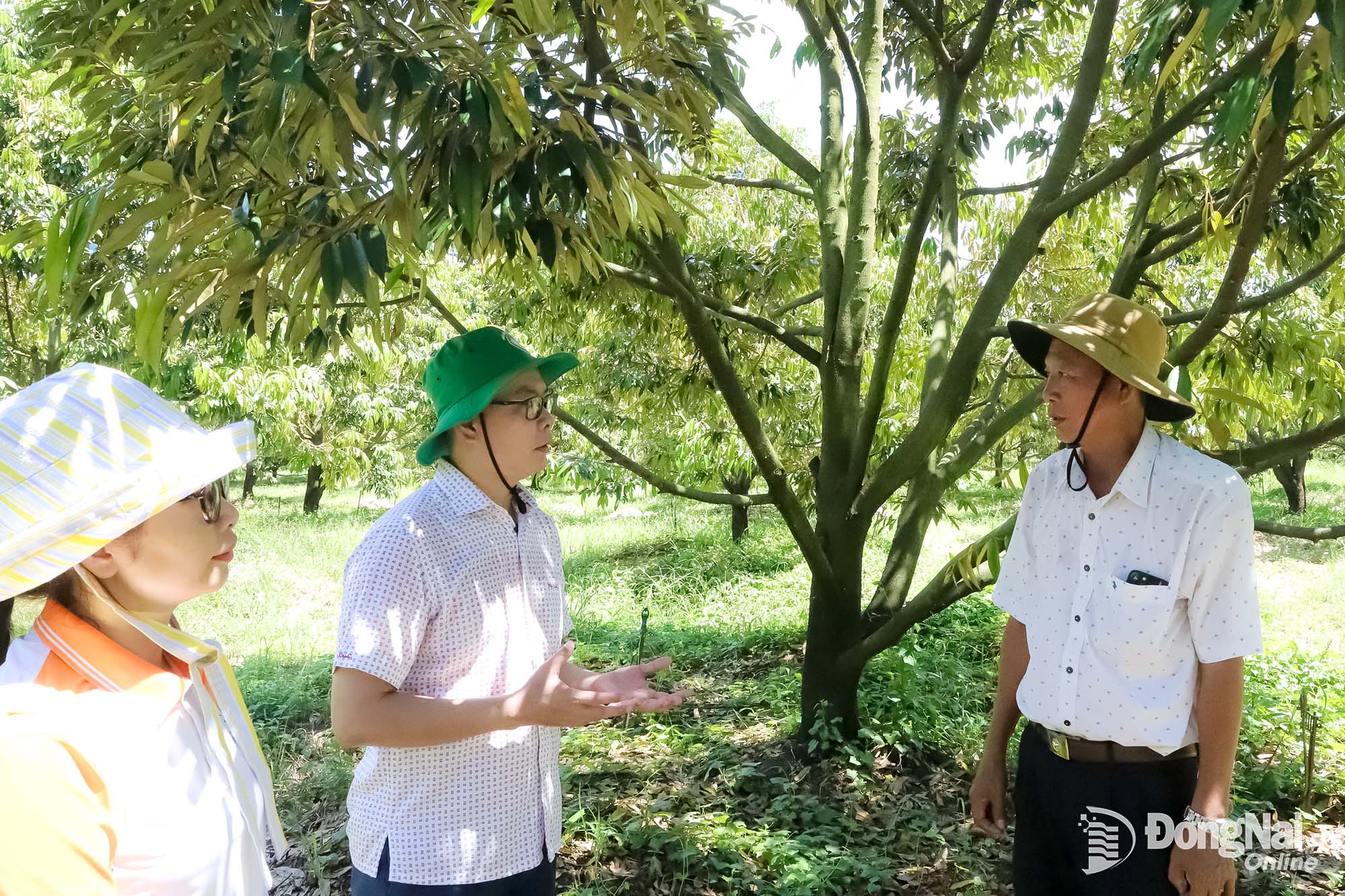 |
| Chairman of the Thanh Son Commune People's Committee Vo Van Trung (far right) personally participates in videos introducing the locality's specialty products and key agricultural products on digital platforms. |
To promote its key agricultural products and specialties and attract business investment, while building linkage chains from growing areas to processing and consumption, Chairman of the Thanh Son Commune People's Committee Vo Van Trung personally participates in videos introducing local agricultural products on digital platforms.
Developing a new generation of farmers with innovative thinking
Although Thanh Son is a remote commune, many local farmers have invested in large-scale production and taken the lead in applying science and technology to farming.
Vo Van Tung grows 30ha of durian trees, including specialty varieties such as Monthong and Musang King, which have already begun producing high yields of good-quality fruit. With such a large growing area, Tung uses unmanned aerial vehicles (drones) to spray pesticides and apply fertilizer. This modern equipment helps reduce labor, save agricultural inputs and labor costs, while enabling timely pest and disease control and ensuring healthy crop growth.
As many areas have sandy soil with poor drainage, Tung has dug ditches along both sides of the tree rows to prevent waterlogging and improve soil aeration. He has also applied techniques to control durian tree height at around 6 meters by topping them, making the trees easier to care for and allowing nutrients to support leaf and fruit growth.
According to Chairman of the Thanh Son Commune People's Committee Vo Van Trung, in addition to helping farmers establish growing-area codes and apply science and technology to improve productivity and quality, the locality is also working alongside them to build brands for agricultural products and specialties. On weekends, he personally visits orchards and scenic locations to film videos introducing local products and connecting them with markets, helping bring Thanh Son's key agricultural products closer to domestic and international consumers.
Tung said that the locality has many large-scale durian and banana orchards, so farmers are keen to apply science and technology. Many orchard owners are experienced in inducing early flowering and fruit setting in durian trees, allowing them to sell their produce at higher prices. One of their techniques involves covering the ground beneath the trees with tarpaulins during the transition from the rainy season to the dry season, helping the trees flower and set fruit one to two months earlier than the main crop season. Farmers are also focusing on safe production and establishing growing-area codes for export, creating sustainable market outlets.
Pham Van Quy, a banana grower in Thanh Son Commune, shared that fertilizer and pesticide prices have continued to rise, while fresh fruit import markets, including China, are becoming increasingly stringent in terms of quality and safety. In response to these requirements, he has shifted toward organic farming, making use of manure and discarded bananas available locally to produce fertilizer for his crops. He also staggers planting schedules, dividing production into several harvest periods throughout the year to reduce the risks of seasonal oversupply and falling prices.
Preparing raw material areas to welcome investors
The area bordering the La Nga River has fertile alluvial soil, making it suitable for wet-rice cultivation and fruit trees. The commune's largest concentrated rice-growing area is the Bau Kien field, covering more than 73ha. To increase the value of agricultural products, farmers in this area have switched to clean rice production.
Nguyen Thanh Hung, Director of the Bau Kien Agricultural Services Cooperative, said the cooperative has partnered with Que Lam Group Joint Stock Company (Ho Chi Minh City) to produce rice according to organic farming processes. Cooperative members can purchase quality-assured organic fertilizers and biological pesticides at favorable prices. They are also provided with agricultural inputs on credit, with payment made after harvesting and selling their rice. The company's technical staff directly guide farmers through clean production processes, helping improve rice productivity and quality. From an initial 1ha pilot area, the model has attracted active registration from cooperative members and expanded to 30ha.
Chairman of the Thanh Son Commune People's Committee Vo Van Trung said the locality has areas specializing in single crops such as rice, durian and bananas, each covering 50-70ha. The commune plans to develop specialized farming areas and gradually establish concentrated growing zones, creating favorable conditions for building sustainable production linkages and increasing agricultural output and value.
As an agricultural commune, Thanh Son identifies agriculture as its central development focus. The Commune People's Committee is paying attention to helping farmers establish growing-area codes for key crops. In particular, the more than 73ha Bau Kien rice field is oriented toward clean rice production. In the coming period, the commune will support the Bau Kien Agricultural Services Cooperative in developing clean Bau Kien rice as one of products under the One Commune One Product (OCOP) program. The locality also organizes technical training and supports farmers in developing clean agricultural production areas and applying safe farming methods.
According to Trung, the improvements in productivity and quality achieved through the application of new technologies and techniques provide a basis for gradually changing traditional farming practices toward safe and sustainable agriculture.
By Binh Nguyen - Translated by Diec Quyen, Thu Ha
Thông tin bạn đọc
Đóng Lưu thông tin