
Dong Nai City is studying a plan to develop an inland waterway transportation network connecting the northern area of the city with the Dong Nai River. The initiative is expected to establish a new freight corridor linking the northern region to the seaport system in the southern part of the city.
 |
| Developing inland waterway transport links will better serve the growing demand for container transport from industrial parks in northern Dong Nai to southern seaports. Photo: Pham Tung |
The development of this inland waterway transportation system is expected to enhance cargo transport capacity and support the city's socio-economic development.
Reducing pressure on road transportation
At the end of June 2026, Dong Nai City officially commenced construction of Component Project 1, covering the section from Ma Da Bridge to Ba Hao Junction, under the project to build the road connecting Ma Da Bridge to Ho Chi Minh City’s Ring Road 4. This section forms part of a strategic road transport corridor that will not only provide direct connectivity between the northern and southern parts of the city but also create a complete interregional transport axis, becoming the shortest and fastest route linking the Central Highlands provinces with Dong Nai City, Long Thanh International Airport, and the Cai Mep-Thi Vai deep-water port complex. The route is also expected to open up new development opportunities by strengthening connections between different areas of Dong Nai and major logistics centers, seaports and Long Thanh International Airport.
According to the consulting unit, industrial parks in the northern area of the city currently generate approximately 3.4 million tons of cargo annually, a figure projected to increase to around 10.5 million tons per year after 2030. Container demand is also expected to rise significantly, from more than 113,000 TEUs per year at present to approximately 350,000 TEUs annually after 2030.
According to the city’s planning, in addition to the above-mentioned transport route, Dong Nai will continue investing in the construction and upgrading of several road routes to strengthen connectivity between the northern and southern parts of the city. At the same time, the city is studying the development of other transportation modes, including inland waterways, to strengthen connectivity between the northern and southern parts of the city, help relieve pressure on the road network while improving freight transport capacity.
Duong Van Hieu, Deputy Director of the Department of Construction, said that under the direction of the City People’s Committee, the department has been developing a proposal for an inland waterway transport system connecting northern Dong Nai with the Dong Nai River as part of a multimodal logistics development strategy for the 2030–2050 period.
According to the consulting unit, Dong Nai has several major rivers, including the Be River, Dong Nai River, La Nga River and Ray River. However, only Tri An Reservoir, the downstream section of the Dong Nai River and its tributaries currently offer suitable conditions for inland waterway transportation. The Be River, by contrast, has a narrow and steep channel, strong currents and numerous bridges and dams, making it unsuitable for waterborne transport. Therefore, the proposed waterway connection between the northern and southern parts of the city would be developed via the Dong Nai River.
Carefully assessing economic efficiency
Under the proposed plan, because there is no direct waterway linking the industrial parks in the northern part of the city, freight would be transported using a flexible combination of road and inland waterway transport. Specifically, cargo from industrial parks would first be transported by road to the proposed Tri An transshipment port, which would be integrated with an Inland Container Depot (ICD) in Tri An Ward. From there, cargo would be transported by by inland waterway to seaports in the southern part of the city.
To implement this plan, the consulting unit proposed three key solutions: increasing the navigation clearance of Ghenh Bridge, the old Dong Nai Bridge and Hoa An Bridge; investing in the Tri An transshipment port; and upgrading the navigation channel along the Dong Nai River. According to the consultant, these measures would reduce pressure on the road network, lower logistics costs and improve regional freight connectivity.
 |
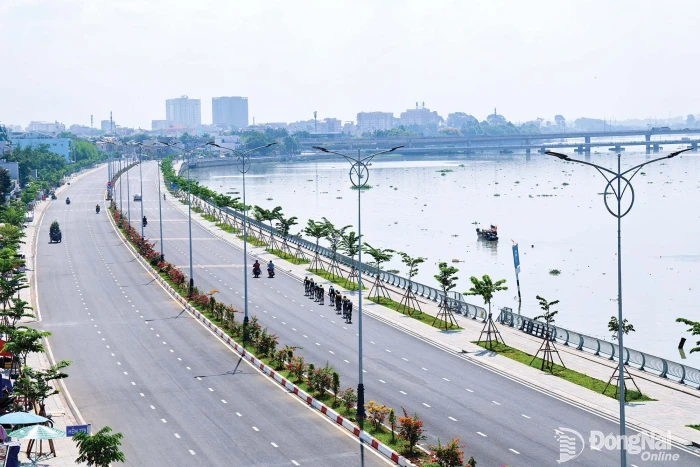
| The Dong Nai River provides favorable conditions for inland waterway transportation connecting the northern and southern parts of the city. |
Commenting on the proposal during a working session held in mid-July 2026, Vu Sao Sang, Deputy Director of the Department of Industry and Trade, noted that the consultant's transport demand forecast was based primarily on the scale of industrial parks in northern Dong Nai and the projected cargo volume. However, it had not specifically assessed the proportion of freight that could realistically be shifted to inland water transport, nor the actual demand from logistics companies and import-export enterprises. He emphasized that further analysis is needed to determine the volume of cargo that could be transferred from road to waterway transport, particularly containerized cargo, industrial raw materials and export goods from industrial parks.
According to Ho Van Ha, Member of the City Party Committee and Vice Chairman of the Dong Nai City People's Committee, the proposal aims to reduce the number of container trucks transporting goods by road while lowering logistics costs. Therefore, the project's economic efficiency is the key consideration, ensuring that investment is cost-effective and avoiding waste.
By Pham Tung - Translated by Diec Quyen, Thu Ha


Thông tin bạn đọc
Đóng Lưu thông tin