
Resolution No. 16-NQ/TW, dated July 21, 2026, of the Politburo on building and developing Dong Nai city to 2035, with a vision to 2065, paves the way for the city to remove bottlenecks, while maximizing its potential and advantages to accelerate development.
 |
| A view of the urban area in Tran Bien Ward, Dong Nai city. Photo: Minh Tai |
The goal is to transform Dong Nai city into a globally connected city with a high quality of life and happiness, ranking among the world’s multifunctional airport cities.
Building breakthrough mechanisms
Over the years, with a solid industrial foundation and strategic geographical location, Dong Nai has achieved significant development results, making positive contributions to the country’s overall development. However, compared with its potential and advantages, the development of Dong Nai has yet to meet expectations.
Dong Nai city is currently regarded as a major construction site of the country, with a series of nationally important projects such as Long Thanh International Airport, expressways and ring roads being developed. This creates highly favorable conditions for Dong Nai to establish a new growth model and accelerate development. However, turning potential and opportunities into development advantages requires the support of special mechanisms and policies.
Against this backdrop, the Politburo’s issuance of Resolution No. 16 is considered a “lever” for the city to accelerate development.
Resolution No. 16 identifies eight key groups of tasks and major solutions for developing Dong Nai city, including building and strengthening the Party and political system; developing planning with a strategic and long-term vision; establishing breakthrough institutions and policies to mobilize development resources; developing a comprehensive aviation ecosystem; developing strategic infrastructure and a modern urban space; building a new growth model based on science, technology, innovation and digital transformation, while developing spearhead economic sectors; comprehensively developing culture, education, healthcare and the people of Dong Nai; and ensuring national defense, security and social order while improving the effectiveness of external relations.
The resolution sets a target for the 2026-2030 period of maintaining annual GRDP growth of at least 10 percent. By 2030, the city’s GRDP is expected to reach USD 44 billion, with per capita GRDP reaching USD9,200; the added value of the digital economy is expected to account for at least 30 percent of GRDP, while the urbanization rate is targeted at 65 percent.
During the 2031-2035 period, annual GRDP growth is expected to remain at 10 percent or higher. By 2035, GRDP is targeted at USD70 billion, with per capita GRDP reaching USD13,000, approaching the level of developed cities in the region. The added value of the digital economy is expected to account for at least 40 percent of GRDP.
During the 2036-2045 period, annual GRDP growth is targeted at 10 percent or higher. By 2045, GRDP is expected to reach USD150 billion, with per capita GRDP reaching USD23,000, placing the city among the high-income economies in the region. The share of the digital economy in GRDP will continue to increase.
During the 2046-2065 period, annual GRDP growth is targeted at 8 percent or higher. By 2065, GRDP is expected to reach USD600 billion, with per capita GRDP reaching USD67,500.
Resolution No. 16 sets the goal that by 2035, Dong Nai city will become an urban area based on the model of an airport city, riverfront city, polycentric city and multifunctional city, characterized by green and smart development, with high-tech industries, aviation and aerospace industries, and an international-standard aviation economy at its core. The city is expected to have high-income residents and a civilized, safe and happy society.
By 2045, Dong Nai city is expected to become a modern aviation hub in the Asia-Pacific region and a dynamic knowledge-based economic center, with a high Human Development Index (HDI), modern urban governance and a civilized, safe, livable and happy society.
By 2065, Dong Nai city is expected to become a globally connected city with a high quality of life and happiness, ranking among the world’s multifunctional airport cities.
Towards a long-term development vision
Assessing the significance of Resolution No. 16 for the development of Dong Nai city, Prof. Dr. Vo Xuan Vinh, Director of the Institute for Business Research under the University of Economics Ho Chi Minh City, said that Dong Nai city has been positioned with a new status and greater stature. In particular, Resolution No. 16 provides a long-term vision, thereby creating long-term development opportunities for Dong Nai city. Such a long-term vision will support planning for infrastructure, environment and urban development. At the same time, it enables the city to formulate long-term development plans, which is an important factor for sustainable development.
 |
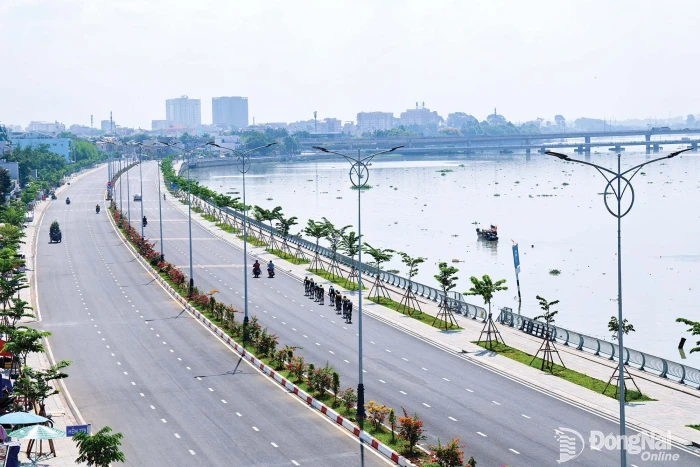
| With the advantage of the Dong Nai River, the city is oriented toward developing a riverfront urban model. |
Meanwhile, Huynh Ho Dai Nghia, a public policy expert from the University of Social Sciences and Humanities under Vietnam National University Ho Chi Minh City, said Resolution No. 16 is of particular importance to the development of Dong Nai city because it provides a strategic framework for repositioning Dong Nai within the national development structure.
According to Huynh Ho Dai Nghia, Resolution No. 16 provides Dong Nai city with six key development breakthroughs, including elevating Dong Nai’s position within the region and the country; placing Long Thanh Airport at the center of a new development cycle; changing the approach to urban planning; turning infrastructure into a tool for restructuring the economy; opening the way for special mechanisms and mobilizing new resources; while requiring Dong Nai to improve the quality of its growth.
“Among these, opening the way for special mechanisms and mobilizing new resources is a highly practical aspect of Resolution No. 16. For Dong Nai, this is a crucial condition for implementing new development models such as an airport city, international logistics, a free trade zone, an innovation center, transit-oriented urban development and other specialized economic spaces”, Huynh Ho Dai Nghia said.
By Pham Tung - Translated by Diec Quyen, Thu Ha


Thông tin bạn đọc
Đóng Lưu thông tin