
The Politburo’s Resolution No. 57-NQ/TW on breakthroughs in science and technology development, innovation and national digital transformation serves as a guiding principle for orienting science, technology and innovation activities. It helps address immediate challenges while establishing a long-term roadmap to lay the groundwork for sustainable development of science, technology and innovation.
In Dong Nai City, local authorities have implemented practical movements and activities tailored to the specific needs of different target groups and localities, from urban and rural areas to ethnic minority communities. These efforts have enabled digital transformation to gradually “take root” in people's daily lives.
Promoting the pioneering role of Party members
The Party Committee of Dong Phu Ward has 41 Party committees and cells with more than 1,200 Party members, all of whom have installed the Electronic Party Member Handbook application. Nguyen Ngoc Quang, Deputy Head of the Party Building Board of Dong Phu Ward, said the widespread use of the Electronic Party Member Handbook application not only concretizes the Politburo’s Resolution No. 57-NQ/TW on breakthroughs in science and technology development, innovation and national digital transformation but also marks an important step toward innovating the Party's leadership methods, improving the operational efficiency of Party organizations, and promoting the role, responsibility, pioneering spirit, and exemplary conduct of Party members in the digital transformation process.
 |
|
Youth Union members and young people of Dong Phu Ward visit Party cells to guide elderly Party members in using the Electronic Party Member Handbook application. Photo: XT |
According to Quang, the application integrates key functions, including Party activities, resolution study, news and communications, documents, archives, document management, and utilities. The functions are designed in a user-friendly manner and provide numerous practical benefits and outstanding features for Party members.
"The Electronic Party Member Handbook application functions as a miniature library, enabling Party members to search for, view, and download documents and materials related to Party work. In addition, Party members can follow regular meeting schedules, receive meeting reminders, access meeting agendas and materials, and submit feedback, responses, and recommendations so that Party committees can effectively understand the thoughts, aspirations, and viewpoints of Party members," said Quang.
Vu Trung Thanh, Secretary of the Tan Ha Neighborhood Party Cell in Dong Phu Ward, said the initial implementation of the Electronic Party Member Handbook application presented certain difficulties, particularly for elderly Party members. However, thanks to the enthusiastic support of Youth Union members and young people, Party members in the cell have been proficient in using the application's functions.
"Party cell meetings have become much more convenient. Instead of relying on stacks of paper documents and lengthy reports as in the past, now with just a few taps on a smartphone connected to the internet, every Party member can access all the meeting content fully and accurately through the Electronic Party Member Handbook application," said Thanh.
Flexible and creative implementation
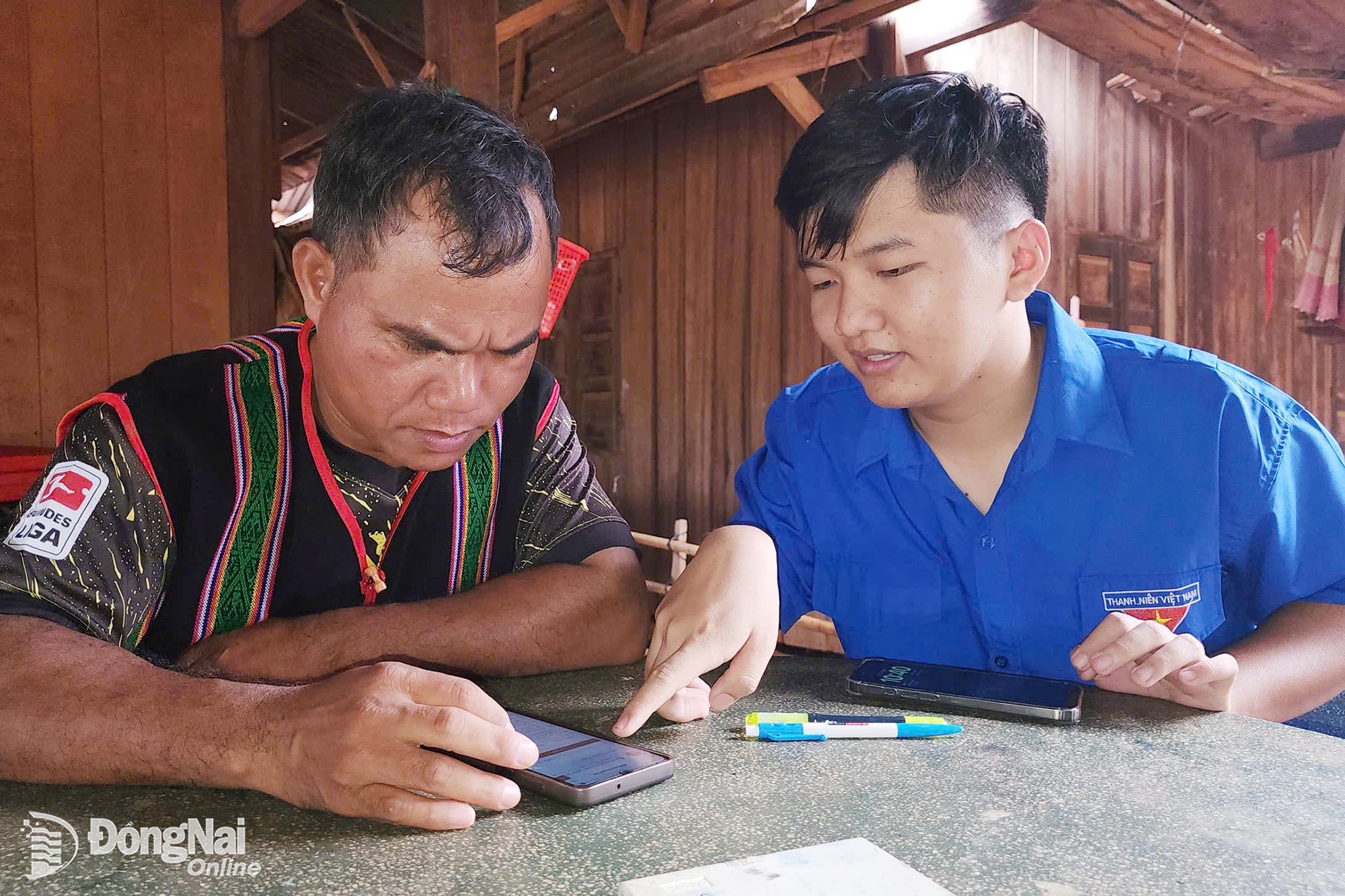
With the goal of ensuring that by 2028 every household has at least one member proficient in using online public services, Bu Dang Commune has introduced the model “Every household has at least one member able to use online public services”. A distinguishing feature of the model is its implementation based on the principles of being easy to learn, easy to understand, and easy to apply. Youth Union members, young people and grassroots officials serve as "digital instructors," providing direct guidance to residents and ethnic minority people on using smartphones to access online public services.
Dieu Lich, a resident of Hung Phu Hamlet in Bu Dang Commune, said: “Administrative procedures had previously required considerable time. Sometimes, even simple procedures such as birth registration or applying for a new health insurance card took an entire day because I had to travel to the commune office. Now that young people come to my home to guide me in logging in to and using the national public service system, everything is much more convenient."
"I do not consider it too difficult. After receiving guidance, I completed the procedures several times and can now handle some simple administrative procedures on my phone by myself. In the short term, it saves time and travel. Once I become more proficient, I will help other families in the village," added Dieu Lich.
 |
|
Dieu Lich, a resident of Hung Phu Hamlet, Bu Dang Commune, has become proficient in using online public services after receiving in-home guidance from Youth Union members and young people. Photo: XT |
Bu Dang Commune covers more than 156 square kilometers and has a population of over 30,000 people from 18 ethnic groups. To achieve the target of having at least one household member proficient in using online public services, the commune authorities have launched the "Go to every alley, knock on every door" campaign to assist residents. To help elderly people and ethnic minorities who face difficulties accessing technology, the commune has focused on training young people and students, who serve as "technological nuclei" within each family.
Le Duc Tu, Director of the Public Administrative Service Center of Bu Dang Commune, said that under the motto "Your procedures are our responsibilities," the commune leadership had previously implemented models such as "Saturdays with the People" and mobile administrative service teams. For the “Every household has at least one member able to use online public services” model, the commune focuses on training one family member, usually a young person capable of proficiently handling essential administrative procedures online. These young people then assist elderly family members and neighboring households, contributing to the achievement of the established target.
For the public, Dong Nai City has set a target for 2026 that 100% of adults will possess basic knowledge of digital transformation and be able to use essential digital services, with at least 60% of the population certified as having achieved digital literacy on the VNeID platform. To achieve this target, localities continue to promote the "Digital Literacy for All" movement. Each locality adopts flexible and creative approaches to gradually integrate digital knowledge and skills into people's daily lives.
By Xuan Tuc - Translated by Minh Hong, Thu Ha



Thông tin bạn đọc
Đóng Lưu thông tin