
Dong Nai City is home to many cultural sediments and the priceless assets of its forefathers, making it one of Southern Vietnam's finest cultural and historical localities.
 |
| The Nguyen Huu Canh Temple relic site is currently being expanded, restored, and upgraded by Dong Nai City. |
Preserving and promoting the values of relics, traditional craft village heritage, culture, and nature is a major responsibility of the local government and all segments of society, as well as an appropriate solution in the process of building a modern yet identity-rich urban area in Dong Nai.
Land of rich heritage
Dong Nai’s history is closely linked to its forefathers’ southward expansion. Since 1698, when Marquis Nguyen Huu Canh established Tran Bien Garrison, the land has affirmed its role as a bustling center for administrative management and trade. Nearly 330 years of history have endowed Dong Nai with a vast heritage treasure. Ancient communal houses, centuries-old pagodas, revolutionary historical sites, and archaeological and ecological heritage locations are not only reminders of the past but also valuable resources for the future.
According to statistical data, Dong Nai currently has 121 ranked relic sites, including six special national relics, 42 national relics, and 73 provincial-level relics, along with nearly 1,500 inventoried relics. Many sites – including Tran Bien Temple of Literature, the Nguyen Huu Canh Temple and Tomb Complex, War Zone D, the Command Headquarters for the Liberation Army of South Vietnam (Ta Thiet Military Base), and Soc Bom Bo – have become important cultural and historical symbols of Dong Nai in particular and the Southeastern region in general.
The heritage space of the new Dong Nai City is also known for many historical relic sites, including the Hang Gon Megalithic Tomb, a unique archaeological site dating back thousands of years; the Central Office for South Vietnam Base; locations within the resistance base system of the Southeastern region; and the Dong Nai Biosphere Reserve, which has been recognized by UNESCO as a World Biosphere Reserve.
Amid the rapid pace of a dynamic and modern industrial city, preserving and promoting the values of heritage, cultural identity that have shaped the land and people of Dong Nai for nearly 330 years remains a major concern, requiring the combined efforts of the entire political system and the community.
Along with relics and scenic sites, the land and people of Dong Nai today are shaped by core values formed throughout their development journey. These include river-based culture associated with the Dong Nai river system; a dynamic industrial tradition; traditional craft villages with deep historical roots, such as Bien Hoa ceramics and Buu Long stone carving village; and the cultural exchange of communities originating from many regions of the country. Artisan Pham Duy Linh, Director of Tan Phat Hung Co., Ltd. in Tran Bien ward, is a third-generation artisan carrying on his family’s Buu Long stone-carving tradition. Although modern machinery has largely replaced manual stone carving because it is easier and faster, he continues to carve stone by hand because of its unique values and his strong passion for preserving his ancestors' traditional craft.
Turning heritage into asset for new city
Dong Nai is a land where diverse and rich cultural values have converged and taken shape. These cultural values are important resources that should be promoted in contemporary life. In particular, tourism development is key to turning tourism into a major economic sector of the city while preserving the traditional cultural and historical values of the land and people of Dong Nai.
In practice, Dong Nai's planned tourism routes are based on existing cultural and heritage resources, including Nguyen Huu Canh Temple, That Phu Ancient Temple, pottery villages, Buu Long scenic area, Tran Bien Temple of Literature, Ta Thiet Military Base, Bu Gia Map National Park, and Cat Tien National Park. Each type of heritage can serve as a foundation for the development of suitable tourism products.
 |
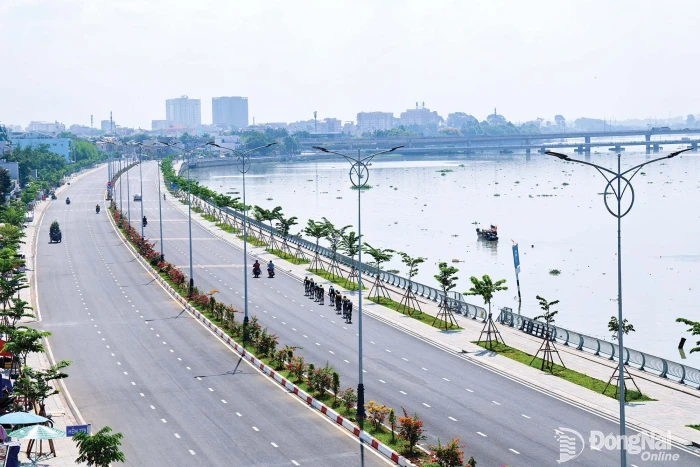
| The Ong Phu Mansion architectural work is preserved by Dong Nai during investment in the riverside road project. |
Tran Quang Toai, Chairman of the Dong Nai City Historical Sciences Association, stated that with methodical investment and coordinated efforts from multiple stakeholders, it is entirely possible to transform these values into a cultural industry that promotes local economic development. He noted that Dong Nai has recently invested in the restoration of historical and cultural relics. When the city decided to preserve Ong Phu Mansion, a century-old architectural structure, during the construction of the riverside road, the decision received broad support from people across the country. According to Toai, properly preserving traditional values, including heritage awareness and conservation, is also a way to move toward a sustainable future. In the long term, it is necessary to address how to promote these values through communication, public awareness raising, exploitation, and the creation of economic value from relic sites in order to generate resources for continued restoration and enhancement.
According to Assoc. Prof. Dr. Nguyen Hoang Phuong, Deputy Dean of the Faculty of Socio-Economics and Environment at Academy of Politics Region II, Dong Nai City needs to combine traditional identity with modern elements to develop the city in a sustainable direction. In particular, it is necessary to make better use of the values of cultural, historical, and scenic relics in the area within the city's development roadmap. This approach will help create a harmonious and modern urban landscape that remains connected to nature and preserves local traditional identity.
For those who work tirelessly to preserve the beauty of traditional craft villages within the flow of culture and history, such as artisan Hoang Ngoc Hien, owner of Hien Nam Pottery Workshop in Bien Hoa ward, ceramics are his life. His pottery kiln continues to operate manually, from shaping and decoration to glazing. He maintains traditional production stages to preserve the value of ceramics while also introducing innovations to promote products. Accordingly, he has expanded channels for introducing and promoting products through platforms such as Facebook and Zalo. Thanks to these modern solutions, an increasing number of customers can be reached, contributing to bringing Bien Hoa ceramics to tourists and expanding the market.
By Vuong The – Translated by Minh Hong, Thu Ha


Thông tin bạn đọc
Đóng Lưu thông tin