
Bu Gia Map (Dong Nai province) is a border commune, with 17 ethnic minorities living in a large forest area. Exploiting this strength, Bu Gia Map commune is focusing on strongly developing ecotourism associated with conserving forest resources and national cultural identity.
 |
| Local introduce the specialty of sour bamboo shoots in Bu Gia Map. Photo: Binh Nguyen |
Notably, Bu Gia Map National Park is actively promoting the development of tourism products that showcase unique indigenous culture, closely linked with forest protection, nature conservation, livelihood development, and community-based ecotourism in the border commune. Among these, the diversity and richness of the commune’s cuisine stand out as a key strength to be further leveraged.
Unique community dishes
Thuc soup (also known as thut soup) has been recognized as one of Vietnam’s 121 signature dishes. It is a familiar dish of the Stieng and Mnong ethnic groups in the remote border commune of Bu Gia Map. This traditional specialty is typically prepared to welcome honored guests and served during holidays, Tet, and major community events such as the traditional New Year, god worship festivals, and new rice celebrations.
The ingredients for this dish are primarily sourced from the natural forest and cooked in bamboo or neohouzeaua tubes. Once the ingredients are fully cooked, the cook uses a long stick to continuously mash and stir them until they become tender and fully blended. It is this distinctive preparation method that gives the unique soup its name.
The ingredients used in thuc soup are highly diverse. Whatever vegetables can be foraged from the fields or forest, wild greens, snails, fish, or even pieces of meat brought along, can all be used in their preparation. However, certain signature ingredients of the Bu Gia Map forest are indispensable: young rattan shoots, betel leaves, bitter eggplant, and hot chili, often cooked together with stream fish or pork, as well as cowhide from cleanly raised pigs and cattle. These natural ingredients are cooked in bamboo or neohouzeaua tubes, blending sweet, nutty, bitter, and spicy flavors into a refined and distinctive dish that leaves a lasting impression on anyone who tries it.
Do Truong Giang, Deputy Director of the Center for Propaganda, Tourism and Rescue Conservation of Bu Gia Map National Park, said: Canh Thuc is a typical dish of Bu Gia Map Ecotourism Area, so it should be included in all menus serving visitors to the park. Canh Thuc cannot be confused with any other dish because it shows a very high sense of community. When going to the forest or the fields, you only need a small piece of meat or a stream fish that cannot be divided equally among everyone, but put into the soup, it will be mixed with other ingredients and divided equally among all members. In daily life, this is a familiar dish in the daily meals of locals. They often eat it with white rice. When going to the forest or the fields, the rice will be cooked in advance and stored in a gourd shell.
In addition to canh thut, canh boi of the Mnong ethnic group is also a highly communal dish, often prepared during festivals and important events within families or the broader community. This soup features the fragrant, nutty flavor of forest vegetables, the natural sweetness of nhao leaves, and the rich creaminess of rice starch. Its main ingredients are rice flour and dried nhao leaves, both pounded into a fine blend. The most meticulous step in its preparation is the pounding of upland rice with nhao leaves. The rice is soaked in water for about 30 minutes, then finely pounded in a mortar and sifted through a winnowing basket to obtain a smooth flour. This flour is then pounded again together with dried nhao leaves.
The vegetables used in canh boi are remarkably diverse, offering many variations. For example, there is canh boi made with sour bamboo shoots and dried meat; versions using mushrooms and upland eggplant with pork, pork bones, or dried beef; and others made with squash shoots and dried meat or bones. A wide range of wild vegetables, such as bamboo shoots, squash shoots, butterfly leaves, chili shoots, and cassava shoots, can all be used as key ingredients in this distinctive soup.
Bu Gia Map National Park has developed a forest camping tour where visitors can enjoy hands-on experiences such as cooking canh thuc, grilling meat and fish by the stream deep in the forest. The park consistently prioritizes the use of local products, not only to offer guests the opportunity to savor distinctive indigenous dishes, but also to help create sustainable livelihoods for the local community.
Tourism specialties
At Bu Gia Map National Park, visitors can also enjoy a variety of flavorful dishes that embody the essence of the mountains and forests, such as wild vegetables, rice wine, corn wine, grilled meat, and bamboo rice.
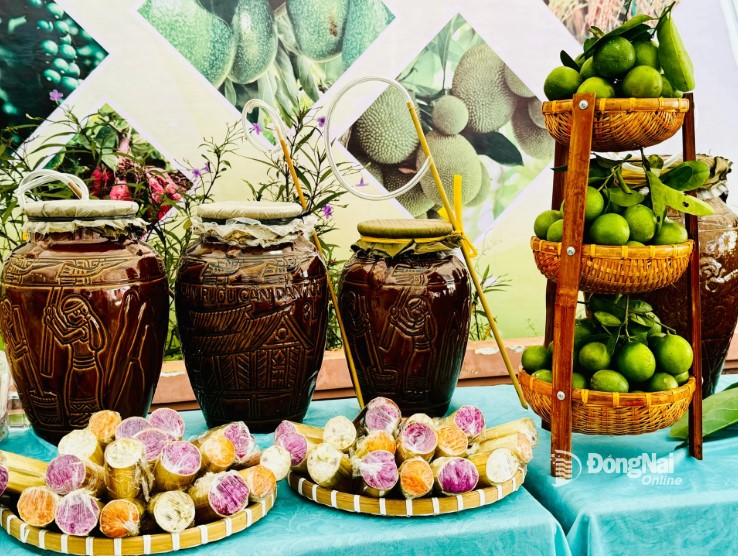 |
| Booth introduces Can wine and bamboo rice at the 1st Congress of Bu Gia Map Commune Party Committee, term 2025-2030 |
Among the various wild vegetables, rattan shoots are considered one of the most distinctive specialties of the Bu Gia Map border commune, and a traditional delicacy of what was formerly Binh Phuoc province. Rattan shoots have a bitter taste with a sweet aftertaste and a cooling sensation in the throat, making them a popular ingredient in dishes such as stewed pork leg, stir-fried dishes, and salads.
In particular, when grilled over charcoal, rattan shoots reveal their full range of flavors, fragrant, rich, mildly bitter, and sweet on the finish, offering diners a truly unique culinary experience. Beyond their taste appeal, rattan shoots are also valued in traditional medicine for relieving bloating, indigestion, and aiding in alcohol detoxification.
Rau nhiep (also known as rau nhip or rau bep), called har piep by the Stieng people (har meaning “vegetable”), is a common wild green found in the forests of Binh Phuoc and the Southern Central Highlands. Highly nutritious and harvestable year-round, this vegetable is widely used by local communities as a key ingredient in many traditional dishes, including canh thuc. It is also commonly used in boiled and stir-fried dishes, all of which are known for their rich flavor.
In Bu Gia Map, many wild vegetable dishes leave a lasting impression on diners after just one taste. These include stir-fried cassava leaves with wild eggplant, dried fish, known as a “rice-consuming” dish, stir-fried palm heart, wild banana blossom salad, and fresh herbs from wild banana trees.
 |
| Specialty wild vegetables in Bu Gia Map |
During campfire nights or culinary exchange events at Bu Gia Map National Park, visitors have the chance to sample a variety of traditional local wines such as rice wine, corn wine, areca wine, and cassava wine. Among them, the most distinctive is rice wine consumed through bamboo straws (ruou can), an essential drink during festivals and special occasions such as weddings, new rice celebrations, new house ceremonies, holidays, and Tet.
Bamboo rice is not only a traditional dish of ethnic minorities in Bu Gia Map but also a delicacy that attracts diners to Bu Gia Map National Park. Sticky rice is cooked in bamboo tubes. Nowadays, this rice dish is varied in many ways such as: purple sticky rice, gac sticky rice, green bean sticky rice, corn sticky rice... In Bu Gia Map, this ethnic rice dish is eaten with traditional soup, a unique way of enjoying it that cannot be found anywhere else.
Along with the development of community tourism and forest tourism in Bu Gia Map National Park, people are increasingly aware of making specialties to serve the enjoyment needs of diners.
To Thi Nga, owner of the Bu Gia Map Mountain Forest Specialty Facility, shared: “I opened this business not only to serve residents in the locality but also to welcome tourists visiting Bu Gia Map National Park, allowing them to enjoy local specialties and purchase them as gifts.
As more visitors come to the park and demand continues to grow, I want to expand the range of specialties to meet their needs, including roasted duck with mac mat leaves, roasted duck vermicelli, and roasted duck pho.
The area has an abundant supply of fresh bamboo shoots, so our facility also prepares pickled bamboo shoots with fresh mac mat fruit. The main ingredients are bamboo shoots and mac mat fruit, seasoned with garlic and chili. This specialty is produced year-round but is especially popular during the Lunar New Year.
By Binh Nguyen - Translated by Quoc Dung, Minho


Thông tin bạn đọc
Đóng Lưu thông tin