
In the era of digitalization and globalization, political-ideological education is not only a part of the curriculum but also a foundation for building personality, character, and civic consciousness for the younger generation. As multi-dimensional information flows and social media strongly impact students' perceptions, educating them on life ideals, ethics, and social responsibility becomes more urgent than ever.
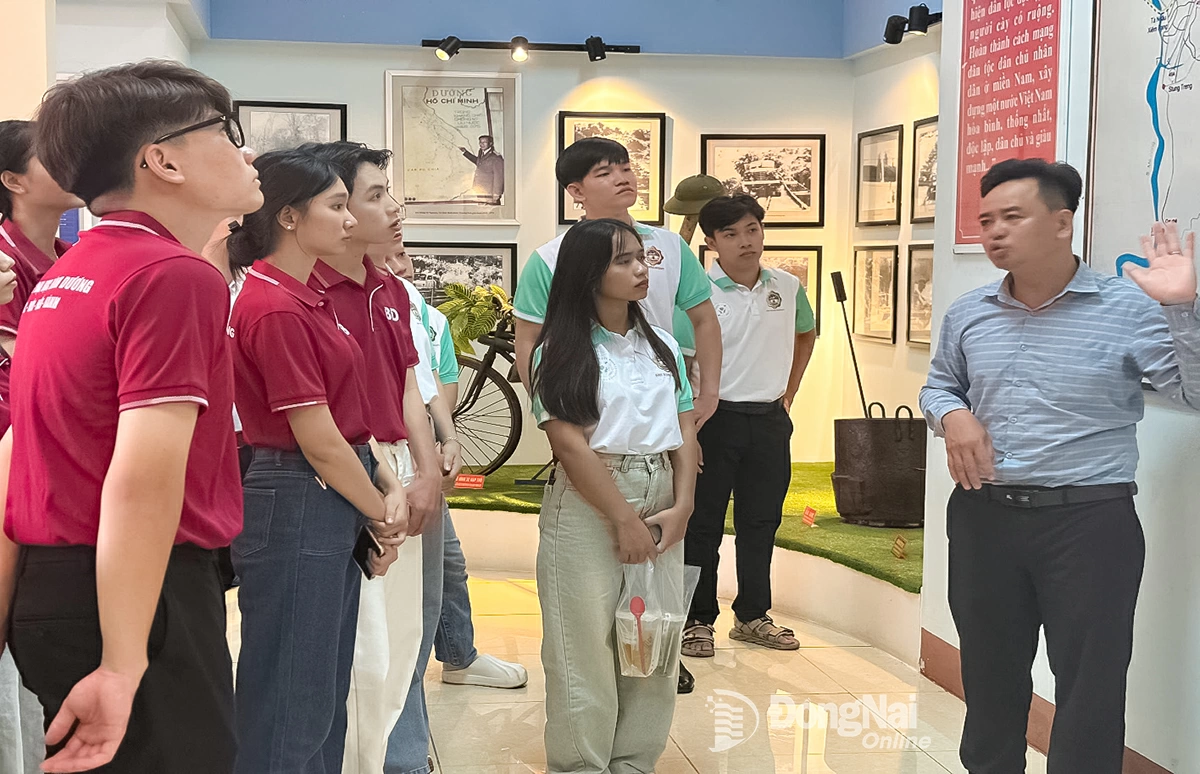 |
| Students in a back-to-the-roots trip at the Loc Ninh Liaison House historical site, Dong Nai province. |
Students may excel in their specialized fields, but if they lack character and ideals, they can easily be drawn into the negative aspects of social media and distorted views in life.
When students face temptations and ideological challenges
Although identified as a fundamental component in the comprehensive education process, political-ideological education currently reveals certain limitations when compared to the rapid changes in contemporary social life.
A segment of students has not yet fully recognized the significance of political-ideological education for personal development. Their approach to the subject is often "perfunctory," more procedural than a self-driven need in their journey of character building and forming a system of life values. This gap makes many young people easily swayed by conflicting narratives, from extreme views to sophisticated distortions on the internet. This is not only a challenge for the education sector but also an indicator of a shift in values among a segment of youth who lack a stable ideological anchor.
Many educational studies in recent years show that students with a correct understanding of life ideals tend to have better academic results, participate more in social activities, and have a proactive spirit in international integration. This is clear evidence that political-ideological education makes a difference in the process of personality formation.
The boom of social media opens up an unprecedented information reception environment in educational history, where students only need a few seconds to access a variety of different viewpoints. However, this very speed and undirected nature can lead young people into a state of cognitive confusion.
An undeniable limitation is that the teaching of political-ideological affairs in some institutions is still heavily academic, focusing on explaining concepts rather than creating genuine academic debate spaces. This makes it difficult for the subject to connect with the lives of students - who need knowledge that can explain the world, guide behavior, and help them understand contemporary issues.
The political-ideological education cannot be understood merely as a collection of lectures or a few credits in a training program. It must be a continuous, ecosystem-like process where theory, practice, and life experiences blend to form each student's character, qualities, and critical thinking abilities. In a rapidly changing social context, political-ideological education needs to move beyond the confines of textbooks to become a journey of nurturing life values and civic responsibility.
Theory closely linked to practice - from knowledge to belief
One of the biggest limitations of political-ideological education is when knowledge remains conceptual. Only when theory "touches the ground," illuminated by practical experience, can students transform knowledge into belief, into their own system of values. With educational models such as: Students with the homeland's seas and islands, Journey to the Roots, Law Day..., students can observe, dialogue, ask questions, and observe history right where history was made.
A technical student from Binh Duong University shared after visiting the Loc Ninh Liaison House historical site: "Before, I thought politics was just dry lectures. But when I stood in that land, I realize the value of peace and the role of the younger generation in preserving these sacred things."
In modern political-ideological education, method is no longer a technical issue but rather a measure of the quality of the process of forming socio-political thought. Many universities implement an "Open classroom" model, creating conditions for students to access current events and civic ethics lessons through: analyzing real-world situations; group discussion and debate; updating lectures with current issues; and applying digital technology and artificial intelligence to simulate situations or support the search for reliable information.
For political-ideological education, the role of lecturers is even more crucial, as they are not only transmitters but also guides, living examples of ideals, responsibility, and ethics. A lecturer of Ho Chi Minh's Thought subject shared: "If we cannot inspire, the subject will be underestimated. But when students understand the ideal centered on the humanity and community, they will change their perspective." The teacher, through their attitude and academic qualifications, is the "emotional anchor" that helps students feel the depth of ideological values - something that cannot be replaced by any technological means.
The following three groups of solutions can be seen as important pillars for comprehensively innovating political-ideological education activities in higher education institutions.
Firstly, innovating content and methods of teaching - bringing ideology into the pulse of the era. Innovating curricula and teaching methods is a prerequisite for political-ideological education not to fall behind the rapid changes of modern society. Educational content needs to reflect major issues of the era such as: digital economy, international integration, non-traditional security, ethics - culture in the digital environment, or the ability to identify and critically respond to fake news and malicious information...
The second group of solutions is building a healthy educational environment - nurturing political culture in schools. An educational environment with a healthy political culture is the most natural and sustainable "space for ideological formation" for students. Instead of limiting political-ideological education to the classroom, schools need to expand it into an ecosystem of diverse activities where students can participate, experience, and regularly practice. Activities such as: youth forums, well-organized youth union and association activities, volunteer movements, competitions to learn about law - history - national sovereignty... not only help students better understand their civic responsibilities but also create conditions for them to practice and affirm their own value system...
The third group of solutions is to apply technology and educational communication - bringing politics closer to young people in the digital space. In the digital age, technology and communication are not only supporting tools but also new spaces for implementing political-ideological education. Building e-learning lecture systems, illustrative videos, digital simulations... helps learners access knowledge more flexibly, diversely, and effectively. In addition, mainstream special sections for students need to be developed as a channel for guiding awareness, providing accurate information, and creating a healthy dialogue space. When technology is integrated proactively and strategically, the political-ideological education will go beyond the classrooms, reaching students through familiar, modern forms that are suitable for the information-consumption habit of digital generation.
By Tu Huu Cong-Translated by Mai Nga, Thu Ha


Thông tin bạn đọc
Đóng Lưu thông tin