
With its position as a leading industrial, service and modern urban hub in the Southern region, along with increasingly improved transport infrastructure and abundant resources, Dong Nai is seizing a “golden opportunity” for a breakthrough.
In this development strategy, developing high-quality human resources is considered a decisive requirement. Humans are regarded as the most valuable asset, the core resource and driving force for Dong Nai to advance confidently in the new era.
High-quality human resources – “the key” in an era of deep integration
After the administrative merger, Dong Nai now possesses significant advantages. The province has a population of nearly 4.5 million, including one of the country’s highest proportions of young, dynamic and well-trained workers. The Resolution of the 1st Dong Nai Provincial Party Congress identified the development of high-quality human resources in high-tech industries, logistics, education, healthcare, science, technology and digital transformation as one of the breakthrough missions laying a solid foundation for the 2025–2030 period.
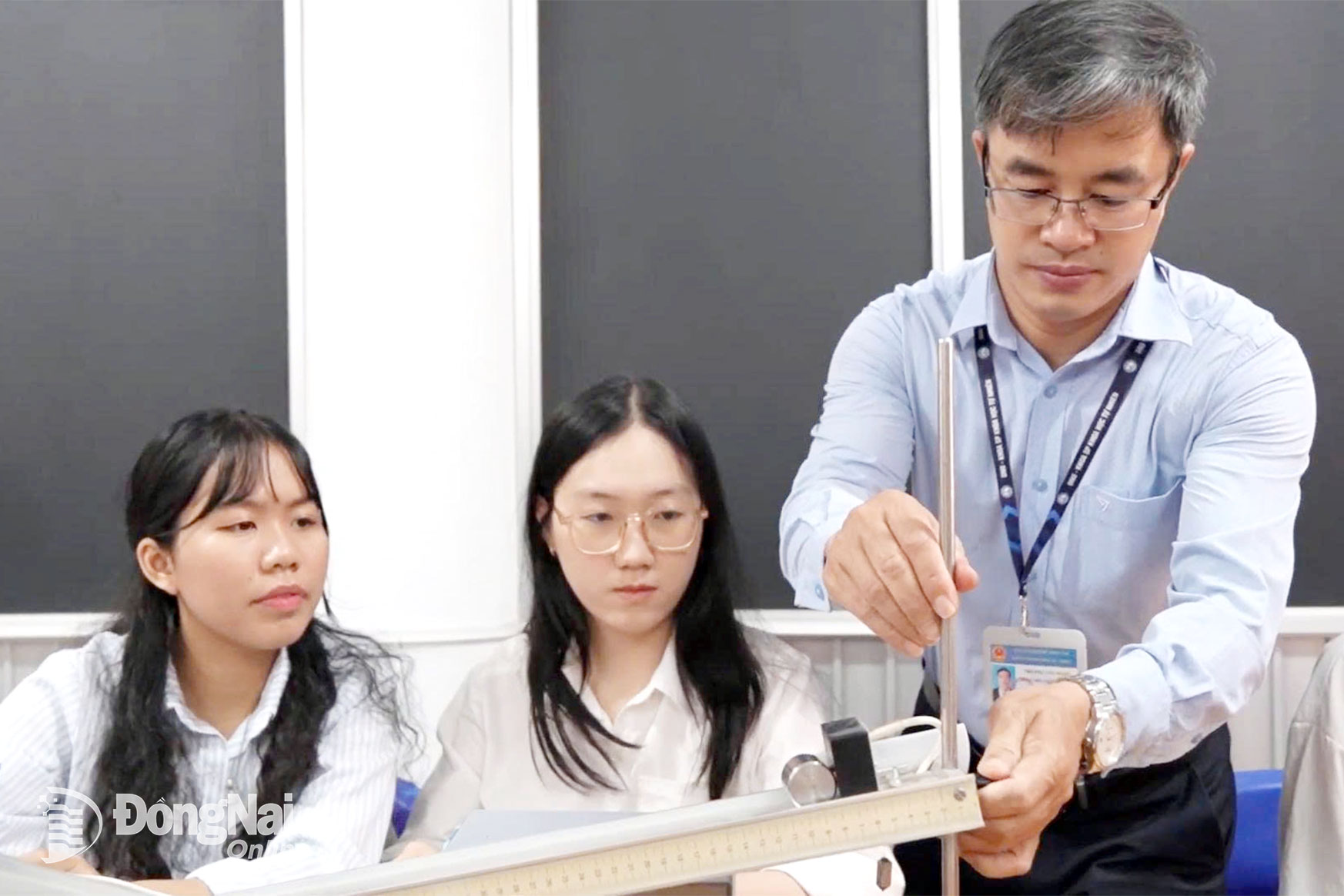 |
| A lecturer at Dong Nai University guides students from Faculty of Pedagogy in Natural Science during a practical session. Photo: Bich Nhan |
In the context of today’s digital transformation era, when competition no longer relies on physical resources but rather on the power of knowledge and technology, it has become essential to possess a high-quality workforce—one that is adaptable and capable of international integration.
Dr. Pham Hung Duc, Vice Rector of Dong Nai University (Tam Hiep ward, Dong Nai province), noted that high-quality human resources are becoming increasingly crucial for Dong Nai province, which hosts one of the nation’s largest concentrations of FDI enterprises and high-tech, logistics and automation industrial zones. This demands workers with not only strong professional knowledge but also technological mastery and an innovative mindset.
“Tertiary education and vocational training play a central role in meeting standards of international integration and forming a solid foundation for Dong Nai to enter a new phase with stronger competitiveness,” Dr. Pham Hung Duc emphasized.
According to Vice Rector of Dong Nai University, high-quality human resources for the new development stage must demonstrate three core competency groups: First is advanced professional and technical capacity that meets regional and international standards. Second is digital competency, including the ability to adapt to digital transformation and apply technology and AI-driven data effectively at work. Finally, its workforce must cultivate soft skills and integration-oriented culture, including critical thinking and teamwork skills.
“In the coming period, Dong Nai University will focus on three major directions: becoming a center for high-quality workforce training in key sectors such as technical education, logistics and creative industries; building a tightly linked ecosystem among the State, educational institutions and businesses to enable students to combine study with hands-on practice; and expanding domestic and international cooperation to enhance training quality. Notably, the university aims to ‘reshape’ its students into digital citizens capable of lifelong learning, creativity and innovation founded on technology,” Dr. Pham Hung Duc shared.
 |
| Students of Lac Hong University receive instructions on pneumatic and automation equipment. |
In recent years, many universities and colleges in Dong Nai have proposed and expanded cooperation with the province to develop human-resource training activities and build modern, high-tech laboratory centers. These partnerships not only benefit educational institutions and local authorities but also help realize the goal of enhancing workforce quality for the Southern key economic region.
Assoc. Prof. Dr. Nguyen Vu Quynh, Vice Rector of Lac Hong University (Tran Bien ward, Dong Nai province), stated that one of the key solutions for developing science and technology, innovation and successful digital transformation in Dong Nai is the development of digital human resources.
“With strong infrastructure but without capable people, success remains difficult. Local authorities, universities and businesses must work together to train and effectively utilize digital human resources so that Dong Nai can achieve both speed and quality in digital transformation, scientific and technological development, innovation and international integration,” Assoc. Prof. Dr. Nguyen Vu Quynh emphasized.
Education makes a positive contribution to the province’s sustainable development strategy
Dong Nai is considered the “cradle” of Vietnam’s industrial sector, with the early establishment of the Bien Hoa Industrial Zone (now Bien Hoa 1 Industrial Park). This foundation has enabled the province to remain the country’s leading locality in terms of the number of industrial zones, with 59 industrial parks and 17 industrial clusters. Dong Nai aims to become one of Vietnam’s major centers for industry and logistics.
To achieve this goal, vocational education institutions have been actively transforming in recent years, becoming pioneers in innovating training programs to meet labor-market demands.
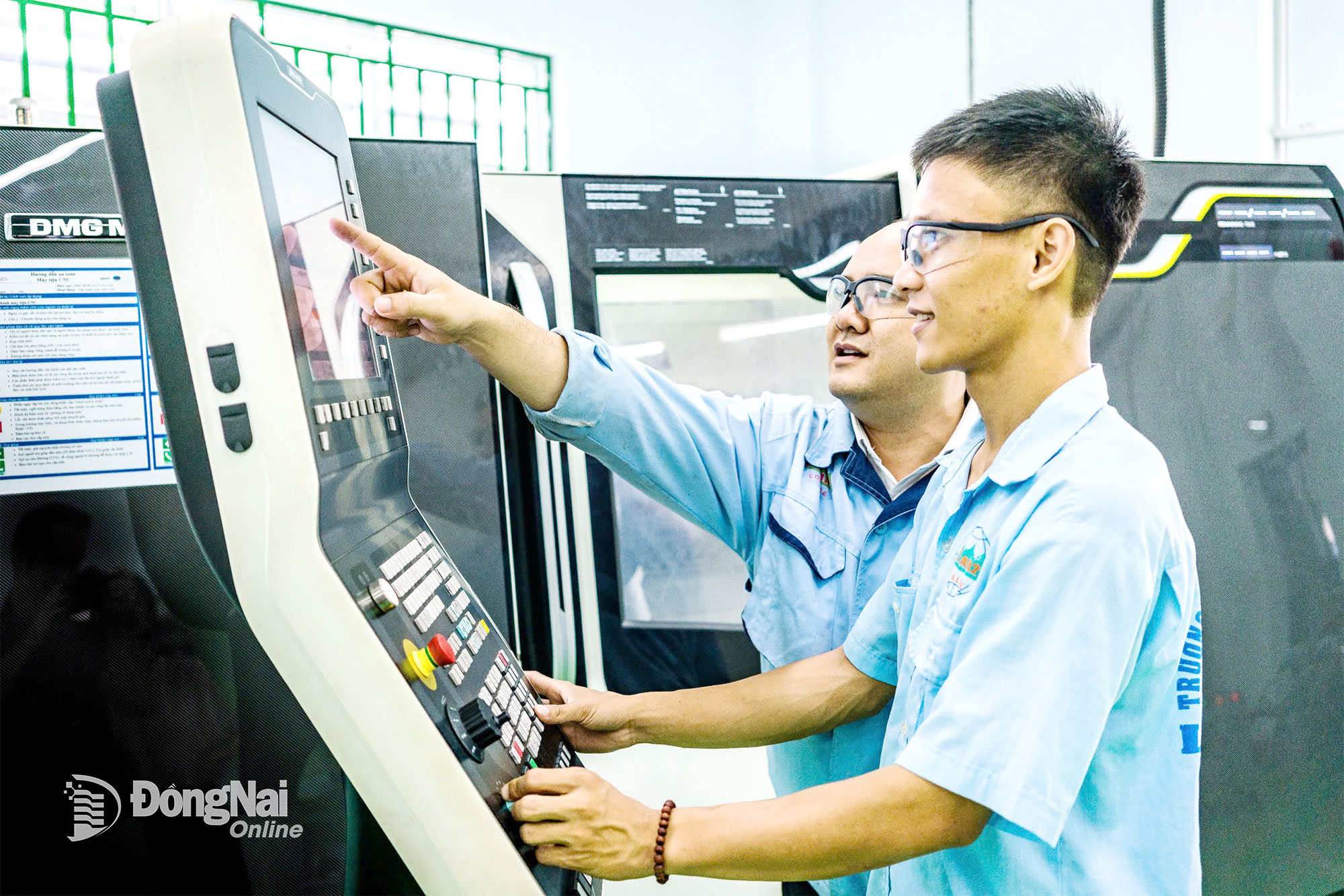 |
| Practical training activities at Lilama2 International Technology College (Long Phuoc commune, Dong Nai province). |
According to Master Nguyen Khanh Cuong, Rector of Lilama2 International Technology College, Dong Nai must cultivate a skilled workforce and highly trained technicians to attract investment in supporting industries and high-tech sectors.
Over the past time, Lilama 2 has pioneered international-standard training models, most notably the dual training system linked with enterprises based on German standards.
Rector Nguyen Khanh Cuong explained that the rapid pace of technological advancement makes it difficult for schools to maintain facilities that keep up. The dual-training model is therefore an effective “key,” allowing institutions to mobilize resources from businesses so that students can train directly on the most advanced technologies. As a result, the college has supplied thousands of highly skilled graduates ready to work for high-tech FDI enterprises in Dong Nai and in international labor markets.
 |
| In addition to practical training, students at Lilama 2 regularly participate in job fairs, where their needs are directly matched with employers. Photo: Bich Nhan |
Lilama 2 is also proactively preparing human resources for major national projects. To supply personnel for Long Thanh International Airport, expected to begin commercial operations in the first half of 2026, the college has established partnerships with units such as Airports Corporation of Vietnam (ACV) and Vietnam Airlines Engineering Company (VAECO). Accordingly, students not only study theoretical courses at school but also spend one to two years receiving training directly at workshops and facilities of aviation enterprises while improving their foreign-language proficiency to master technical documents. To date, Lilama 2 has selected and trained nearly 300 personnel in equipment maintenance programs, ready to take on positions once Long Thanh Airport becomes operational.
Moreover, Rector Nguyen Khanh Cuong of Lilama2 International Technology College added: “To get ready to “anticipate” the North–South high-speed railway project, which is expected to require about 100,000 workers, Lilama 2 is coordinating with relevant agencies to begin workforce preparations.”
To successfully operate the billion-dollar projects, industrial parks and smart urban areas, high-quality human resources provided by institutions like Lilama 2 are an indispensable factor for Dong Nai’s development. This forms a solid foundation for Dong Nai to remain proactive, confident and competitive in the context of global integration.
Rector of Lilama2 Nguyen Khanh Cuong said : “Today, the concept of global citizens is increasingly emphasized. Educational institutions are training a globally oriented workforce, workers who must demonstrate professional skills, foreign-language proficiency and digital capability. Lilama 2 is focusing on developing students into global technicians with these three core competencies. We expect our students, after completing training, to be capable, confident and ready to contribute to the development of Dong Nai and the nation”.
Dr. Pham Hung Duc, Vice Rector of Dong Nai University, added that as the province’s key public educational institution, Dong Nai University is oriented toward becoming an applied, innovative and digitally transformed university closely aligned with the province’s and the Southern key economic region’s socio-economic development needs.
“Our goal is to build a solid momentum, thereby contributing positively to the province’s sustainable development strategy. Humans are the most valuable asset, the essential resource and driving force for Dong Nai to rise strongly in the new era,” Dr. Pham Hung Duc affirmed.
By Ha Le, Bich Nhan – Translated by M.Nguyet, Thu Ha


Thông tin bạn đọc
Đóng Lưu thông tin