
Alongside setting an ambitious double-digit economic growth target, the Party Organization and authorities of Dong Nai Province have placed particular emphasis on social security and sustainable poverty reduction. The province considers this a key political task and top priority, contributing to its journey towards rapid and sustainable development.
To realise this important objective, immediately after the successful first Party Congress of Dong Nai Province for the 2025–2030 tenure, all levels, sectors, and localities have, based on their respective functions and conditions, implemented a series of social security and social welfare policies under the motto “leaving no one behind”, with people placed at the centre of every policy and strategy.
Proactive and pioneering approach
Following the merger, the new Dong Nai Province is home to diverse ethnic and religious communities and shares a long border with the Kingdom of Cambodia. The fact that residents along the border have settled stably, along with the establishment of the all-people border defence posture, has formed a strong line safeguarding the nation’s frontiers. Within the country, Dong Nai remains one of Vietnam’s leading industrial hubs, attracting thousands of workers each year from across the country seeking job opportunities. Dong Nai has also seen strong development across various types of economic sectors, creating diversity and richness in its workforce, employment, and income sources.
These distinctive characteristics, while creating a vibrant and diverse economic landscape with extensive development across multiple sectors and strengths forming linkages from production and processing to product distribution, have also posed significant challenges for Dong Nai in ensuring social security, job creation, income stability, and housing for residents.
Ensuring social security has been identified as one of the key pillars and foundations for sustainable development. With the determination to lead and act ahead, the province acts proactively without waiting for the central government, while local authorities, and departments and sectors act without waiting for the provincial government. Upholding the spirit “local initiative, local action, local responsibility”, right after the successful Party Congresses at all levels, sectors and localities in the province have promptly developed their own action programs. They have rolled out strategic measures aimed at driving change “from the ground up”.
A typical example is the construction of boarding and semi-boarding schools for students in border areas. Immediately after the central government issued relevant policies, the provincial education and training sector conducted surveys and identified the needs of localities to proceed with implementation.
According to the Department of Education and Training, there are currently 36 schools in eight border communes, with more than 19,300 students. Among them, about 1,300 students require boarding accommodation, and over 9,200 need semi-boarding facilities. To meet this demand, the province plans to invest in 390 additional items for 14 existing school facilities, including classrooms, specialised subject rooms, kitchens, and dining halls. The total investment is estimated at VND 396 billion. The goal of both the province and the central government is to ensure that students in border communes can access suitable boarding and semi-boarding policies, enabling them to attend school with peace of mind while helping local households settle and build livelihoods along the frontier.
 |
| The Department of State Reserves, Region 2, hands over rice allocations to students at Dong Nai Boarding High School for Ethnic Minorities in Hung Thinh Commune. Photo: Phan Tri. |
Mobilizing public strength to care for the people
With the aim of reducing the province’s poverty rate by 1–1.5 percentage points annually during the 2025–2030 period, Dong Nai has been implementing the principle of “mobilising the people’s strength to care for the people.”
Alongside communication campaigns to raise awareness and encourage self-reliance among poor households, agencies and organisations have launched various practical initiatives to mobilise resources and create sustainable livelihoods.
According to the provincial Vietnam Fatherland Front Committee, in the first nine months of 2025, 1,334 Great Solidarity Houses worth a total of VND 111.2 billion were built, and the “For the Poor” Fund raised VND 146.6 billion. Fifty-seven “Compassionate Markets” were organised, bringing total social security contributions to over VND 400 billion.
As part of an emulation campaign launched to celebrate the country’s major anniversaries and the Party congresses at all levels, the Provincial Women’s Union carried out 312 projects and activities worth over VND 5.9 billion, mobilised resources to build 19 houses worth VND 1.8 billion, organised gratitude programmes for people with meritorious services and policy beneficiaries worth over VND 1.2 billion, and awarded scholarships worth VND 280 million to 50 orphans.
By the end of September 2025, the province had built 1,576 new houses and repaired 383 for policy beneficiaries, poor households, and families in difficult circumstances, with total funding nearing VND 122 billion.
 |
| Representatives of the Dong Nai Red Cross Society and sponsors present gifts to women in difficult circumstances in northern border communes. Photo: Xuan Huy |
Nguyen Tan Phu, Vice Chairman of the Dong Nai Fatherland Front Committee, stated that in the coming period, the committee will continue to mobilise stronger social resources for poverty reduction and coordinate with local authorities to support livelihoods, vocational training, and job creation for sustainable poverty alleviation. The committee will also enhance supervision to ensure transparency and fairness, leaving no one behind on the province’s development path.
Developing social housing – solving the settlement challenge
As a major industrial province, Dong Nai welcomes thousands of migrant workers every year. While providing essential human resources for the province, this influx also puts increasing pressure on social infrastructure, housing, employment, and public services.
According to official statistics, nearly 882,000 workers are covered by social insurance and health insurance, including about 21,000 with difficult living conditions. Around 700,000 workers are employed in industrial parks, with an estimated 450,000 requiring housing. Additionally, about 150,000–200,000 others, including freelancers, officials, civil servants, and low-income groups, require housing. The total demand for social housing across the province is estimated at 600,000–650,000 people, or 150,000–160,000 housing units.
Based on the view that “stable housing is the foundation for establishing a livelihood” and that people are the centre, key stakeholder, driving force and the target of development, the first Provincial Party Congress for 2025–2030 set a target of completing about 65,000 social housing units during the tenure, gradually realising the dream of decent housing for young workers.
To realise this goal, in addition to seriously implementing laws, decrees, and circulars issued by the central government, the province has promulgated a number of specific regulations to concretize policies in line with its local characteristics and circumstances. It has established a Steering Committee for Social Housing Development and issued regulations on standards, beneficiaries, and conditions for the purchase, rental, and rent-to-buy of social housing. At the same time, it has directed efforts to shorten administrative procedures to accelerate project implementation. As of September 2025, the provincial People’s Committee had assigned 10 investors to develop approximately 11,000 units and approved four commercial housing projects to include social housing components, providing an additional 6,000 units.
At an online meeting in October 2025 between Deputy Minister of Construction Nguyen Van Sinh and localities on social housing development, Vice Chairman of Dong Nai Provincial People's Committee Ho Van Ha affirmed that the Province should continue implementing breakthrough measures to meet Government targets, prioritising land reserves near industrial parks and public transport routes to ensure ready land for investment projects.
To expand eligibility and provide more people with access to social housing, the province has issued regulations adding two new priority groups: officials, civil servants and public employees transferred from former Binh Phuoc to Dong Nai and individuals whose homes are located 20 km or more from their workplace; and residents with land expropriated for projects who do not qualify for resettlement. In addition to central banking credit packages, Dong Nai also offers local interest rate support and mobilises resources from enterprises and the Vietnam Bank for Social Policies.
One example is the family of Nguyen Thi Diem Ly (45, from Thien Hung Commune, Dong Nai province), who received a VND 500 million loan from the Bu Dop branch of the Vietnam Bank for Social Policies to build a new home under the social housing loan scheme. With a 1.2 percent annual interest rate reduction, her family will save a considerable amount over the 25-year loan period.
“Our family had lived for years in a deteriorating small house with many inconveniences,” Ly said. “Thanks to the social housing loan programme, our dream of a comfortable, stable home has finally come true. With our modest income as civil servants, the long-term, low-interest loan is a great relief that eases our financial burden. We are delighted.”
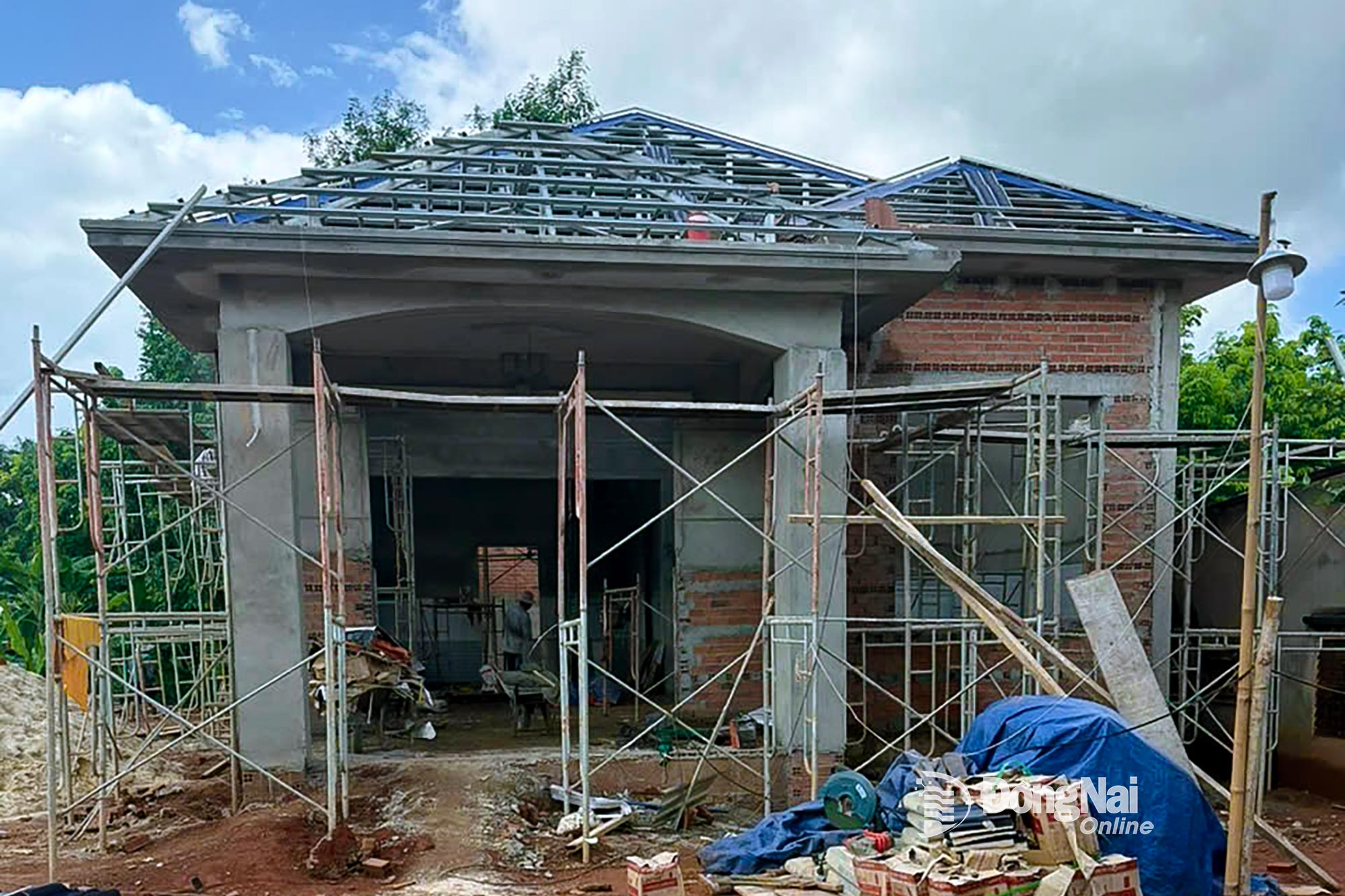 |
| The new house of Nguyen Thi Diem Ly’s family is under construction with a social housing loan. Photo: Duc Dung. |
With its proactive and pioneering approach in implementing policies to launching practical programmes for the people, Dong Nai is steadily asserting its position as a dynamic, creative, and compassionate province, where residents not only benefit from economic growth but also enjoy social security, happiness, and sustainable livelihoods.
According to the Resolution of the first Provincial Party Congress for the 2025–2030 term, by 2030, Dong Nai aims to create jobs for 2.6 million workers, raise the proportion of trained labourers with certificates to 40 percent, and keep unemployment below 2 percent. The multidimensional poverty rate will decline by 1–1.5 percentage points annually, while per capita income will reach VND 120 million. The province also plans to complete about 65,000 social housing units during this period.
By Minh Luan – Translated by My Le, Thu Ha


Thông tin bạn đọc
Đóng Lưu thông tin