
For many years, faced with the pressure of rapid population growth and limited state budget resources for school infrastructure, Dong Nai province has proactively advanced the socialization of education. As a result, the province has attracted investment totaling thousands of billions of Vietnamese dong, establishing a comprehensive network of non-public educational institutions from preschools to universities.
 |
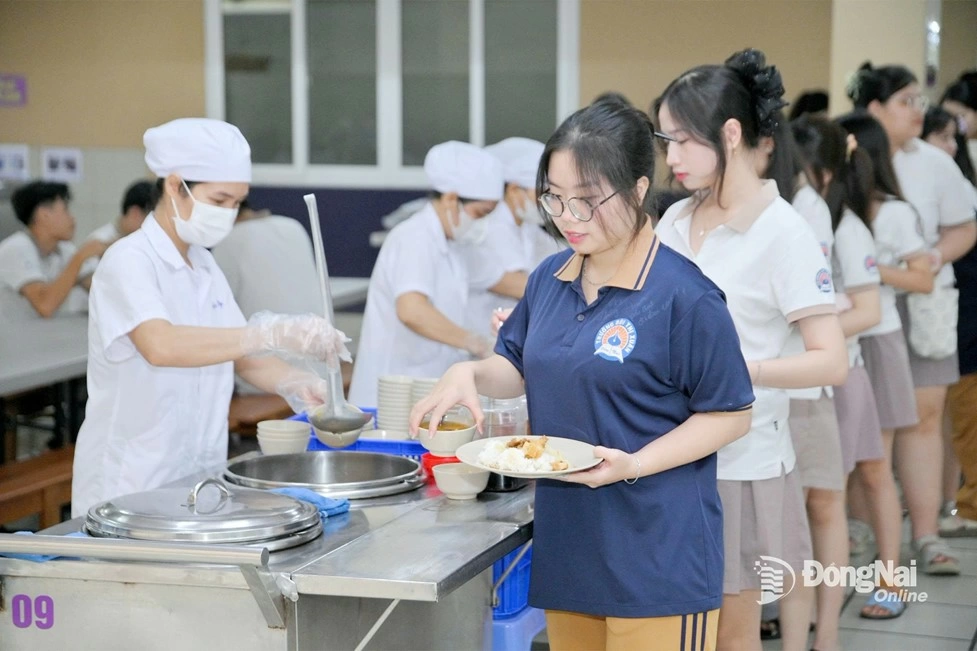 |
| Students of Bui Thi Xuan Primary-Secondary-High School ( in Tam Hiep ward) have lunch at the school canteen. Photo: Cong Nghia |
Trieu Thi Ha, owner of Thien Binh Kindergarten and Preschool in Long Binh ward, shared: “More than ten years ago, I began investing in early childhood education in the former Long Thanh town (now Long Thanh commune) after recognizing the high demand for childcare, especially for children under the age of three. Today, my family has expanded with a second facility in Long Binh ward to meet the childcare needs of workers in the industrial zones.”
Confident in investing in education
Located in a densely populated residential area of Long Binh ward, Thien Binh Kindergarten and Preschool is a relatively spacious and well-equipped facility. In addition to classrooms and activity rooms for children, the facility also features a swimming pool and a kitchen to prepare daily meals. Tuition fees range from 1.5 to 1.8 million VND per month, making it affordable for parents who are workers renting accommodations in the local industrial zones.
Ngo Kim Hue, a worker at Mabuchi Motor Vietnam Co., Ltd., located in Bien Hoa 2 Industrial Park, Tran Bien ward and a mother of a child under three, said: “Currently, there are many private preschools available, allowing parents to choose childcare options according to their financial capacity.”
Meanwhile, Dinh Ngoc Tu, Chairman of the Board of Directors of Dinh Thuan Joint Stock Company, stated that after more than 15 years of investing in education, the company has developed a network of kindergartens, general education schools, and vocational secondary schools in Tam Hiep ward, Long Thanh commune, and Trang Bom commune. The company is now preparing to establish additional general education institutions once the state facilitates land-use procedures.
Le Xuan Tho, Principal of Tran Dai Nghia Primary-Secondary-High School (located in Ho Nai ward), stated that the school is situated in an area with numerous industrial zones and a dense population. Public schools in the region are overcrowded, and there is no nearby public high school, making student enrollment relatively easy. The school currently has over 6,000 students from grades 1 to 12. Since most students are children of industrial workers, the monthly tuition fees are kept low, ranging from 1.2 to 1.5 million VND. Additionally, many parents prefer the school for its semi-boarding model, which offers convenient drop-off and pick-up options.
Need for policies to support the development of private education
To date, Dong Nai province has established a network of over 200 private schools, ranging from preschools to universities, with significant private investment in both primary and higher education. In addition to general education schools following the national curriculum set by the Ministry of Education and Training, the province has developed bilingual schools and schools offering 100% international curricula. Notably, Dong Nai now hosts three private universities offering multidisciplinary programs, including one institution meeting international accreditation standards, while several programs have achieved U.S. educational standards.
Dong Nai province will continue to actively encourage the socialization of education, aiming to establish key high-quality schools with international standards, from general education to universities. This direction was affirmed in the Resolution of the 1st Provincial Party Congress for the 2025-2030 term. The Department of Education and Training will continue to advise the province on policies that safeguard the rights of educational investors, while also creating additional regulatory and policy incentives to encourage greater investment in education.
Truong Thi Kim Hue, Member of the Provincial Party Committee and Director of the Department of Education and Training
According to the Department of Education and Training, Dong Nai province has outperformed the national average in advancing the socialization of education. Before the merger with Binh Phuoc province, Dong Nai was among the leading localities nationwide in the development of private education. Currently, private schools in the province enroll nearly 150,000 students, accounting for almost 20% of the total student population. Previously, the proportion of students attending non-public schools in Dong Nai was estimated at 20.6%, compared to the national average of just 6.68%.
Beyond enrollment figures, private schools in the province are also sharing more than 7,000 teaching positions with the public sector. This collaboration helps the province save a significant amount annually on teacher salaries, thereby easing pressure on the state budget.
The investor of a major non-public educational institution in Tran Bien ward noted: The state is increasing investment in public education, including fully subsidizing tuition, raising teacher salaries, and building additional public schools. These are sound policies, warmly welcomed by both parents and teachers. However, private investors in the education sector need to carefully reassess their strategies to adapt accordingly.
For example, when the state offers free tuition at public schools, private schools must compete on service quality to retain students and earn the trust of parents. Historically, teacher salaries at private schools have been significantly higher than those at public schools. However, this gap is narrowing as the state increases wages for public school teachers. As a result, private institutions must reassess their strategies for retaining staff, as teachers may consider leaving for public schools due to their increasingly competitive compensation policies.
Pham Ngoc Ly, Principal of Bui Thi Xuan Primary-Secondary-High School, commented: “State support for public education is entirely appropriate and contributes to enhancing the quality of national education in the new era. At the same time, the government should implement complementary policies for the private education sector, such as partial tuition subsidies for students and additional corporate income tax incentives, to enable non-public education to continue growing strongly.”
By Cong Nghia – Translated by Quoc Dung, Minho


Thông tin bạn đọc
Đóng Lưu thông tin