
Nearly 40 years ago, when the country embarked on its renewal process, Dong Nai's education sector also began its challenging transformation journey. Schools with bamboo walls and mud structures, simple thatched roofs, makeshift desks and chairs, and scarce textbooks were common sights in many rural, remote, and ethnic minority areas. Yet, amidst difficulties, teachers and students still nurtured the aspiration to change their lives through literacy, igniting a persistent spirit of studiousness across generations.
From the first bricks that built simple, sturdy schools, Dong Nai laid the foundation for a comprehensive educational renovation process. Renovation at that time was not just about building more classrooms, but also about renovating mindsets: learning to be a good person, to work, and to contribute to building an increasingly prosperous homeland and country.
Elevating educational quality
 |
| Deputy Secretary of the Provincial Party Committee, Chairman of Dong Nai Provincial People's Committee Vo Tan Duc presents gifts to students of Phuoc Thien High School (Nhon Trach commune, Dong Nai province) on the opening day of the 2025-2026 school year. Photo: Hanh Dung |
After nearly 4 decades, Dong Nai's educational landscape has completely changed. From having makeshift thatched roofs, the entire province now boasts over 1,300 schools from preschool to high school. The rate of solidly constructed classrooms has reached over 95%, basically eliminating temporary classrooms. Nearly 70% of schools meet national standards, many of which meet national standards level 2, creating better learning conditions for millions of students.
Along with facilities, the quality of education in Dong Nai has also continuously improved. Many schools have become bright spots with a 100% high school graduation rate for many consecutive years. Many excellent students have achieved the title of provincial valedictorian, university valedictorian, and won high prizes in national excellent student competitions, Olympiads, STEM - Robotics competitions, etc.
 |
| Students of Phuoc Thien High School (Nhon Trach commune) at the opening ceremony of the 2025-2026 school year. Photo: Hanh Dung |
Ngo Thi Minh Phuc, Principal of Phuoc Thien High School (Nhon Trach commune) shared: "I started working at the school in 1999, one year after its establishment. Since then, the school's facilities have been improved, and the human resources meet the requirements of the new general education program well. The school's educational quality has increased significantly. Especially, in the past 3 years, Phuoc Thien High School has had students achieving the title of provincial valedictorian and university valedictorian. The graduation rate has been above the provincial average for many consecutive years, reaching 100%."
 |
| Students of Nguyen An Ninh Primary School (Tam Hiep ward) learn English with foreign teachers. Photo: Hanh Dung |
Established in 2012, Nguyen An Ninh Primary School (Tam Hiep ward) achieved national standards level 1 in 2018. By 2024, the school achieved national standards level 2 and was accredited with quality level 3.
Hoang Thi Ngoc, the school's principal, said: To achieve these results, all officials, teachers, and employees of the school have united and worked together to create the best conditions for teaching and learning. Currently, the school organizes 2 sessions a day for 100% of students. In particular, it focuses on life skills education, organizes computer science classes, and integrates STEM learning to help students explore and create science and technology. The school also cooperates with foreign language centers so that students can learn English with foreigners, and organizes activities in a "learn through play, play through learning" approach.
In addition, the school has a team of young teachers who are knowledgeable about technology, eager to learn, actively innovate teaching methods, attract attention, and develop students' abilities. Thanks to this, the quality of education at the school has significantly improved year by year.
Promoting digital transformation
In the context of the Fourth Industrial Revolution (Industry 4.0), Dong Nai identifies digital transformation as a "key" to improving the quality of education. To date, most schools have implemented information technology applications from management to teaching organization.
At Tan Xuan Secondary School (Binh Phuoc Ward), students are checked in using face or fingerprint scanning tools instead of the manual roll call as before. After students check in, the system records their attendance. If a student is absent with or without permission, the school's management system will send a notification message to the parents' phone numbers. This helps to manage students more effectively between the school and families.
Regarding teaching methods, if previously lectures were confined to blackboards and chalk, now smart interactive whiteboards, projectors, digital learning materials, and online platforms have become powerful support tools for teachers. Teachers have transformed from communicators to facilitators, inspiring critical thinking, capabilities, and qualities, helping students actively discover knowledge.
 |
| Teachers and students of Tan Xuan Secondary School (Binh Phuoc Ward) during a practical lesson. Photo: Hanh Dung |
Vu Thi Hien, Head of the Literature Department at Tan Xuan Secondary School, shared: "Every teacher must proactively innovate teaching methods, apply information technology, and digital transformation in teaching to promote students' creativity and proactiveness. In addition, we need to innovate assessment methods, enhance experiential activities, creative innovation, and career orientation for students."
In many other schools, students have access to digital learning resources, virtual classrooms, and practice problem-solving skills through online platforms. From there, they gradually build a "smart school" model - where students can learn anytime, anywhere, learning data is digitized, and parents can easily monitor their children's learning process.
Trinh Thi Phuong Mai, Principal of Tan Xuan Secondary School, affirmed: "Digital transformation in education has helped reduce human resources, administrative tasks, and improve management efficiency. Synchronized software from financial to professional expertise has created a big step forward for the school."
Keeping the door to knowledge wide open through socialization
 |
| Teachers and students of Lac Hong Bilingual Primary-Secondary-High School (Tran Bien Ward) in a lesson applying artificial intelligence. Photo: Hanh Dung |
Dong Nai is one of the leading localities nationwide in educational socialization. Thanks to mobilizing resources from the community, businesses, and parents, many modern and advanced non-public schools have emerged, especially international and bilingual schools such as IPS, A Chau, Lac Hong Bilingual... In these schools, students learn in a modern environment with open libraries, laboratories, standard sports facilities, and bilingual-international training programs, helping them access global knowledge right in their homeland.
Truong Quoc Khanh, a 12th-grade student from Class 12E at Lac Hong Bilingual Primary-Secondary-High School (Tran Bien Ward), expressed: "I am very satisfied with the curriculum. The school has many subjects related to artificial intelligence and digital transformation, closely following current social realities. The school's facilities are also very spacious, with full practice fields, and the cafeteria has many delicious dishes..."
"I plan to apply for the Automotive Engineering major at Ho Chi Minh City University of Technology. The school has very specific subjects for that major, such as Stems and AI Robotics. These engineering subjects help me consolidate my knowledge and build a foundation to easily integrate into university later," Quoc Khanh confided.
Nguyen Thi Diem Trang, Principal of Lac Hong Bilingual Primary-Secondary-High School, said: "The school has made AI - Robotics a compulsory subject. At the same time, we train teachers to apply artificial intelligence in teaching, helping students be ready to enter the digital age. Not stopping at what has been achieved, the school will continue to innovate, contributing to training global citizens."
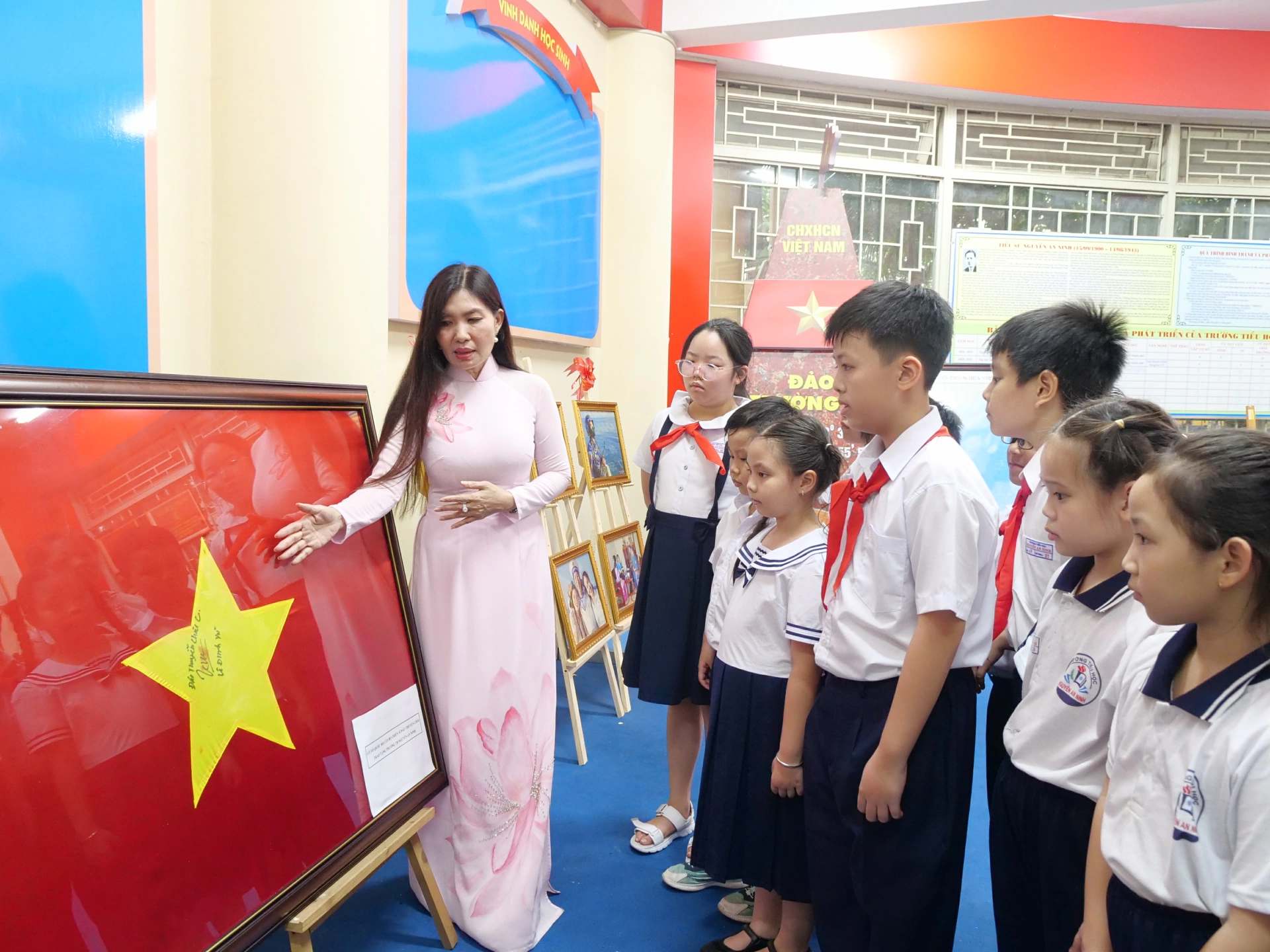 |
| Principal of Nguyen An Ninh Primary School, Hoang Thi Ngoc, educates students on patriotic traditions. Photo: Hanh Dung |
Not only at the general education level, but also at the preschool level - the foundation of early childhood - there has been a strong transformation. The system of public and non-public preschools has rapidly increased, and the percentage of schools meeting national standards is growing. Children are educated in a friendly environment, developing life skills, motor skills, and preparing well for the next educational level.
Le Thi Thom, Principal of Thong Nhat Kindergarten (Tran Bien Ward), shared: The school develops a teaching plan with content that balances both play and learning. This creates excitement for children in each lesson.
Vocational education and tertiary education are also emphasized to meet the demand for high-quality human resources for a dynamic industrial province. The system of vocational schools, colleges, and universities has expanded in scale, diversified in majors, and strengthened links with businesses to enhance practicality.
Nguyen Khanh Cuong, Rector of Lilama 2 International College of Technology (Long Phuoc Commune), said: Students studying at the school have the opportunity to work abroad with high salaries and excellent promotion opportunities within businesses. The training program is developed by the school in close cooperation with businesses. Therefore, after graduation, students can easily adapt to the work of businesses without needing retraining. They are exposed to the most modern equipment and machinery during their studies.
Pham Hong Thang, Deputy Director of Dong Nai Department of Education and Training, emphasized: "Dong Nai's education sector is determined to continue effectively implementing resolutions, especially the 2018 general education program, considering this a key political task. The goal is to build smart schools and happy schools, where students acquire not only knowledge but also comprehensive development of skills and character. In addition, we will continue to promote digital transformation in education to further improve the quality of teaching and learning."
Dong Nai aims that by 2030, 40% of the workforce will hold degrees or certificates, the unemployment rate will be below 2%, and 80% of public preschools and general education schools will meet national standards.
This is an important preparation for Dong Nai to become an education and training, science and technology center of the Southeast region in the near future.
By Hanh Dung, Thu Hong – Translated by Mai Nga, Thu Ha


Thông tin bạn đọc
Đóng Lưu thông tin