
The rural environment is under increasing pressure from pollution due to population growth and the rising volume of solid waste generated from production and daily life. According to statistics, Dong Nai province currently generates about 2,600 tons of household solid waste (HSW) per day. In areas that were formerly part of Binh Phuoc province, while waiting for approval to build centralized waste treatment projects, raising residents’ awareness on proper HSW management plays an extremely important role.
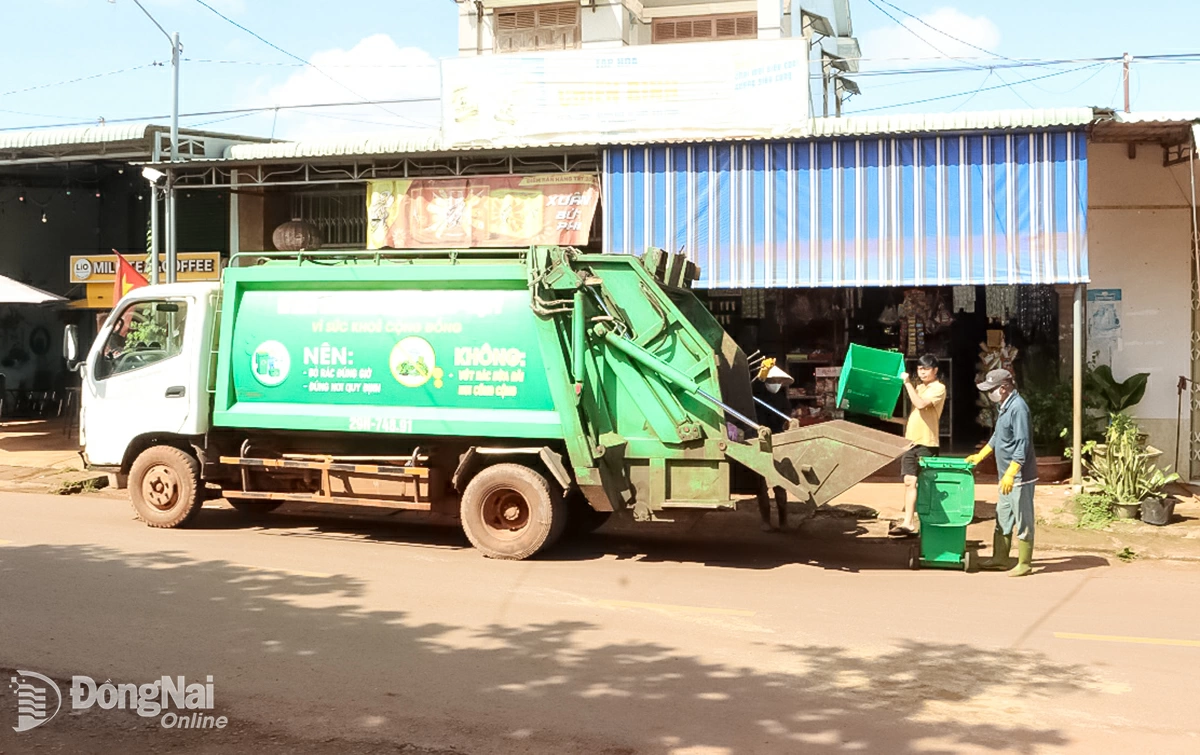 |
| Specialized trucks from Green Environment company collect household waste directly from residents in Nghia Trung commune. Photo: Vu Thuyen |
Garbage-free residential area
Village 2 is the central residential area of Nghia Trung Commune, Dong Nai province, where National Highway 14 runs for 25 kilometers, passing by numerous schools, manufacturing and business establishments, and traditional markets. Despite this, the roads throughout the area remain remarkably clean and free of waste. Instead, large and small mobile trash bins are placed along both sides of the road, in front of households, businesses, and production facilities. Every day, residents sort and deposit all types of household solid waste into these bins, which are then collected and transported by specialized trucks operated by the Green Environment Company. This practice has brought practical and meaningful benefits, fostering a clean and healthy environment for both the community and individual households.
Nguyen Thi Van, a resident of Village 2, Nghia Trung Commune, shared that: thanks to communication efforts and warnings from local authorities about the harmful effects of environmental pollution caused by HSW, she and other households in the area have become more conscious about collecting and sorting waste at the source and disposing of it at designated locations. At the same time, families and contracted waste collection businesses have coordinated effectively, ensuring that no waste is left uncollected, thereby preventing pollution in the residential area.
In Nha Bich Commune, Dong Nai Province, concerned about the environmental impact of residents indiscriminately dumping household solid waste, the Nha Bich Agricultural and Commercial Cooperative invested in specialized waste collection trucks in 2020. This meaningful initiative not only addressed waste issues in residential areas but also contributed to meeting environmental criteria in the development of new-style rural areas in the locality.
The resolution of the Commune Party Committee for the 2025–2030 term sets a target of collecting 95% of household solid waste in the commune by 2030. To achieve this goal, raising public awareness on waste collection, sorting, and treatment, particularly encouraging households to sort and process waste at the source, is essential. In addition, the commune continues to develop its household solid waste treatment plan and maintains contracts with the Green Environment Company to ensure proper collection and disposal at designated sites.
Than Thi Lan Thanh, a resident of Hamlet 5, Nha Bich Commune, shared: Previously, without specialized collection trucks, some residents had to bury or burn HSW in rubber plantations, which was unhygienic. Now, residents only need to put their waste into bins, and when collection trucks arrive, the waste is taken away. This initiative is very convenient, and the environment is much cleaner. Having specialized trucks collect waste daily has contributed to changing residents’ awareness, thereby creating a garbage-free environment in the residential area.
Understanding the importance of household solid waste collection for the living environment, not only residents in densely populated areas but also those in outlying areas, including locals and workers, have developed a strong awareness of collecting and disposing of waste at designated locations.
At Nghia Trung Rubber Plantation, Phu Rieng Rubber One Member Limited Company makes use of short midday breaks not only to clean the latex collection area and workplace grounds but also to voluntarily collect waste across the plantation and along nearby roads, bringing it to designated disposal points. These efforts help keep the working environment clean and well-ventilated, improve road conditions, reduce environmental pollution, and contribute to climate change mitigation.
Comprehensive measures
Nghia Trung Commune spans 222 square kilometers and has a population of over 33,000, generating approximately 7 tons of household solid waste per day. As such, waste collection and treatment remain a persistent challenge. To address this issue, even before the administrative merger, the former communes of Duc Lieu, Nghia Trung, and Nghia Binh had signed contracts with Green Environment Company to regularly collect and transport waste to designated disposal sites, in accordance with set schedules at two local waste depots.
According to Luong Dinh Hai, Vice Chairman of the Nghia Trung Commune People's Committee, the collection of household solid waste is a daily necessity. For this reason, the commune regularly instructs relevant agencies to conduct public outreach and educate residents on proper waste collection, handling, and disposal at designated sites, and to avoid indiscriminate littering. At the same time, the People's Committee encourages households to voluntarily collect, sort, and treat waste at home, particularly by converting organic waste into fertilizer. The committee is also firmly committed to strictly penalizing acts of littering along roads.
According to the Nghia Trung Commune People’s Committee, the locality is implementing penalties under the 2020 Law on Environmental Protection, with fines ranging from VND 500,000 to 2 million per case (depending on severity) for acts of indiscriminate littering. As a result, residents in the locality have become highly conscious about waste collection, sorting, and treatment. The challenge, however, lies in the 25-km stretch of National Highway 14 passing through the commune, where many passersby still engage in environmentally harmful behaviors while traveling.
In addition to the strong commitment of local Party committees, authorities, residents, and businesses, the swift engagement of relevant departments, agencies, and units is urgently needed. It is because, across the areas formerly within Binh Phuoc province, 22 temporary dumpsites remain, containing an estimated 350,000 tons of waste. Meanwhile, the only treatment facility, the Dong Xoai Waste Treatment Plant, operated by Binh Phuoc Environment JSC, continues to receive and process household solid waste from the former Dong Xoai city and surrounding areas, and is constantly overloaded.
Notably, many temporary dumpsites in communes such as Phuoc Son, Dak Nhau, Bom Bo, and the former Phuoc Long town have existed for years, while also being located close to residential areas, causing serious environmental pollution. In addition, some individuals take advantage of quiet hours to dump waste indiscriminately at the entrances to these sites, blocking access and degrading the appearance of surrounding neighborhoods. Despite the installation of prohibition signs by local authorities, the situation continues.
The Dong Nai Provincial People's Committee is directing relevant departments and agencies to coordinate with investors in proposing and implementing key waste treatment projects, particularly in areas formerly under Binh Phuoc province. While awaiting the rollout and operation of these projects, the active involvement and strong support of Party committees, local authorities, and residents play an essential role in raising public awareness about protecting the living environment in residential areas.
By Vu Thuyen - Translated by Thu Hien, Minho




Thông tin bạn đọc
Đóng Lưu thông tin