
 |
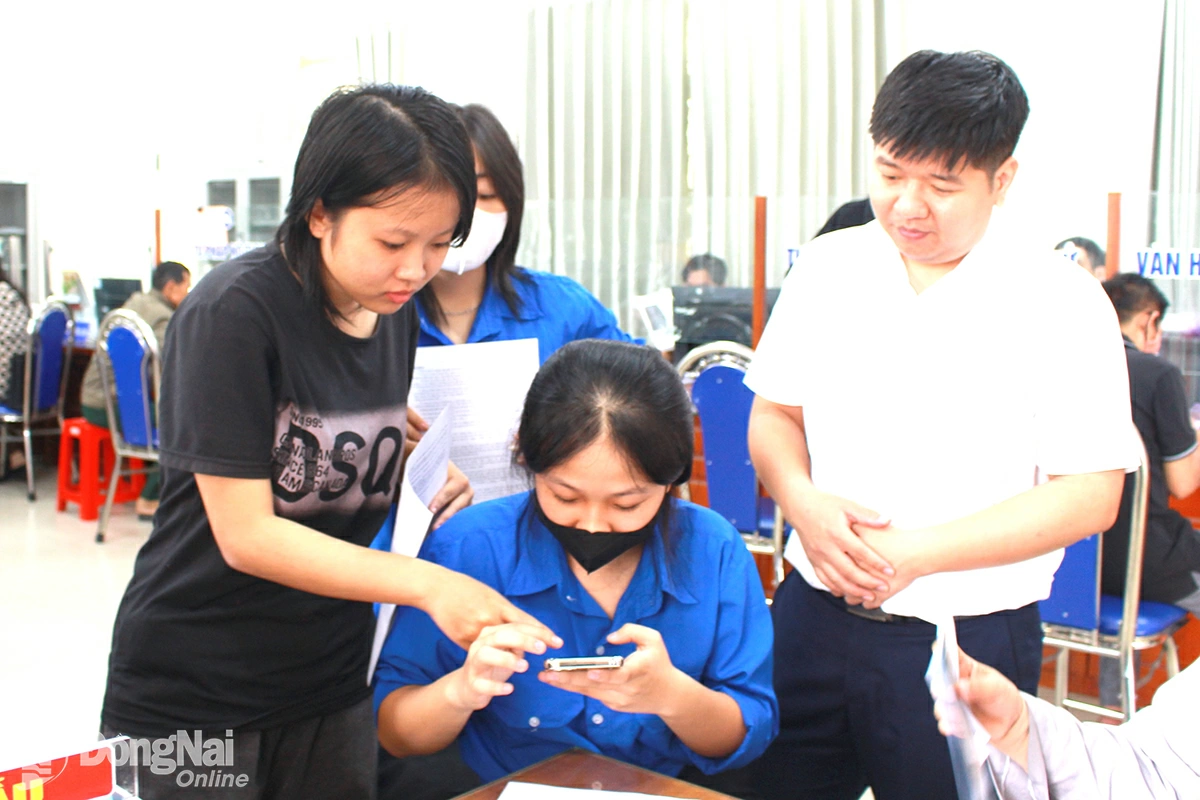
| Residents are guided attentively by officials and Youth Union members during the handling of administrative procedures at the Phuoc Thai Commune Public Administrative Service Center. Photo: Ho Thao |
In Dong Nai, administrative reform is always defined as a key and breakthrough task, contributing to building a transparent, professional, and effective public administration while promoting socio-economic development.
“Officials are very welcoming and enthusiastic. Right from the entrance, there is already someone guiding us, so people feel very friendly and approachable,” Le happily shared.
Vice Chairman of An Phuoc commune People’s Committee Doan Duc Thanh said: Recognizing public satisfaction as the benchmark for administrative reform effectiveness, the communal People’s Committee has focused on implementing administrative reform tasks comprehensively and consistently. At the communal Public Administrative Service Center, the unit in charge of directly handling administrative procedures for citizens, the commune has reviewed and supplemented staffing, upgraded infrastructure and necessary equipment to ensure a synchronized, efficient working environment. At the same time, the commune has strictly emphasized discipline and service attitude among its officials to provide the best possible support for both citizens and businesses.
Dong Nai also regards the annual administrative reform index evaluations of each agency and unit as important criteria for assessing leaders’ performance, and as a basis for rewards and recognition for collectives and individuals.
Not only in An Phuoc Commune, but the operation of public administrative service centers across the province has so far been implemented in a uniform and effective manner, meeting the needs of residents and businesses. Moreover, the establishment of commune-level public administrative service centers, in line with regulations on the implementation of the one-stop shop and interconnected one-stop shop mechanisms, has created favorable conditions for citizens and organizations in handling administrative procedures.
In particular, since July 1, 2025, with the implementation of the two-tier local government system, in response to the rising demand of residents and businesses for handling administrative procedures, the leadership of Dong Nai province has directed the assignment of officials and civil servants to work overtime on Saturdays to promptly and efficiently receive and process administrative applications.
The province has requested stronger proactive coordination among departments, sectors, vertically managed agencies, commune and ward People’s Committees, as well as between units, divisions, civil servants, and public employees in implementing administrative reform. It also called for overcoming the practice of shirking responsibility that causes delays in handling administrative procedures for citizens and businesses, and for strictly complying with the requirement to apologize to citizens when applications are processed late.
Deputy Director of the Department of Natural Resources and Environment Dang Minh Duc said that as a department receiving a very large number of applications, especially land-related procedures, it has made continuous efforts to improve early and on-time processing rates as well as online submission. From July 1 to 31, 2025, the department received an average of 1,580 applications per day, with land-related cases accounting for 97.8%. Thanks to significant efforts, the on-time and early processing rate reached 99.2% overall, and 99.3% in land procedures. Online submission rates reached 89.8%, with 89.6% in the land sector.
Meanwhile, Deputy Director of the Department of Justice Nguyen Trong Tri noted that the department requires all staff to uphold responsibility and service-mindedness. To spread professionalism and citizen-friendly service, the department has attached a thank-you letter from the director along with every administrative service result delivered to the public.
Dong Nai has consistently led and directed the comprehensive implementation of administrative reform in all aspects: institutional reform, administrative procedure reform, organizational restructuring of state administration, civil service reform, public finance reform, and the building of e-government and digital government.
A major success has been the smooth operation of the two-tier local government model since July 1 under the Central Government’s directive. The province has quickly stabilized an efficient and streamlined apparatus after restructuring, without disrupting public services, earning high approval from citizens.
To continue fostering development momentum and achieving clear, comprehensive, synchronized, and effective improvements in public services following the provincial merger and the implementation of the two-tier local government model, the province’s leadership is directing further acceleration of administrative reform in the coming period.
On August 14, Deputy Secretary of the Provincial Party Committee and Chairman of People’s Committee Vo Tan Duc signed Directive No. 03/CT-UBND on strengthening the accountability of heads of units and localities in carrying out administrative reform tasks.
With respect to Directive 03, Chairman of the Provincial People’s Committee requested that heads of departments, agencies, and relevant units, as well as Chairpersons of commune and ward People’s Committees, directly organize and comprehensively implement administrative reform tasks at their respective units and localities. Administrative reform must be regarded not as the responsibility of specialized divisions alone but as the duty of the entire government system, starting with the leaders of each unit and locality. At the same time, discipline, administrative order, and the sense of duty among officials, civil servants, and public employees must be rectified and reinforced, particularly in carrying out instructions from higher authorities and in the process of guiding, receiving, and handling administrative procedures, as well as dealing with matters related to organizations, individuals, and businesses.
According to Deputy Director of the Department of Home Affairs Ha Thanh Tung, the province has tasked the department with leading inspections of civil service performance and administrative reform implementation. The focus is on complying with internal regulations and workplace rules; enforcing administrative discipline and order; upholding professional ethics, workplace culture, and professional responsibility in the performance of duties by officials, public servants, and employees at agencies and localities. In recent days, the inspection team has worked with relevant units in line with the plan.
Based on the inspection results, strict measures will be proposed against violations; in particular, the responsibility of the heads of units and localities will be clearly defined if wrongdoing occurs within their areas of management without timely detection, correction, and handling.
Compared to the whole country, in post-restructuring period, Dong Nai now ranks ninth in area, fifth in population, and fourth in economic scale. These conditions will create more opportunities for Dong Nai to make stronger breakthroughs in development. However, achieving real breakthroughs requires the vigorous involvement of the entire political system in carrying out tasks, including administrative reform — a direct driver for development.
By: Thao Lam
Translated by: M.Nguyet-Thu Ha


Thông tin bạn đọc
Đóng Lưu thông tin