
Over the past 80 years of national development, Dong Nai’s healthcare sector has made continuous efforts to overcome challenges, achieving remarkable progress in protecting, caring for, and improving public health
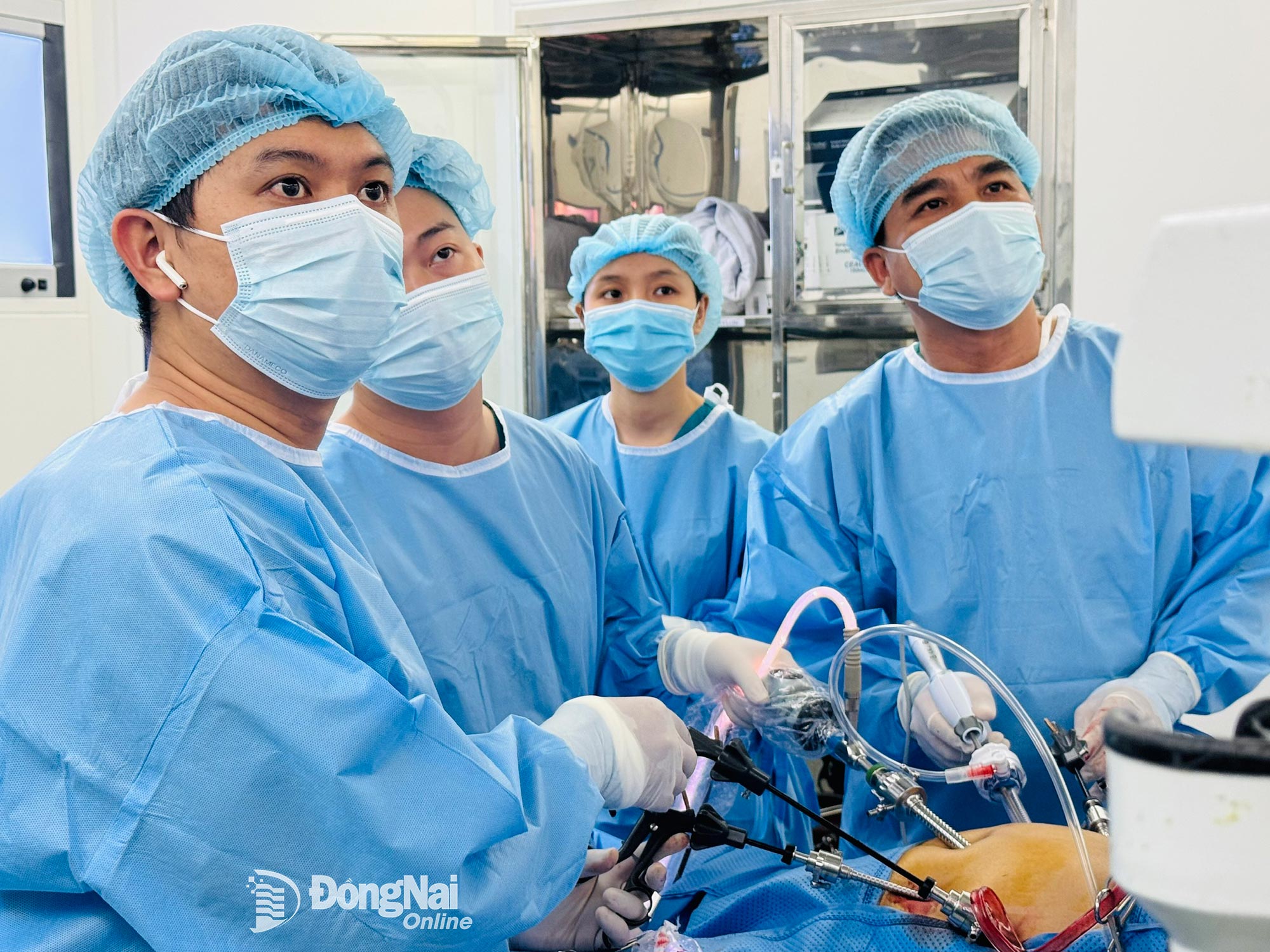 |
| A laparoscopic surgery is conducted at Dong Nai General Hospital. Photo: Hanh Dung |
These achievements have not only enhanced people’s quality of life but also made important contributions to the overall development of the province and the country.
Extensive healthcare network, growing workforce
According to Specialist level II Doctor Do Thi Nguyen, Director of Dong Nai Department of Health, the province’s healthcare system has seen tremendous growth in both scope and quality. From its modest beginnings, Dong Nai now hosts 8 central- and ministerial-level hospitals and institutes, 3 provincial general hospitals, 3 regional general hospitals, 5 specialized hospitals, and 6 provincial-level specialized centers. In addition, the province has 22 regional medical centers, 95 commune and ward health stations, and 176 satellite clinics.
Dong Nai ranks among the top provinces nationwide in private healthcare network, with 12 private hospitals, 111 general clinics, over 2,000 specialized clinics, and more than 4,000 pharmacies and medical service facilities.
The medical workforce is also expanding in both size and expertise. Among more than 15,000 healthcare offcials and employees, there are over 10 PhDs, 150 specialist level II doctors, 110 masters, and nearly 1,000 specialist level I doctors. On average, Dong Nai has 10 doctors, 16.5 nurses, and 4.6 pharmacists per 10,000 residents — a crucial foundation for delivering high-quality treatment and adopting advanced medical techniques locally.
Thanks to this continuous development, many provincial-level hospitals in Dong Nai now perform advanced procedures that were previously available only at national-level institutions, such as open-heart surgery, endoscopic heart surgery, ECMO (extracorporeal membrane oxygenation), and targeted temperature management. Regional and provincial hospitals have also mastered other complex techniques like endoscopic joint replacement, percutaneous nephrolithotomy, orthopedic endoscopy, and laparoscopic general surgery.
Particularly, cardiology has made significant breakthroughs with five effective cardiovascular centers that have saved tens of thousands of patients. In stroke treatment, Dong Nai General Hospital received the Diamond Status from the World Stroke Organization, while Thong Nhat General Hospital and Long Khanh Regional General Hospital earned Platinum Status.
Specialist level II doctor Ngo Duc Tuan, Director of Dong Nai General Hospital, noted that thanks to skilled medical staff and modern facilities, equipment and technology, the hospital has made strong progress. “This enables local residents to access high-quality healthcare services without having to travel far, thus saving costs, time, and effort,” he said.
“The hospital will soon carry out kidney transplantation and establish three specialized centers in oncology, emergency and cardiology. These centers will not only develop their expertise but also connect with and support lower-level hospitals and medical centers. Ultimately, the biggest beneficiaries will be the people,” Doctor Ngo Duc Tuan added.
Moving toward smart healthcare
In line with the “digital transformation wave,” Dong Nai’s healthcare sector is actively implementing digital initiatives to enhance service efficiency.
Compared to the past, patient registration procedures have been significantly improved. All medical facilities in the province now accept national ID cards for health insurance registration.
Moreover, electronic medical records are being gradually adopted, enhancing management efficiency and reducing costs, time, and administrative workload.
Specialist level II Doctor Phan Van Huyen, Director of Long Khanh Regional General Hospital, shared that the hospital began using electronic medical records in 2020. The system has since been upgraded, bringing many benefits to doctors, nurses, patients and managers. The hospital has also applied artificial intelligence (AI) in diagnostic imaging, providing strong support for doctors in diagnosis and treatment.
Recently, Thong Nhat General Hospital has also rolled out electronic health records to replace traditional paper files. Meanwhile, 27 other hospitals and regional medical centers across Dong Nai are accelerating efforts to implement the system by September 30, 2025, in line with the directive from the Prime Minister and the Ministry of Health. At the same time, projects such as the Telemedicine consultation and treatment system with a total investment of over VND 20 billion, and the End-User IT equipment project for Dong Nai healthcare digital transformation worth nearly VND 25 billion, are being expedited, with the aim of building a smart healthcare system.
Specialist level II Doctor Luu Van Tuong, Director of Cam My Regional Medical Center, emphasized: “To improve healthcare quality and patient satisfaction, our leadership considers building a highly qualified, skilled and dedicated workforce the most important factor. Many doctors who underwent advanced training have returned and committed themselves to the center, where together they have carried out new and advanced techniques. At the same time, our facilities have been renovated to be more modern and clean, helping patients feel comfortable and satisfied when seeking treatment.”
Dong Nai currently has more than 13,400 hospital beds, equivalent to 30 beds per 10,000 people, ranking second in the Southeast region after Ho Chi Minh City. There are no longer cases of overcrowding where patients had to share beds or lie on the floor as in the past.
Director of the Department of Health Do Thi Nguyen, that preventive work in healthcare plays a vital role in improving comprehensive health services for the population. “Thanks to effective preventive work in healthcare, we’ve managed to control dangerous diseases such as COVID-19, dengue fever, measles, and hand-foot-and-mouth disease.”
“In the future, Dong Nai’s healthcare system will shift from a passive treatment model to a proactive prevention and care approach. Our goal is for every resident, especially those in remote, rural, and ethnic minority areas, to get access to quality healthcare. We will continue to invest in and upgrade grassroots-level medical system so that it will become the closest, most understanding force to the people, providing the best primary healthcare services and minimizing cases when patients have to be transferred to higher-level hospitals,” said Director of the Department of Health Do Thi Nguyen.
Hanh Dung
Translated: Thuc Oanh - Thu Ha




Thông tin bạn đọc
Đóng Lưu thông tin