On August 4, Gartner- a world's leading information technology research and advisory company- had shared the new Magic Quadrant for Unified Communications (UC), a study seeking to help businesses to have the right decision for their UC.
On August 4, Gartner- a world's leading information technology research and advisory company- had shared the new Magic Quadrant for Unified Communications (UC), a study seeking to help businesses to have the right decision for their UC.
 |
The primary goal of UC is to improve user productivity and to enhance business processes. UC offers the ability to significantly improve how individuals, groups and companies interact and perform.
The UC products may be composed of a single vendor (stand-alone) suite, or enterprises may deploy a portfolio of integrated applications and platforms spanning multiple vendors. In many cases, UC is deployed to extend and add functionality to established communications investments.
Gartner defines UC products (equipment, software and services) as those that facilitate the use of multiple enterprise communications methods to obtain that goal. This can include the control, management and integration of these methods. UC products integrate communications channels (media), networks and systems, as well as IT business applications and, in some cases, consumer applications and devices.
The midsize and large enterprise UC markets are now considered by Gartner to be in the early mainstream adoption phase, and the best practices for deployment and end-user adoption are maturing. However, most enterprises currently operate with non-unified-communications solutions.
In Gartner’s UC Magic Quadrant, Microsoft is leading, in both Completeness of Vision and Ability of Execute.
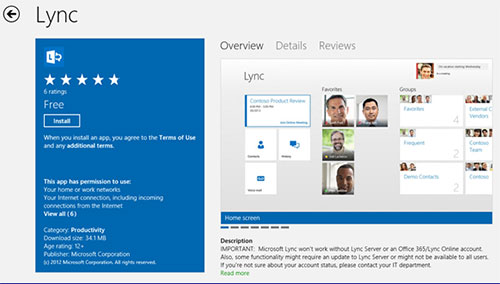
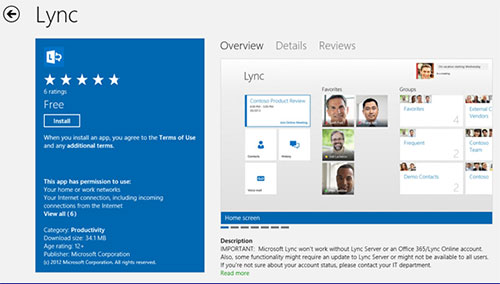
Microsoft Lync offers a full suite of UC functionality that Microsoft continues to improve with each release. It integrates with Office applications, Active Directory and Skype.
Microsoft has a broad set of additional business applications that will increasingly be leveraged, including Office Graph (which uses machine learning to define the context and connect users with relevant documents, conversations and people) and Cortana (a digital assistant).
The Lync partner ecosystem expanded at a rapid pace; however, more importantly, the partners' skill level and experience in complex deployments that include voice and video also improved significantly year over year.
Lync's improved federation capabilities have proven an effective way for groups to collaborate across organisational boundaries. For cloud delivery, Microsoft offers Lync Online as part of the Office 365 suite, as well as in private cloud configurations; in both cases, partners can be leveraged for telephony.
However, enterprises should be aware that Lync Online offers only a subset of the on-premises Lync solution, most notably with limited PSTN connectivity.
Enterprises that have a significant number of employees that can benefit from Lync's collaboration model should consider the Lync solution and understand how it might change their business processes and worker productivity.
Enterprises considering deploying Lync telephony or video should understand the topology and infrastructure requirements, how they will support branch offices, and (if relevant) how they will deploy and obtain global third-party support. Enterprises with advanced telephony feature requirements should also ensure that the needed functions are supported.
And below are typical Lync strengths:
Microsoft Lync continues to make significant gains in the market and is attractive to a broad range of enterprises. In many cases, it is initially deployed for its IM, presence and Web conferencing functionalities, with gradual incremental deployments of telephony and video added as follow-on phased deployments for specifically targeted groups or regions.
The vendor has significantly improved its go-to-market strategy for Lync during the last year, positioning itself to more adequately address the real-time communications requirements of enterprises over the next several years.
Microsoft has added video capabilities, including support for Lync room-based video systems and interoperability of standards-based video endpoints.
Customers report that Lync functions can be readily integrated into business processes and applications, providing new, different and effective ways to perform tasks. Often, these new functions are achieved by deploying Lync enhancements from a growing list of ecosystem partners.
In this study, Cisco, Avaya and Mitel are also considered as the Top ranking for UC solution after Microsoft.
(Source: VIR)