
In recent years, Dong Nai has placed strong emphasis on innovation and the development of an innovation startup ecosystem.
 |
| Technology enterprise showcases digital transformation products at the Science and Technology Exhibition during Techfest Dong Nai 2025. Photo: Hai Quan. |
In early October 2025, the Ministry of Science and Technology (MoST) announced the Provincial Innovation Index (PII) 2025. Dong Nai ranked 12th out of 34 provinces and cities nationwide with a total score of 44.92.
Leveraging strengths, addressing limitations
The PII provides a comprehensive and objective reflection of each locality’s socio-economic development based on science-technology and innovation of each locality, including Dong Nai. The index identifies strengths, weaknesses, as well as the potential and conditions necessary to foster innovation. It has become an important tool for localities to design policies and development strategies.
According to the 2025 PII Report, the index consists of 52 indicators grouped into seven pillars, based on the structure of the Global Innovation Index (GII).
Five input pillars reflect the enabling conditions for socio-economic development driven by science-technology and innovation, including institutions, human capital and research & development; infrastructure; market sophistication; and business sophistication.
In addition, there are two output pillars that reflect the impacts of science, technology and innovation on socio-economic development, including the knowledge, creativity and technology products, and the impact pillar.
“Dong Nai focuses on developing a science, technology and innovation ecosystem, building a tightly linked network, ranging from science research and technology transfer to the development of the science-technology market and human resource capacity. The province aims to promote commercialization of science research and technology development (R&D) outcomes and expand connectivity not only within Dong Nai but also across innovation and startup hubs throughout the Southern region.”
Le Truong Son, Member of the Provincial Party Standing Committee, Vice Chairman of the Dong Nai People’s Committee.
The impact pillar includes factors related to production and business performance (industrial production index, number of OCOP products rated four stars or higher, export value/GRDP, labor productivity growth) and socio-economic impacts (poverty reduction rate, employment rate in the economy to the total population, per capita income, and the human development index).
Dong Nai’s 2025 PII results show that Dong Nai scored well in several pillars: infrastructure (4th nationwide), market sophistication (5th), and impact (4th). In addition, the province also needs to improve its scores and rankings in the pillars of institutions; human capital and R&D; business development level; and knowledge, creativity, and technology outputs. Specific indicators requiring attention include equal competition (institution pillar); local budget spending on science-technology/GRDP; R&D/GRDP (human capital and R&D pillar); environmental governance (infrastructure pillar); the proportion of spending on workforce training in the enterprise’s total expenditure (business sophistication pillar).
Deputy Director of the Dong Nai Department of Science and Technology (DoST) Vo Hoang Khai said the province will strengthen measures to improve Digital Transformation Index (DTI) and PII. In the coming period, Dong Nai will continue refining policies in line with Resolution No. 57-NQ/TW on breakthroughs in science-technology, innovation and national digital transformation; increase investment in innovation support centers at universities; and foster stronger linkages among education institutions, enterprises and investors.
Strengthening linkages to drive innovation
The network of innovation-oriented enterprises in Dong Nai continues to expand. According to the DoST, as of September 2025, the province had 88 innovative startups, three units operating innovation centers, one provincial-level startup advisory council, four units with startup/innovation divisions, and seven units operating startup clubs. Dong Nai also recorded 28 commercialized innovation products; five patents and utility solutions registered in the province; 553 applied scientific papers related to innovation; and 67 public-sector innovations recognized.
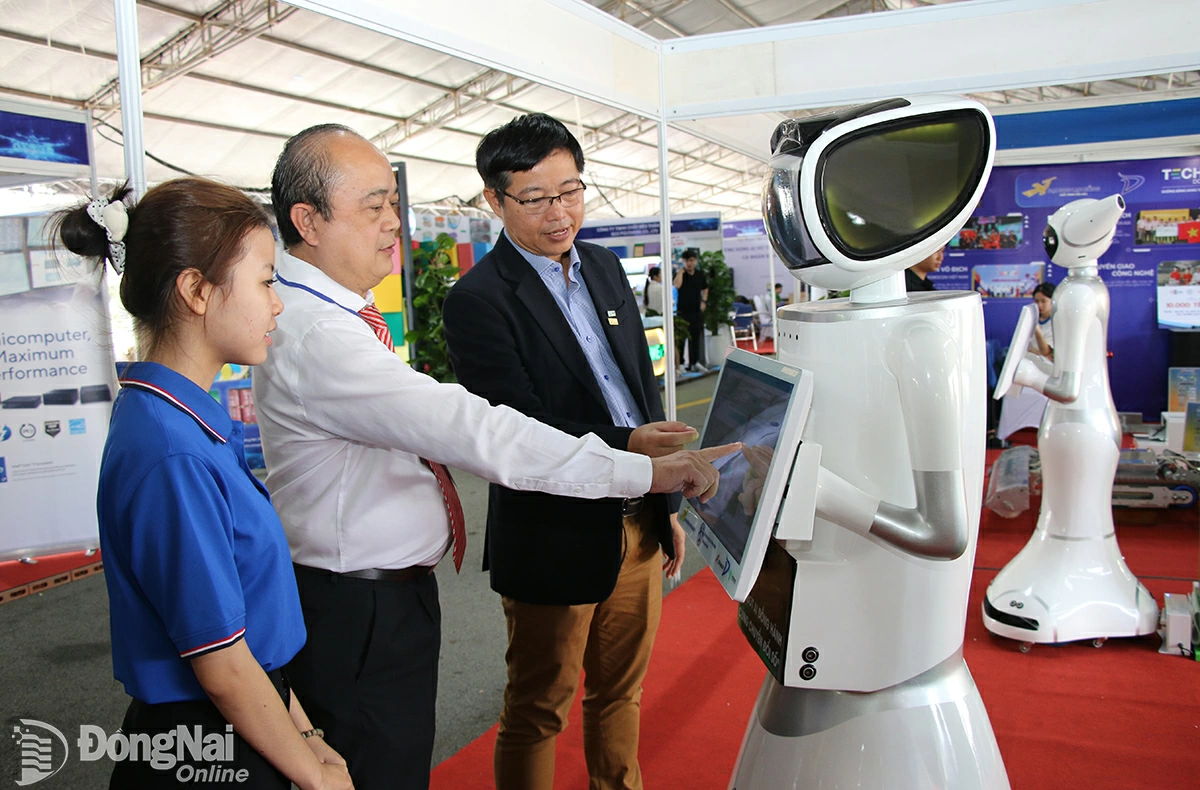 |
| Deputy Director of the DoST Vo Hoang Khai and delegates visit an exhibition booth showcasing digital technology and innovation products at Techfest Dong Nai 2025. Photo: Hai Quan |
These figures highlight the initial impact of local innovation policies, with academic-business linkages gradually expanding and creating momentum for private enterprises to contribute more significantly to economic growth.
Deputy Director of the DoST Vo Hoang Khai added: “Active engagement by the State and the combined efforts of all four key stakeholders (government, academia, enterprises and investors) will generate strong momentum for Dong Nai to apply science-technology, innovation and digital transformation. This will support sustainable economic growth in the new development phase. The leading role of the State is reflected in strategic orientation, institutional improvement and development resource mobilization.”
Experts note that Dong Nai holds significant conditions and potential to develop its innovation ecosystem. The province plans to invest in critical future-oriented infrastructure such as an innovation hub in Long Thanh, a high-tech park, and a concentrated IT zone surrounding Long Thanh International Airport. These promise to position Dong Nai as an attractive destination for technology and logistics enterprises and a growing market for technological products.
Nguyen Van Thanh, Director of the Center for Market Development of Science and Technology (under the MoST), said that an essential task for Dong Nai to develop the science and technology market and promote innovation is to expand and effectively operate a network of intermediary organizations and technology consultants. The localities must standardize and certify the activities of intermediaries such as transaction floors, brokers, valuation units and technology transfer consultants; while building consultant networks linked to experts in technical, legal, financial and investment fields. Strengthening regional technology promotion centers such as those in Dong Nai, Bac Ninh and Ho Chi Minh City… Moreover, the localities also expand international cooperation and adopt foreign technology transfer that align with each locality’s socio-economic development orientation.
Member of the Provincial Party Committee and Director of the DoST Pham Van Trinh said the province prioritizes developing an innovation and startup ecosystem, accelerating science-technology adoption in production and management, and supporting enterprises in transitioning to smart manufacturing based on digital technologies. The province will focus on developing a digital workforce and applying AI, blockchain and big data to improve productivity, reduce costs and expand technological markets.
By Hai Quan – Translated by M.Nguyet, Thu Ha


Thông tin bạn đọc
Đóng Lưu thông tin