
There are no formal halls, no podiums, and no distance between officials and citizens, the "Morning coffee with residents" sessions in Tri An Commune are becoming a space for close, open and substantive dialogue.
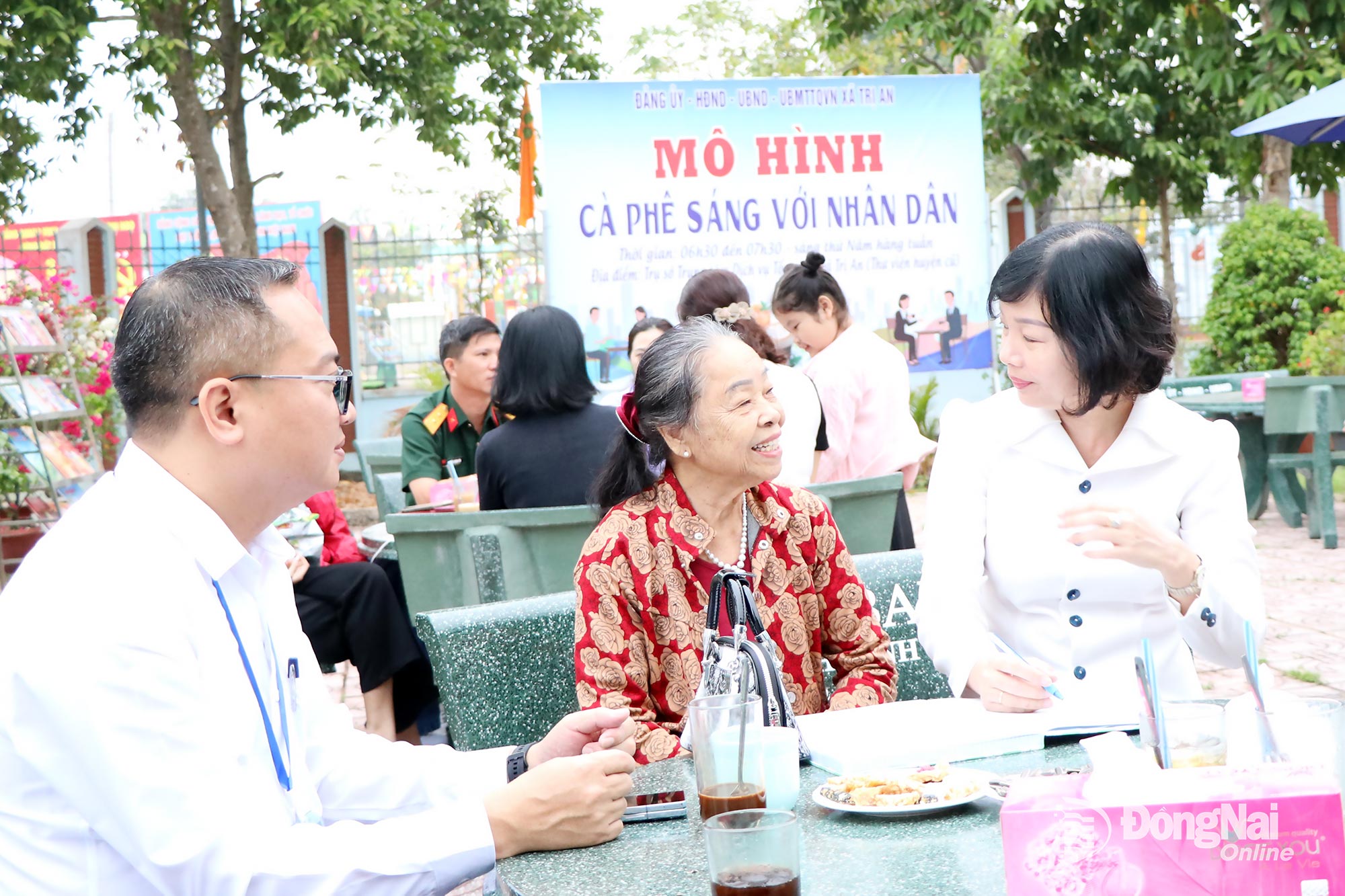 |
| Chairwoman of Tri An Communal People's Committee Nguyen Thi Dung (far right) talks with locals during a "Morning coffee with residents" session. Photo: To Tam |
From everyday stories over a hot cup of coffee, many livelihood issues are promptly resolved; many contributions are received and clearly responded to. After about 2 months of implementation, the "Morning coffee with residents" model not only creates social consensus but also contributes to building an image of a service-oriented, modern, and friendly government.
Efficiency gained from a people-centric model
On Thursday morning, as the sun just rose above the green trees in Tri An commune's central park, the atmosphere in front of the Communal Library was already bustling. Locals heading out for morning exercise or on their way to the market, etc., stopped by a small corner of the yard where tables and chairs were neatly arranged. There, communal leaders and officials had arrived early, personally brewing coffee and hot tea to invite the people. The morning coffee, therefore, was not just for enjoyment but also a "bridge" between the government and the people.
Although the “Morning coffee with residents" model is not new and has been implemented in many localities, Tri An communal leaders decided to apply it from early 2026 after recognizing its suitability for local conditions. The program is held every Thursday morning, from 6:30 a.m. to 7:30 a.m.
According to Nguyen Thi Dung, Chairwoman of Tri An Communal People's Committee, after the merger, the area is larger, requiring local government to be closer to the people to fully listen to their thoughts and aspirations.
"Not everyone is bold enough to express their opinions at large meetings. Therefore, the Communal Party Committee and People's Committee, in coordination with the General Service Center and the Communal Office, organized this model in the library yard, which is near the park, convenient for people going out for work or exercises to stop by. Participants include leaders of the Communal Party Committee and People's Committee, as well as representatives of relevant units," Dung said.
Initially, many complaints have been resolved quickly. For example, in Hieu Liem hamlet, through the morning coffee sessions, people reported that the street light system was damaged, causing insecurity at night. Immediately after, the Communal People's Committee directed the economic department to work with the operating unit, and the system has now been repaired according to the people's recommendations.
Or, for instance, the situation of some young people driving at high speeds on some roads, posing a potential risk to security and order. After being reported, communal leaders directed the police force to increase patrols and promptly rectify the situation, helping to significantly reduce this problem.
The locals shared not only general issues, but many personal stories such as land disputes and policy regimes. All content was recorded by officials in a logbook or self-recorded by the people. Based on that, communal leaders assigned processing according to their authority and provided specific written responses.
Creating a bridge between the government and the people
According to Nguyen Thi Dung, the core purpose of the program is to build an image of a service-oriented, modern, fast, and convenient government. Through the model, the government promptly grasps and resolves difficulties for people and businesses. At the same time, it receives ideas and initiatives to develop the local economy and society.
The model also contributes to improving administrative reform indicators such as PAPI, PCI, PAR Index, SIPAS; building a friendly, healthy environment to attract investment and develop the economy. More importantly, it creates a close dialogue space where grievances are "de-escalated" from the outset. Many complicated, special cases, especially those related to land, have seen tension reduced and prolonged complaints minimized once they were thoroughly heard of and addressed.
After about 2 months of implementation, the model initially shows positive signs. However, Tri An commune has hamlets up to 40km away from the center, making it difficult for people to travel. Therefore, the communal leaders plan to expand the organization locations to hamlets such as Ma Da, Hieu Liem... under the form of socialization. The coffee sessions can be held by using local cafe spaces, both creating more customers for household businesses and being convenient for the people. Communal leaders will take turns attending the morning coffee sessions to ensure the presence of the heads.
Besides, the commune aims to diversify models such as: adding "book coffee" to encourage reading culture or introducing local specialty products in the coffee space to promote and support product consumption. From what began as a dialogue activity, the model can develop into a venue for cultural, economic and social activities in the locality.
Pham Thi Tuyet Nhung (57 years old, a resident of Tri An commune) believes the model is very practical. " “Sometimes, when going to the office, time is limited, and people find it difficult to express all their views. Here, it's more comfortable, and we can discuss things more thoroughly. I hope the model is maintained in the long term so that everyone has the opportunity to meet and contribute their opinions to the government," Nhung expressed.
From a simple morning cup of coffee, the authorities and people of Tri An are joining hands to build a space for sincere and responsible dialogue. When the distance between them is shortened, companionship will be stronger. That is the foundation for the locality to develop stably, maintain security and order, and improve the material and spiritual lives of the people in the new period.
"After the merger, the government still has many things to worry about, but small activities like these create great consensus. When the people trust and are ready to contribute, from neighborhood sanitation, lighting alleys to attracting investment, that is the foundation for sustainable growth. Trust in small things opens the way for great strides."
Provincial Party Committee member, Secretary of Tri An Communal Party Committee Nguyen Thanh Tu
By To Tam -- Translated by Mai Nga, Thu Ha


Thông tin bạn đọc
Đóng Lưu thông tin