
From July 1, 2025, Dong Nai Province, together with the rest of the country, officially implemented the two-tier local government model. With a renewed spatial framework, vision and mindset, Dong Nai has taken decisive action and achieved concrete and comprehensive results across socio-economic development, national defense and security, as well as Party building efforts.
 |
| Politburo member and Prime Minister Pham Minh Chinh (front row, far right) inspects construction progress of the Bien Hoa - Vung Tau Expressway project on December 14, 2025. Photo: Cong Nghia. |
Deputy Secretary of the Provincial Party Committee and Head of the Provincial Party Committee’s Organization Commission Thai Bao, noted: “The tangible results Dong Nai has achieved after six months of implementing the two-tier local government model are truly encouraging. They demonstrate the province’s close, flexible and innovative leadership and direction, which have swiftly unlocked existing potential and advantages, contributing to the country’s rapid and sustainable development.”
Placing trust from the very beginning
Before the merger of the former provinces of Binh Phuoc and Dong Nai into the new Dong Nai Province and the official implementation of the two-tier local government model from July 1, 2025, the contingent of officials from the provincial to the commune levels had been thoroughly prepared in both mindset and manpower to better and more effectively serve the public and businesses.
Overcoming significant difficulties and pressure in the early days, the administrative apparatus from the provincial to the grassroots level quickly stabilized and operated effectively through flexible and innovative approaches. As a result, after a period of “experiencing” the new governance model, the majority of residents and enterprises genuinely feel satisfied and are increasingly confident in the system.
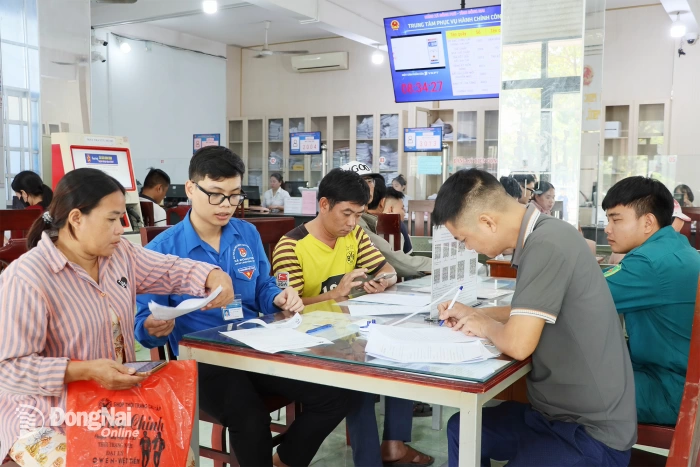
In Bu Dang Commune, with the spirit of ensuring uninterrupted reception and processing of administrative procedures, from the very first days of implementing the two-tier local government model, in addition to officials and civil servants working at the commune People’s Committee headquarters, the locality also organized mobile teams to reach hamlets directly to receive and handle administrative procedures for residents. Although mobile in nature, these teams were able to comprehensively cover most of the administrative dossiers needed by the public, such as birth registration, marriage registration, health insurance, verification of judicial records, certification of various documents, updating Level-2 digital identification on VNeID, and notably, first-time applications for land-use rights certificates.
In Xuan Hoa Commune, from the outset of implementing the two-tier local government model, the commune identified the need to build a professional service-oriented administration, with information technology and digital transformation serving as key drivers, and the sense of responsibility of officials and civil servants as the decisive factor for success.
Secretary of the Xuan Hoa Commune Party Committee and Chairman of the Commune People’s Council Ta Quang Truong said that in the past, many administrative procedures were received and processed in paper form, whereas they are now handled entirely online. In this process, officials and civil servants not only receive and process applications for residents but also diligently guide them on how to submit online dossiers in a way that is easy to understand and simple to carry out in subsequent submissions.
Meanwhile, in Phu Hoa Commune, located more than 90 kilometers from the provincial center and formed through the merger of several former communes, despite its expanded geographical area, residents feel a greater sense of closeness thanks to the people-oriented, grassroots approach of commune officials. Officials transferred from the former district level and from the province to the commune have quickly integrated into local life, going beyond the routine reception and processing of administrative procedures to work directly alongside residents in the fields.
Nguyen Van Vien, Chairman of the Phu Hoa Commune People’s Committee, shared: “When reassigned by the province to work at the commune level, I initially had certain concerns due to being far from my family and unfamiliar with grassroots work. However, those concerns quickly faded, giving way to a strong commitment to serving the people. Even on weekends, when there are still pending matters for residents, I am willing to stay and continue working with my colleagues at the commune until everything is resolved.”
In Tran Bien Ward, the provincial center with the largest population as well as the highest number of businesses and household enterprises in the province, the pressure placed on local officials and civil servants is immense. To address these challenges, the Ward Party Committee issued highly specific policy directions and exercised close, hands-on leadership in guiding and overseeing their implementation. Notably, the reception areas for citizens handling administrative procedures have been arranged in a scientific and efficient manner, with officials who are well-versed in each field assigned to monitor and expedite the processing of applications. Any bottlenecks are resolved on the basis of safeguarding citizens’ legitimate rights while complying with legal regulations, avoiding situations where issues within the ward’s authority are unnecessarily referred to higher levels or left pending.
In 2026, Dong Nai is determined to achieve double-digit economic growth. To this end, further strengthening the sense of responsibility and linking performance evaluation of officials and civil servants — especially the heads of agencies and localities — has been identified as a key task. The province will step up the implementation of large-scale infrastructure projects, particularly in transport and social housing, through new, flexible and effective approaches. At the same time, administrative reform and efforts to build a transparent and favorable investment and business environment will continue to be intensified to attract major investors, while creating more enabling conditions for the private sector to thrive. These measures are expected to generate strong and sustainable growth momentum for the locality.
NGUYEN VAN UT, Deputy Secretary of the Provincial Party Committee and Chairman of the Provincial People's Committee
Sparing no efforts in meeting public expectations
Contrary to the initial concerns and pressures during the early implementation of the two-tier local government model, Dong Nai welcomed a series of positive developments toward the end of 2025, as socio-economic performance improved markedly and national defense and security continued to be strengthened. Notably, the province’s Party-building efforts received high praise from the central authorities. A highlight was the province’s GRDP growth rate in 2025, which reached 9.63%, exceeding the 8.5% target set by the Government following the merger of Binh Phuoc and Dong Nai provinces. This marked the highest growth rate recorded by Dong Nai in many years, placing it among the leading provinces and cities nationwide. Moreover, in 2025, Dong Nai set a new record in state budget revenue, surpassing the landmark figure of VND 100 trillion.
In 2025, Dong Nai Province received high praise from both residents and businesses for the effectiveness of its leadership, direction, and governance across various sectors.
A resident of Phuoc Tan Ward, Pham Van Hung, shared that in recent years, the province has implemented many major infrastructure projects, particularly in transport, but their execution faced significant difficulties. However, in 2025, the public witnessed strong and decisive action from provincial and grassroots authorities. A notable example is the site clearance for the Bien Hoa - Vung Tau Expressway project passing through Long Thanh District and Bien Hoa City, which had previously missed deadlines multiple times for the handover of 100 percent of cleared land. When the province deployed key officials to work closely with local authorities, jointly mobilize public support, address concerns, and ensure legitimate rights and interests of residents while balancing the interests of both the people and the State, broad consensus was achieved, enabling progress in land clearance for the project.
Pham Thi Hoa, a retiree in Long Thanh Commune, shared: “By now, we have a clear answer regarding the superiority and tangible efficiency of the two-tier local government model and its people-centric spirit. Fewer administrative levels have yielded greater results; many bottlenecks have been cleared, and numerous projects have been accelerated toward completion.”
Reflecting on her joy as 2025 drew to a close, opening up the year 2026 with new expectations, Hoa added: “We are immensely proud to witness the first official flights landing at Long Thanh International Airport in these final days of the year. Alongside this, Component Project 3 of the Ho Chi Minh City’s Ring Road 3 through Dong Nai, including the Long Thanh Bridge, has officially opened to technical traffic. Furthermore, the previously struggling connection between Dong Nai and Ho Chi Minh City, caused by the overloaded Ho Chi Minh City - Long Thanh - Dau Giay Expressway, has now been expanded. We expect that in the next one to two years, the infrastructure in the Long Thanh - Nhon Trach area and the entire province will be completed, creating a new spring-board for the entire Southeast region.”
By Cong Nghia - Translated by Thu Cuc, Thu Ha



Thông tin bạn đọc
Đóng Lưu thông tin