
Dong Nai’s journey toward “digital integrity” stands as a testament to its bold institutional reforms, breakthroughs in administrative performance indicators, and adoption of transformative technologies like VNeID. Together, these tools form a “steel shield” that promotes transparency in public service and eliminates environment conducive to misconduct.
Yet, technology alone cannot guarantee integrity. The true strength of that “shield,” and the real measure of progress behind the so-called “numbers that speak for themselves,” ultimately depend on people.
Even more importantly, as Dong Nai restructures and renews its public administration of the two-tier local government model towards one characterized by modernity, integrity and accountability, the human factor plays a decisive role. Beyond the established policies and legal frameworks, it is the mindset and commitment of officials, civil servants, and public employees, their willingness to shift from “managing” to “serving”, that ultimately determine the effectiveness of reform.
This provides a solid foundation for building public service ethics, enhancing the effectiveness of the state apparatus, thereby reinforcing the people’s trust in the leadership of the Party and the State.
PEOPLE AT THE CORE OF A SERVICE-ORIENTED ADMINISTRATION
Policies, tools, and legal frameworks may set the direction, but it is the people who bring them to life. The human factor is not merely a matter of workforce size or qualifications, it also encompasses awareness, attitude, ethics, and most importantly, a transformation in mindset: from “managing” to “serving”.
 |
| At the Department of Finance, officials and civil servants are striving to embody this philosophy, embracing the Party Committee’s call to place citizens and businesses at the center of public service. (Photo: Ngoc Thanh) |
A public administration is truly strong only when its pool of officials, civil servants, and public employees is defined by integrity, competence, and dedication. When every official, civil servant and public employee recognizes themselves as a servant of the people, no longer a gatekeeper in a transactional system, then procedures become simpler, obstacles are resolved faster, and the relationship between government, citizens, and businesses grows more transparent, efficient, and humane. This is the cornerstone of an ethical, honest, and accountable public service ethics.
On July 1, 2025, Dong Nai Province, in step with the rest of the nation, officially launched its two-tier local government model. Alongside the merger of departments, boards, and sectors, 270 commune-level units from both provinces of former Dong Nai and former Binh Phuoc were consolidated into 95 new wards and communes.
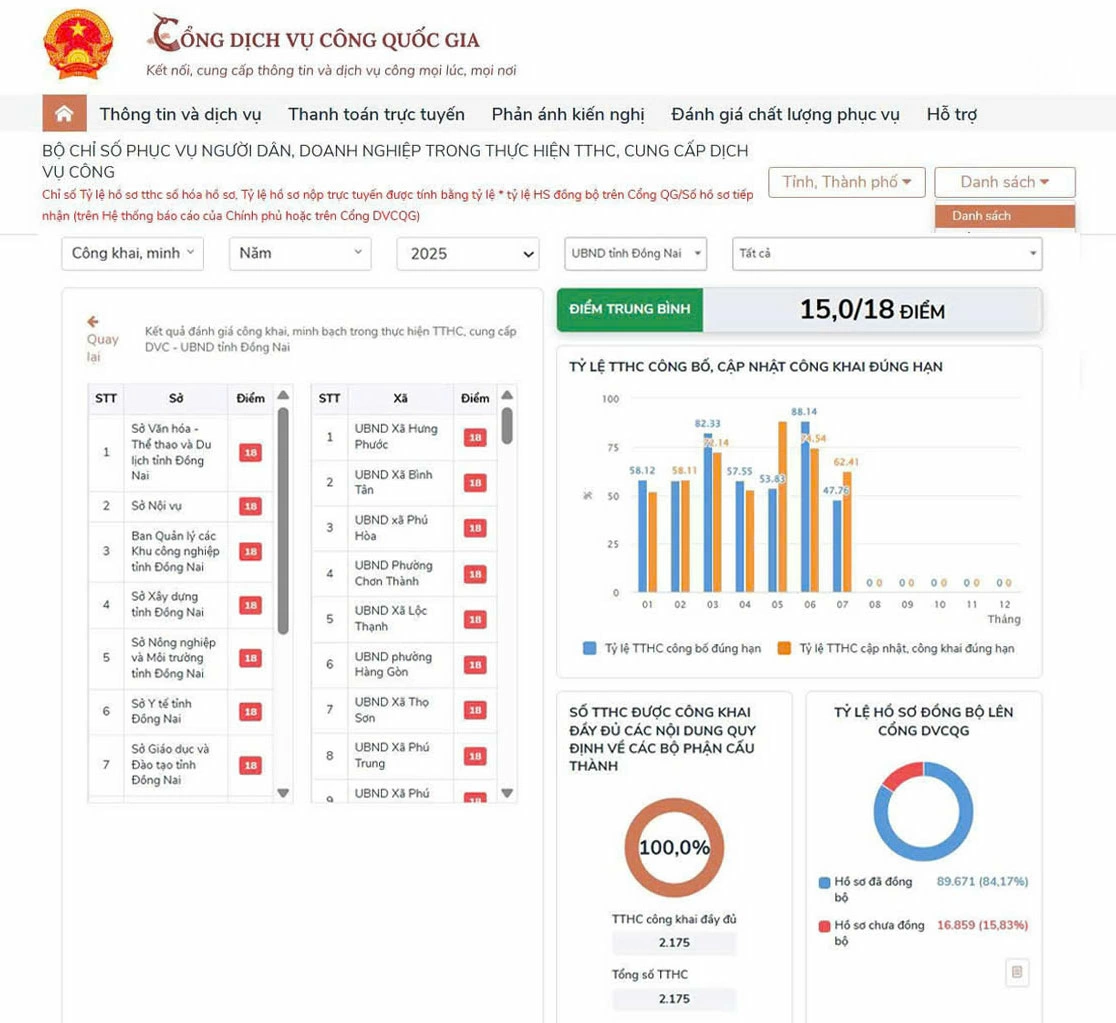 |
| The results of the province’s public and transparent evaluation of administrative procedures and public service delivery were published on the National Public Service Portal on July 30, 2025. (Screenshot: Hai Ha) |
Despite the tight transition period, characterized by a spirit of "running while lining up", the new administrative apparatus has quickly found its rhythm. In less than a month, the 95 wards and communes began operating smoothly, staying closer to the people, and embodying a renewed commitment to serving the public.
Truong Thi Huong Binh, Member of the Provincial Party Committee and Director of the Department of Finance, noted that her department’s core philosophy is now defined by a service mindset. “Every official and civil servant in the Department of Finance now works with a single goal—to serve. We serve organizations, individuals, and businesses that come to work with the Department.”
This shift is more than a slogan, it is a profound commitment to changing the way public service is delivered. By viewing citizens and businesses as “customers” to be served rather than “subjects” to be managed, local authorities are redefining the very essence of public service. The transformation from a “management mindset” to a “service mindset” marks a pivotal turning-point, one that demonstrates how a sense of responsibility and integrity have taken root in the thinking of key officials.
According to Nguyen Quoc Vu, Secretary of the Party Committee and Chairman of the People’s Council of Ho Nai Ward, integrity is an indispensable virtue in today’s digital environment, as the handling of administrative procedures increasingly moves from in-person to online platforms. This transition not only makes public services more convenient for citizens, but also serves as a safeguard, preventing misconduct and reducing opportunities for corruption among public servants.
 |
| At the Ho Nai Ward Public Administration Service Center, specialists now guide citizens through online administrative procedures. (Photo: Hai Quan) |
This is also a consistent viewpoint and guiding principle that the Party Committee and the authorities of Ho Nai Ward have clearly conveyed to the ward’s contingent of cadres and civil servants, especially those directly handling administrative applications. The requirement is to ensure that in the digital and electronic environment, operations are conducted with the highest degree of openness, transparency, and clarity, leaving no room for personal gain or abuse of power.
UPHOLDING PUBLIC SERVICE ETHICS IS UPHOLDING THE SATISFACTION OF CITIZENS AND BUSINESSES
Integrity and responsibility stand as the two core pillars of public service ethics. Integrity is reflected in honesty, impartiality, selflessness, and the refusal to exploit power for personal gain. Responsibility is demonstrated in a proactive spirit, dedication, and the courage to make and own decisions - without avoidance or blame-shifting.
When integrity and responsibility are deeply embedded within the public sector, these qualities foster citizens’ trust in state apparatus, strengthen the investment climate, and elevate satisfaction among both citizens and businesses, thereby promoting sustainable socio-economic growth.
 |
| The Party Committee and People’s Committee of An Vien Commune demonstrate their resolve to build a disciplined, responsible, dedicated, and friendly administration on banners and slogans at the Commune Public Administration Service Center. (Photo: Hai Ha) |
As one of the key provinces in the Southern Economic Zone, Dong Nai is fully aware of the importance of building public service ethics, especially in today’s digital era. The province has been implementing a comprehensive set of initiatives and policies to bring this goal to life.
A series of strategic resolutions and directives issued by the Provincial Party Committee and People’s Committee have established a clear roadmap for ethical governance in the digital era.
Among them, Action Plan No. 469-KH/TU dated May 16, 2025 identifies “building digital culture, public service ethics, and professional ethics in the digital environment” as a key mission. This is a foundational document, underscoring the province’s vision of aligning digital transformation with the development of public service ethics. Similarly, Decision No. 456/QD-UBND dated July 21, 2025 introduces a performance monitoring system through a set of indicators for digital direction and management. This tool enables transparent oversight of provincial operations, helping leaders track progress in real time while reducing the potential for irresponsibility or evasion, a critical step toward reinforcing ethical conduct in public service. Meanwhile, Plan No. 223/KH-UBND dated June 26, 2025 emphasizes the importance of “integrated, synchronized, rapid, and effective digital transformation to support organizational restructuring”. The plan defines digital transformation as the “backbone” of the new administrative system, anchoring transparency at its core to prevent corruption and inefficiency.
UPHOLDING PUBLIC SERVICE ETHICS IS THE KEY TO EARNING THE TRUST AND SATISFACTION OF CITIZENS AND BUSINESSES
“Over the past years, the Ho Nai Ward’s Party Committee and authorities has continuously fostered and strengthened the moral standards of its officials through ongoing political education sessions, regular meetings, and Party cell activities. At the same time, the ward has intensified inspection and supervision efforts, helping officials, civil servants and public employees cultivate a strong sense of revolutionary morality, national self-esteem, and accountability, consistently reminding them of their moral duty and responsibility to the people they serve. These initiatives not only address existing shortcomings but also ensure the successful fulfillment of organizational tasks and responsibilities.”
Nguyen Quoc Vu, Secretary of the Party Committee, Chairman of the People’s Council of Ho Nai Ward
In addition, Dong Nai’s ongoing administrative reform plans, both regular and thematic, focus not only on streamlining the apparatus and simplifying administrative procedures but also place special emphasis on the human factor, aiming to enhance the quality of officials, civil servants, and public employees.
“TRANSFORMING” TO BUILD A WORKPLACE ENVIRONMENT OF INTEGRITY AND ACCOUNTABILITY
does not lie in official documents, but in the way they are implemented and truly internalized in the awareness and actions of each civil servant and public employee.
The true transformation does not lies on paper, but in the way policies are carried out and how deeply they shape the mindset and daily actions of every official, civil servant and public employee. It is through this internal shift that a workplace culture grounded in integrity and responsibility is gradually built.
Across Dong Nai, the “transformation” is taking shape at every level, from the leadership at all levels to individual divisions, agencies, units, and officials, civil servants and public employees. In terms of institutional frameworks and policies, the province has proactively reviewed and proposed amendments, supplements, or the introduction of new regulations aimed at cutting red tape, eliminating unnecessary intermediaries, and reducing direct contact between officials, civil servants, public employees and citizens to limit misconduct.
 |
| At the Department of Finance, officials and civil servants embrace a motto of the Party Committee and the Department’s leadership by shifting toward serving citizens and businesses rather than exercising authority. (Photo: Ngoc Thanh) |
Transparency and openness in processes, procedures, and fees have become top priorities. Portals and e-government platforms have been heavily invested in and developed, allowing residents and enterprises to access information and complete transactions remotely. This not only improves convenience but also significantly curbs petty corruption.
Vo Tan Duc, Deputy Secretary of the Provincial Party Committee, Chairman of the Provincial People’s Committee, and Head of the Provincial Steering Committee for Development in Science, Technology, Innovation, and Digital Transformation, and Implementation of Project 06, emphasized that departments, agencies, and localities will strengthen leadership, guidance, and the implementation of administrative reforms toward building a modern administration. The focus is on accelerating information technology application, strengthening administrative discipline, and ensuring that every official and civil servant upholds accountability. All levels, sectors, units, and individuals strictly comply with regulations requiring them to issue formal apologies to citizens whenever administrative delays occur.
 |
| Citizens completed administrative procedures at the Provincial Public Administration Service Center in May 2025. Photo: Ngoc Thanh |
Integrity and responsibility remain the moral compass of public service ethics, the true measure of public trust in state apparatus. As administrative reform deepens and the socialist rule-of-law state continues to take shape, these values have become not only urgent priorities but enduring foundations for sustainable progress. At the heart of this transformation lies the human factor: unity, determination, and a profound shift in mindset – from “managing” to “serving”. The road ahead may be long, but the collective resolve of officials, civil servants and public employees and the trust of the people will keep driving this transformation forward, toward a government truly of the people, by the people, and for the people. This enduring partnership is what will strengthen public confidence, improve governance efficiency, and lay a solid foundation for the province’s sustainable future.
By Ngan Trieu – Translated by Ngan Trieu, Thu Ha


Thông tin bạn đọc
Đóng Lưu thông tin