
Amid rolling hills of emerald cashew trees and coffee gardens heavy with fruit, few would guess that this quiet corner of Dak Nhau, in Dong Nai Province, once sheltered a legendary resistance base - the Nua Lon Base. It stands as a symbol of shared hardship and unbreakable solidarity between soldiers and civilians during years of grueling resistance war against the U.S., a spirit immortalised in the late composer Xuan Hong’s song The Sound of Pestles in Bom Bo Village.
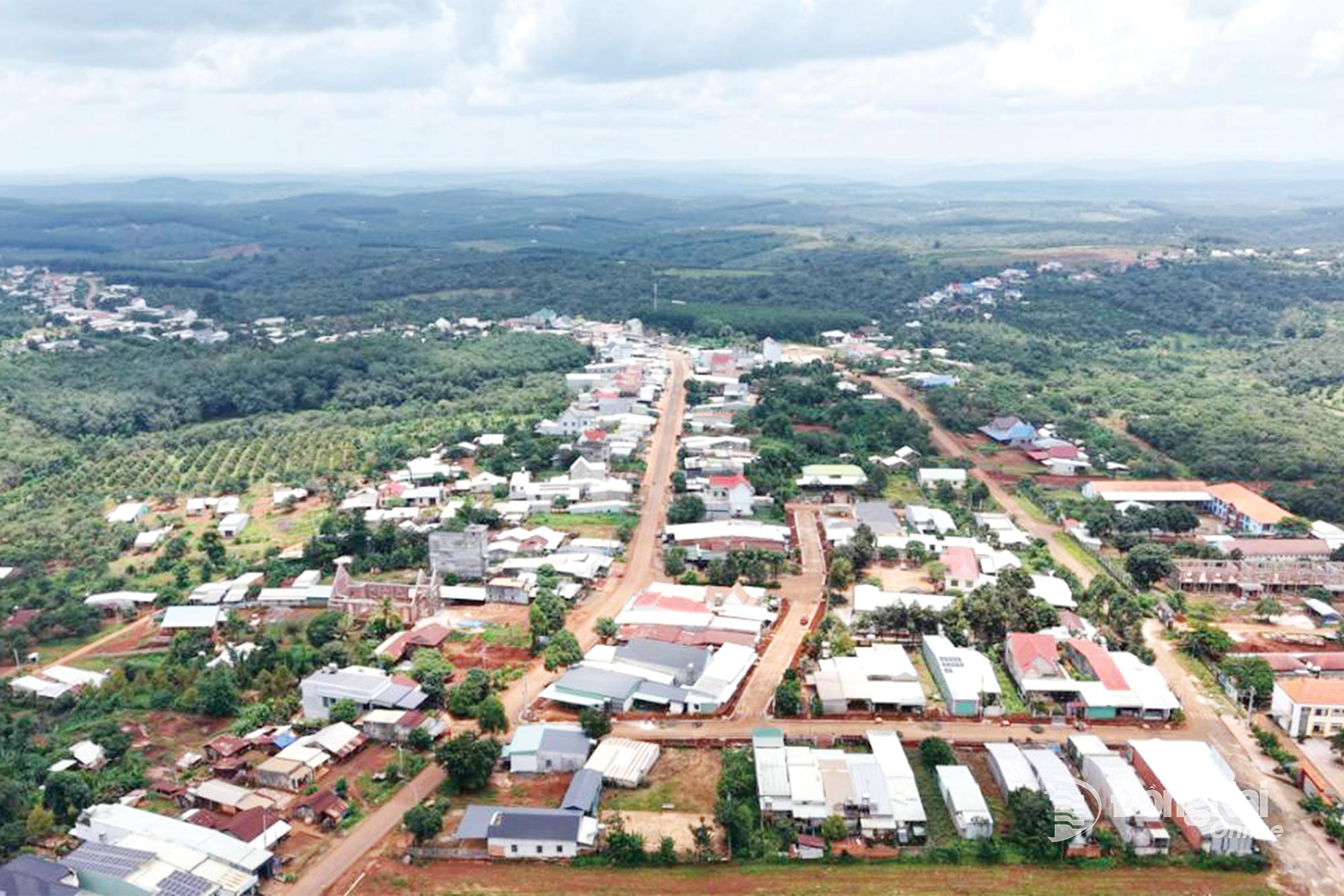 |
| Dak Nhau Commune strives to become an “advanced new-style rural commune” by 2030. Photo: Nhu Nam |
A story of soldier–civilian loyalty
The Nua Lon Base now lies within the boundaries of Hamlet 5, Dak Nhau Commune, Dong Nai Province. In the pivotal years between 1960 and 1965, this unassuming location was the starting point of a strategic corridor linking the major rear areas in the socialist North with the frontlines of the South. From this base, tens of thousands of southern cadres, soldiers, compatriots and their children would gather, first journeying north before flowing back to the battlefields. It was this relentless tide of movement and supply that would eventually carve the path for one of history's most legendary supply routes: the Ho Chi Minh Trail.
Dieu M'Rieng, a former Armed Security soldier in Region 10 and former Head of the Bu Dang District Party Committee's Propaganda and Training Commission in former Binh Phuoc province, is now in his seventies. He recalls that the The Nua Lon Base has now turned into lush cashew and rubber plantations. Time may have erased its traces, but he still remembers the dense primeval forest bridging the Central Highlands and southeastern Vietnam - a perfect location for a revolutionary base.
He recounts the story of mid-1960, when comrade Pham Thuan, known as Ba Thu, was tasked with leading an armed propaganda team to Bom Bo Village to establish contact with a northern working delegation sent to support the southern battlefield. After more than a month navigating the forest without success, and running out of supplies, Ba Thu returned to Dak Nhau to establish a base. Food was scarce; so each person survived on just half a tin of rice per day.
"The U.S. search-and-destroy operations were relentless back then," recalled Dieu M'Rieng said. "Our troops and the Bom Bo villagers had to pull back deep into the jungle. We were stretched so thin that a day's ration was just half a canteen of rice. That's how this place earned its name: the Nua Lon (Half-Can) Base."
Bom Bo had just thirty households then, and about eighty residents. At the base, by day, our men fought alongside the troops while the women gathered rice, corn, whatever could be found. At night, we'd all pound rice together by the light of dried bamboo torches, flickering in the dark. Each mortar was operated by 2–4 people taking turns pounding rice. When enemy planes buzzed overhead, we'd douse the flames and dive into bunkers. We could feel the people's love in every single grain of rice. We harvested grain still milky in the fields. Every handful mattered. Everything was done for the campaign, good logistics won the war.”
DIEU M’RIENG
In Dieu M Rieng’s memory, the year 1965 stands out. To prepare for the Dong Xoai–Phuoc Long Campaign, the Stieng people of Bom Bo (now Bom Bo Commune) followed the Party and President Ho Chi Minh into the base, mobilising mortars and pestles to feed the troops. In just three days and nights, they pounded five tons of rice, keeping soldiers well-fed and battle-ready. They also delivered nearly 2,000 baskets of rice and 80,000 cassava plants, set thousands of traps, and organised local forces to defend the hamlet, engaging in almost 50 skirmishes and neutralising hundreds of enemy troops.
A legacy preserved in words
The Nua Lon Base and its stories of courage and solidarity have inspired writer Vuong Thi Thu Thuy from Ho Chi Minh City to pen the novel Sacred Land. The book draws on tales from elder Dieu Len, a Bom Bo guerrilla honoured as a Hero of the Resistance War against the U.S. imperialism. He is the witness to the years when the S’tieng people and the soldiers shared every grain of rice, every cassava root, every dried corn cob in the deep jungle, eating just half a can of rice per day to save supplies for the troops.
"I am forever grateful to the people of Bom Bo from those years. Those humble, resilient people helped secure victory through their patriotism and their loyalty to the revolution. I wrote 'The Sacred Land' as a tribute, and I also hope the younger generation today, especially our youth, will understand and feel a greater pride in their homeland's history," Vuong Thi Thu Thuy shared.
 |
| Bom Bo people’s movement of revolutionary struggle during the resistance period. Photo: Archives |
La Van Hung, a teacher from Dak Nhau Primary School, notes that today the Nua Lon Base now is only a patch of forest bordering the new cashew and rubber plantations. Historical traces have faded, but the name and the heroic feats of soldiers and civilians are still remembered by successive generations. “Even if the base’s remains are no longer visible, I hope students know and take pride in our national history. S’tieng students, in particular, should remember exemplary heroes such as Dieu Xien, Dieu K’Ru (A), Dieu Doan, Ho Thanh Van… Their sacrifices and dedication built the proud legacy of our homeland,” he says.
The heroic land in the new age
The road to the Nua Lon Base today is a smooth ribbon of asphalt, winding through hills carpeted with verdant cashew and rubber plantations. Dak Nhau Commune, home to 13 hamlets and 26 ethnic groups, counts ethnic minorities at roughly 51.7% of its population. Covering over 182 square kilometres, the commune has more than 23,000 residents, with agriculture remaining its economic backbone.
The first Party Congress of Dak Nhau Commune (in the 2025–2030 period) has set two ambitious targets: an average annual growth of 10% in state budget revenue and a similar 10% rise in the total value of local products. To meet these goals, the commune is aggressively restructuring its agricultural output, expanding high-value crops such as fruit trees, rubber, and coffee, while developing industrial-style livestock farms. Extension services, veterinary support, and plant protection programs have been deployed effectively, boosting both yield and product quality.
For their significant contributions to the national liberation struggle, the people and armed forces of Dak Nhau were awarded the title Hero of the People’s Armed Forces on December 20, 1994.
Nguyen Trong Lam, Secretary of the Party Committee and Chairman of the People’s Council of Dak Nhau, explained that the local Party leadership has translated the development goals outlined in the draft documents of the first Party Congress (in the 2025–2030 period) into concrete action plans. The commune has identified five key tasks and four strategic breakthrough areas. These include comprehensive urban planning and infrastructure development, holistic rural modernisation with housing and social welfare improvements, agricultural restructuring with sustainable value chains and high-tech applications, and developing a highly skilled workforce while preserving and promoting local cultural heritage linked to tourism.
The recent administrative merger has unlocked Dak Nhau's potential, expanding its productive landscape and creating a new canvas for growth. This strategic shift allows the commune to finally leverage its resources and design policies that are both visionary and aligned with the people's aspirations. The commune is fostering closer regional ties with neighbouring districts and placing a strong emphasis on sustainable, clean, and efficient agriculture. High-quality agricultural products are seen as the key driver for raising living standards. With these strategies, Dak Nhau is on its way of becoming an advanced new-style rural commune by 2030 - a fully developed, culturally rich, and highly livable place.
By Dao Bang – Translated by Thien Kim, Thu Ha


Thông tin bạn đọc
Đóng Lưu thông tin