
On October 22, a working delegation from the Editorial Team under the Subcommittee in charge of Socio-Economic Affairs for the 14th National Party Congress, led by Tran Hong Quang, Vice President of the National Institute for Economics and Finance under the Ministry of Finance and Standing Member of the Editorial Team of the Subcommittee in charge of Socio-Economic Affairs, held a working session with Dong Nai province on several matters serving the tasks of the Subcommittee in charge of Socio-Economic Affairs.
 |
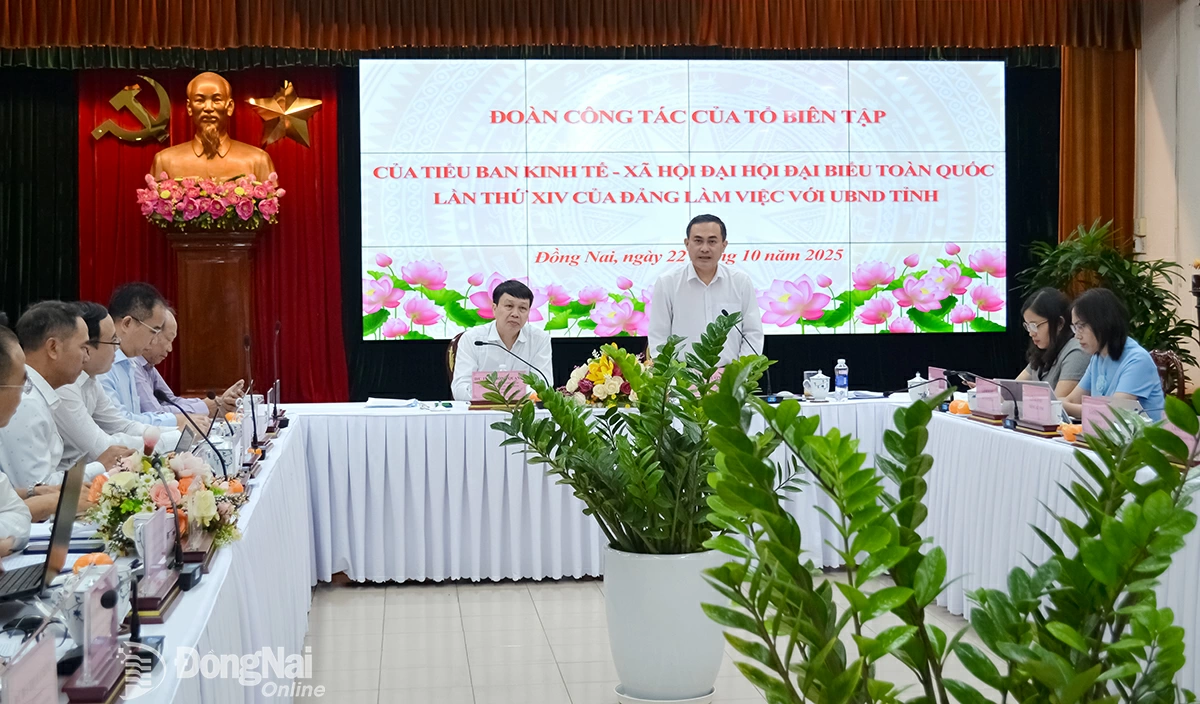
| Tran Hong Quang, Vice President of the National Institute for Economics and Finance, speaks at the working session. Photo: Phuong Hang |
Le Truong Son, Member of the Provincial Party Standing Committee and Vice Chairman of the Dong Nai Provincial People's Committee, chaired the working session with the delegation.
 |
| Le Truong Son, Member of the Provincial Party Standing Committee and Vice Chairman of the Dong Nai Provincial People’s Committee, speaks at the working session. Photo: Phuong Hang |
At the working session, leaders of the Department of Finance and several provincial departments and sectors briefed the delegation on solutions to promote Dong Nai’s economic growth to reach double digits in the 2026–2030 period; the results of implementing the three strategic breakthroughs during the 2020–2025 term and the orientation for 2026–2030 period; as well as the development status of industrial parks and economic zones in the province and the orientation for the 2026–2030 period.
Provincial leaders also introduced the delegation to Dong Nai’s current context following its administrative merger, highlighting the province’s advantages and new development spaces.
To support Dong Nai's development, on September 9, 2025, the Provincial People's Committee issued Document No. 4852/UBND-TH to the Ministry of Finance, providing feedback on the draft report for the adjusted National Master Plan for the 2021–2030 period, with a vision to 2050, in which Dong Nai's position and role were proposed.
 |
| Delegates attend the working session. Photo: Phuong Hang |
Specifically, Dong Nai province holds a position and role within the southern dynamic region, encompassing areas connected to Ring Road 4, the Moc Bai–Ho Chi Minh City Expressway, the Ho Chi Minh City–Thu Dau Mot–Chon Thanh Expressway, the Long Thanh–Ho Tram Expressway, and newly added zones around Tri An Lake. This addition aims to guide the province’s eco-tourism development, contributing to the formation of an industrial–logistics–tourism service linkage chain. The province also proposed further research on tourism development opportunities, including forests, rivers, waterfalls, valuable historical sites, and seaports, such as Long Thanh International Airport and Tan Son Nhat Airport.
In addition, Dong Nai proposed incorporating the Long Thanh–Hoa Lu economic corridor, connecting Long Thanh International Airport and the southern seaports of the province with the Hoa Lu Border-Gate Economic Zone, the Central Highlands, and ASEAN countries (Cambodia, Thailand, Laos). The province also recommended developing a transport route linking ASEAN countries (Thailand, Laos, Cambodia) through the Hoa Lu International Border Gate to Long Thanh International Airport, Phuoc An Port, and Cai Mep–Thi Vai Port, while establishing new dynamic urban centers with direct linkages to Ho Chi Minh City.
The province also recommended adding several regional linkage projects, including a passenger station on the North–South high-speed railway section running through Dong Nai (in Xuan Hoa commune); the Bien Hoa–Loc Ninh railway line connecting to Cai Mep Port and Can Gio Port; the Thu Thiem–Long Thanh urban railway project; the extension of Metro Line No. 1 (Ben Thanh–Suoi Tien) to Tran Bien ward (formerly Bien Hoa City) and Long Thanh International Airport; and additional expressway routes to enhance connectivity and expand the development space of the southern key economic region.
Moreover, Dong Nai proposed establishing a free trade zone in the province to leverage the advantages of Ho Chi Minh City’s financial center and Long Thanh International Airport.
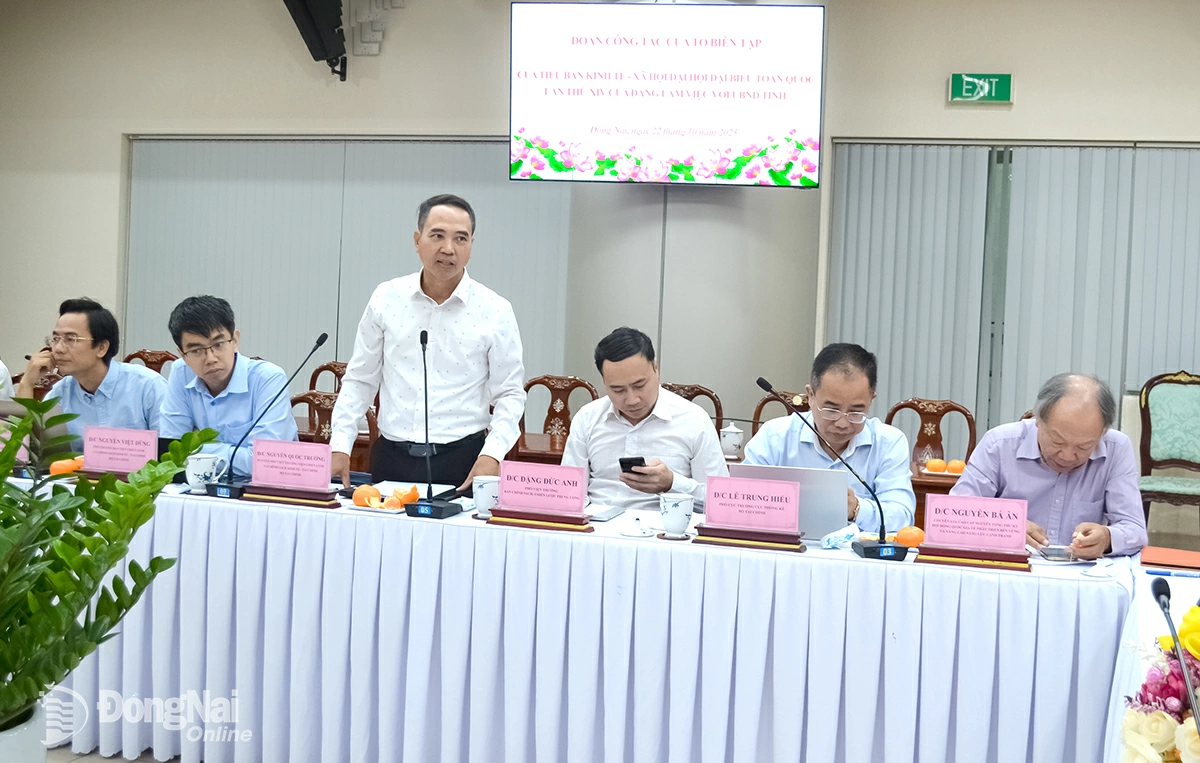 |
| Nguyen Quoc Truong, Vice President of the National Institute for Economics and Finance under the Ministry of Finance, speaks at the working session. Photo: Phuong Hang |
In the upcoming period, as Dong Nai adjusts its provincial planning, the province will redefine its overall growth drivers, restructure development areas, establish strategic economic corridors, and build dynamic growth zones.
To realize its development goals in the coming time, Dong Nai has proposed that the Central Government include in the Action Program for implementing the Resolution of the 14th National Party Congress the following key initiatives: the establishment of a Free Trade Zone in Dong Nai province; the introduction of special mechanisms and policies for the province; and the early review and study of both theoretical and practical aspects of local government organizational reform, particularly the two-tier local government model, to identify suitable solutions.
Furthermore, in setting national development goals and targets, the focus should not be solely on economic growth but also on improving people’s quality of life. Indicators related to housing, green spaces, healthcare, education, and access to online public administrative services should be regarded as essential criteria that comprehensively reflect the quality of development and the happiness of the people.
 |
| Truong Thanh Vu, Vice President of the Regional Planning and Development Department under the Ministry of Finance, speaks at the working session. Photo: Phuong Hang |
Dong Nai also proposed implementing uniform standards for core knowledge across all textbooks and separating textbooks from workbooks to prevent waste and allow for reuse.
The province emphasized the need for more effective environmental protection solutions to mitigate water and air pollution and to better address climate change in alignment with the Sustainable Development Goals. It also underscored the importance of robust measures and effective sanctions to address acts that cause environmental pollution.
Dong Nai also recommended clearly defining the responsibilities and authority among central, local, and grassroots levels, following the motto "locality decides, locality does, locality is responsible". These should be concretized through legal regulations to create the necessary framework and space for local development.
Comrade Tran Hong Quang, Vice President of the National Institute for Economics and Finance under the Ministry of Finance and Standing Member of the Editorial Team of the Subcommittee in charge of Socio-Economic Affairs for the 14th National Party Congress, said that through the working session with Dong Nai, the delegation gathered information about the province’s development orientations, particularly regarding the exploitation of the Long Thanh International Airport after its operation begins and the establishment of a Free Trade Zone in the province. He affirmed that Dong Nai’s proposals and recommendations will be reported to the Editorial Team of the Subcommittee in charge of Socio-Economic Affairs for the 14th National Party Congress for consideration, ensuring alignment with the province’s development direction while also promoting the growth of the Southeast region and the country as a whole.
By Phuong Hang – Translated by Dang Huyen, Minho


Thông tin bạn đọc
Đóng Lưu thông tin