
At the conference summarizing the implementation of Resolution No. 18-NQ/TW dated October 25, 2017, issued by the Party Central Committee on continuing to reform and streamline the organizational structure of the political system for greater efficiency and effectiveness, held by the Dong Nai Provincial Party Committee on October 14, Pham Thuy Luan, Member of Provincial Party Committee and Deputy Secretary of the Party Committee of the Dong Nai Provincial People’s Committee, stated that immediately after the administrative unit restructuring, the Dong Nai Provincial People’s Committee proactively issued administrative reform plans tailored to the requirements of the two-tier local government model.
The review, adjustment, and standardization of the entire administrative procedure system were swiftly implemented to ensure uniformity, openness, and transparency in processing matters for citizens and businesses, in alignment with the two-tier local government model. Based on this foundation, provincial departments, sectors, and commune/ward-level People's Committees proactively translated these efforts into action programs tailored to local realities.
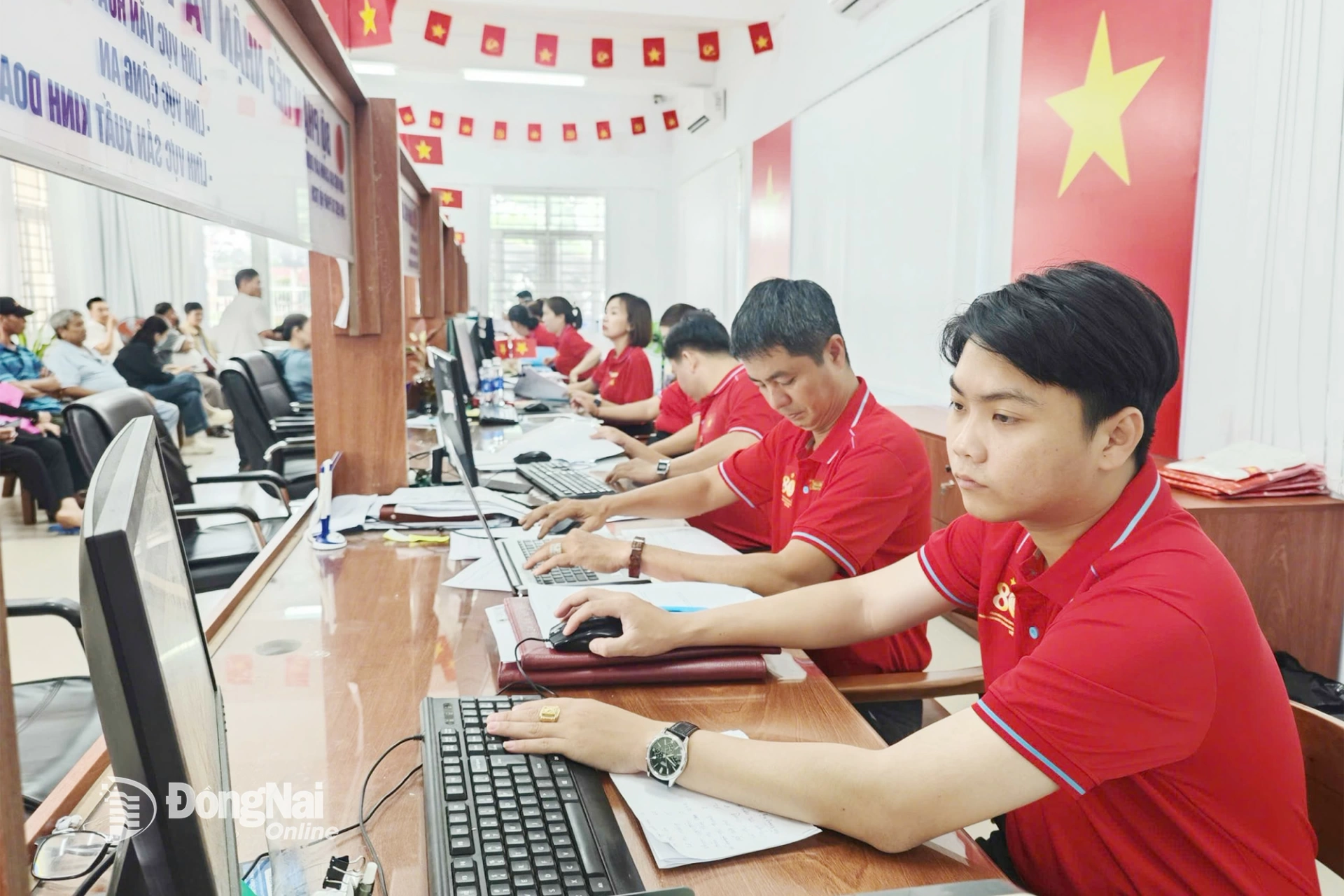 |
| Public Administrative Service Center in Xuan Hoa commune. Photo: Duc Quy |
At the same time, the province has implemented a range of innovative administrative reform models linked to public service accountability. Notable examples include: the “No Administrative Boundary Dependence” model; fee and charge reductions for using online public services; the “No-Appointment Administrative Procedure Settlement” model; the “30-Day Campaign to Increase Digitalization and Online Public Service Usage”; the “30-Day-and-Night Campaign to Accelerate the Disbursement of 2025 Public Investment Capital”; the expansion of 45 citizen identification and electronic ID account registration stations; the “90-Day-and-Night Campaign to Clean Up Marriage Data”; and the pilot of “Online Public Service Support Points” at 25 locations.
Thanks to the coordinated implementation of the above-mentioned reform models, after operating the two-tier local government system for over three months, Dong Nai province has seen clear progress in administrative reform. The quality of public services for citizens and businesses has significantly improved; the rate of online applications has risen sharply; data has been standardized, interconnected, and shared more efficiently; and administrative discipline and order have been further strengthened.
As a result, the province has achieved several notable outcomes: a total of 2,176 administrative procedures have been made public, of which 2,054 (94.39%) have been integrated into the National Public Service Portal. The rate of fully online public services exceeds 87%; the digitalization rate of dossiers reaches 97.85%; and nearly 99% of cases are resolved on time or ahead of schedule.
In addition to administrative procedure reform, the province has also vigorously advanced decentralization and delegation of authority. Dong Nai has coordinated with central ministries and sectors to implement decrees and circulars defining the division of powers among different levels of government. Based on this framework, the Provincial People’s Council has issued 43 resolutions covering areas such as organizational structure, personnel, finance, budgeting, and management authority in key sectors, including investment, construction, land, natural resources and environment, education, and healthcare. Granting more authority to grassroots levels has not only expedited administrative processing but also enhanced the initiative and accountability of commune-level authorities in serving the people.
Concurrently, following the administrative restructuring, the “new” Dong Nai province has vigorously promoted decentralization and delegation in key sectors, including investment, construction, land management, natural resources and environment, social welfare, education, and healthcare. The province has focused on reforming administrative procedures, simplifying and standardizing processes, and strengthening the accountability of commune-level authorities.
Since the implementation of the two-tier local government model, the Provincial People's Committee has carried out decentralization in four sectors: agriculture, education, construction, and finance. It is also in the process of finalizing procedures for decentralization in six additional areas, including agriculture and environment, construction, healthcare, and internal affairs.
In addition, the Provincial People's Committee has issued a decision authorizing the implementation of 14 specific tasks across various sectors, including internal affairs, agriculture and environment, culture, sports, and tourism, healthcare, science and technology, and industry and trade. These efforts have contributed to more streamlined, timely, and effective management and administration across the province.
By Phuong Hang – Translated by Dang Huyen, Minho


Thông tin bạn đọc
Đóng Lưu thông tin