
On the morning of September 2, 1945, at historic Ba Dinh Square, President Ho Chi Minh solemnly read the Declaration of Independence – an immortal epic that shattered the shackles of colonialism and feudalism, proclaimed the birth of the Democratic Republic of Vietnam, and granted the people independence, freedom, and happiness to realize the aspiration for strength and prosperity, stepping into a new era, the era of the nation's rise.
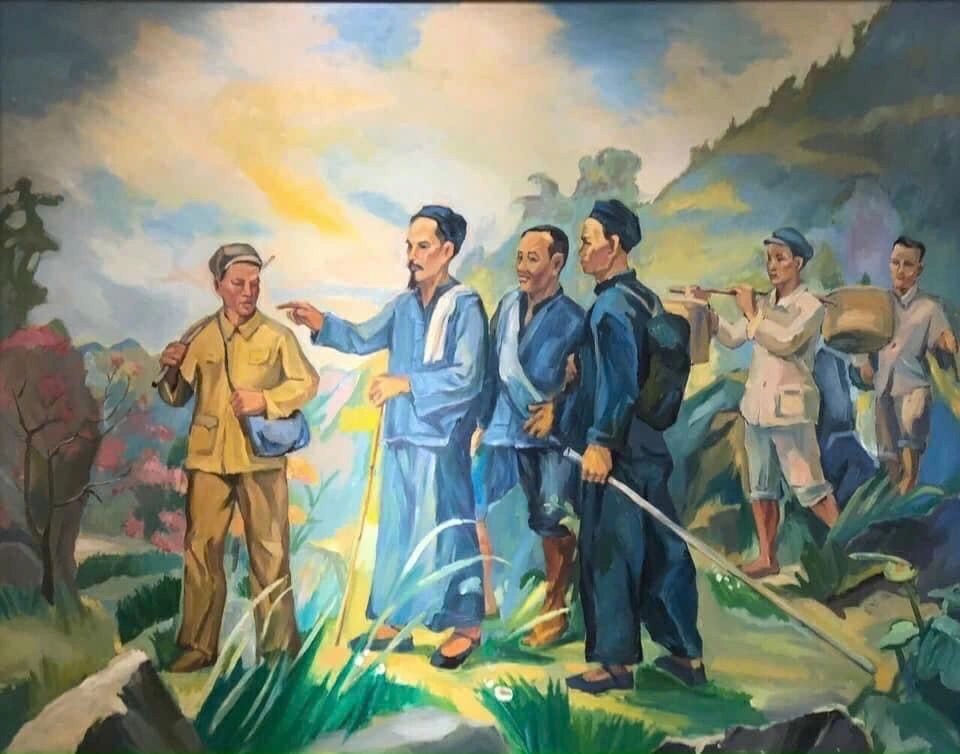 |
| After 30 years of traveling abroad in search of a path for National salvation, on January 28, 1941, leader Nguyen Ai Quoc and fellow revolutionaries returned to Pac Bo, Truong Ha commune, Cao Bang province to establish a revolutionary base in preparation for the general uprising. Painting: Trinh Phong |
The spirit of the Declaration of Independence was lit by President Ho Chi Minh from the revolutionary cradle of Pac Bo, Cao Bang (1941-1945) – a “red address” in the journey of National liberation. Dong Nai Newspaper and Radio, Television (DNNRTV) proudly presents a five-article series titled: “The spirit of the Declaration of Independence – Vietnam rises into a new era”, portraying the history of struggle for national liberation ignited by President Ho Chi Minh at Pac Bo, Cao Bang, leading to the sacred moment of reading the Declaration of Independence and the enduring lessons for building and defending the nation in the new era.
Part 2: Pac Bo – a “strategic base” spreading the banner of revolutionary struggle and the determined-to-win will
Following Vi Thi Thoa, a guide at the Pac Bo Special National Relic Site (Cao Bang), we walked along the Lenin stream, listening to the story of Spring 1941, when leader Nguyen Ai Quoc crossed milestone 108 to return to the homeland and chose Pac Bo as the revolutionary base. Amidst the deep green mountains and forests, history seemed to stretch from the Hong Kong Conference (February 1930) – where President Ho Chi Minh chaired the merger of communist organizations, founded the Communist Party of Vietnam, and drafted the first Political Thesis – to Pac Bo cave and the Khui Nam shack. Here, the Party’s revolutionary line for national salvation was secretly concretized among the people: training cadres, printing materials, building bases, and opening the “Southward path.”
 |
| Milestone 108, where Nguyen Ai Quoc and the revolutionary delegation set foot upon returning to the homeland on January 28, 1941, is still preserved intact. Photo: Truong Ha |
From the fire of Pac Bo, the movement spread across Viet Bac and advanced to the lowlands, so that by Autumn 1945 the nation stepped into independence and freedom with a shining truth: The people’s will and strategic terrain created revolutionary strength.
Pac Bo, a strategic revolutionary base, expanded nationwide
The terrain map of Pac Bo resembles a shield: Towering limestone mountains, intertwined caves, streams winding through cliffs, trails along slopes, and only a few kilometers from the border – close enough for ensuring international contact, deep enough for safe refuge when pursued. This “geographical advantage” was a crucial natural condition for Nguyen Ai Quoc to select Pac Bo as a base upon his return on January 28, 1941.
But mountains and forests alone were not enough. The essence was the people’s support.
 |
| The delegation of DNNRTV officials and reporters visit Pac Bo cave, where leader Nguyen Ai Quoc and Party cadres lived and worked during the early days of revolutionary activities. Photo: Truong Ha |
According to Thoa, even before President Ho Chi Minh returned to the country, the border region of Cao Bang, especially Ha Quang, Hoa An, and Nguyen Binh districts, had long seen resistance movements against feudal lords and collaborators since the early 20th century, along with the Vietnam Revolutionary Youth League and later various salvation organizations. Tay, Nung, and Dao people wholeheartedly sheltered cadres, “living among the people, relying on the people to operate.” This factor of “human harmony” turned geographical advantage into strategic strength. From Pac Bo, President Ho Chi Minh could observe the situation, test strategies, and more importantly, lead the movement from the cradle of rural-mountainous areas down to the lowlands.
President Ho Chi Minh assessed: “The Cao Bang base will open great prospects for our revolution. Cao Bang has had strong movements before, and it is close to the border, which is very convenient for international communication. But from Cao Bang, the movements must be expanded to Thai Nguyen and further south to connect with the rest of the country. Only by linking with Thai Nguyen and the entire nation can we attack during favorable times and hold our ground under difficult circumstances.”
 |
| DNNRTV delegation visit the area showcasing President Ho Chi Minh’s activities at Pac Bo Special National Relic Site in Cao Bang. Photo: Truong Ha |
Pac Bo was the “starting point” of major decisions in the 1941-1945 period; where the Party’s line met practice, so that documents did not remain on paper but turned into material forces: organizations, people, and bases. The combination of strategic terrain and people’s support answered why Pac Bo was chosen and why from here the “flame” could spread endlessly.
The Viet Minh movement advances Southward
To implement strategic tasks of National liberation, in May 1941, President Ho Chi Minh convened the 8th Central Conference at the Khui Nam shack, completing a strategic shift: Placing national liberation above all, founding the Vietnam League for Independence (or Viet Minh Front), building bases, and preparing for armed uprising. In other words, from the “Red Thesis” of 1930, by 1941 the revolutionary program “touched the ground” at Pac Bo.
 |
| Member of the Provincial Party Committee, Editor-in-Chief of DNNRTV Nguyen Thi Minh Nham visits Khui Nam shack, where leader Nguyen Ai Quoc chaired the 8th Central Conference. Photo: Truong Ha |
In early mornings, guide Vi Thi Thoa would recite Ho Chi Minh’s verses to visitors as a shared memory of generations: “Morning by the stream, evening in the cave / Cornmeal porridge, bamboo shoots always ready / On a wobbly stone table translating Party history / A revolutionary life is truly rich…”, which recreated the past: from the deep forest, a “revolutionary general staff” once met, drafted documents, built networks, and ran training classes, each small link was then combined into a vast organized movement, getting ready to act when opportunity arrived.
After the 8th Conference (May 19, 1941), the Viet Minh Front officially came into being. President Ho Chi Minh and Party cadres urgently organized political-military-mass work training; printed materials, leaflets, and manuals; and published Vietnam Doc Lap Newspaper – the famous organ of the Viet Minh, compact, easy to distribute, simple yet sharp in content, “saying what the people thought, writing what the people needed,” reaching every hamlet.
From training classes in Pac Bo and Khui Nam, dozens of liaison officers, organizers, and propagandists fanned out to Bac Kan, Thai Nguyen, Lang Son…, gradually opening “Southward arteries” along two routes: Through Viet Bac (Thai Nguyen, Tuyen Quang, Bac Kan) via Routes 3 and 4 down to the midlands, north of the Red River, connecting to Hanoi, Haiphong, Nam Dinh… This was the special “cadre route” of the pre-August Revolution period: Small-scale yet effective, compact yet deep. They carried the line, documents, methods of mass work, founded salvation associations, developed self-defense units, and prepared the uprising nucleus.
Many early revolutionaries such as Vo Nguyen Giap, Pham Van Dong, Hoang Van Thu, Hoang Quoc Viet… were closely tied to Pac Bo, Cao Bang in different stages of the struggle. From here, the national salvation path was passed hand to hand, not only through rational argument but also through the strength of exemplary action. Pac Bo was therefore a school for cadres, an editorial room, a printing press, and a “mobile evacuation hub” whenever circumstances changed. Cadre teams would cross forests and streams, work alongside farmers, persistently laying the groundwork of rural strength surrounding urban centers, leading the movement Southward by gradual absorption.
From Pac Bo, leader Nguyen Ai Quoc and the Party Central Committee established and led the Viet Minh, proving a practical truth: propaganda, organization, and action form an inseparable chain. Training without outreach is “self-learning.” Outreach without organization is “spontaneous movement.” Organization without people’s support will soon collapse. At Pac Bo, these three links interlocked seamlessly, driving the “Southward path” – from mountains to plains, from bases to cities.
Tran Hung Dao forest – the cradle of revolutionary armed forces
If the Viet Minh was the political-mass front, then the armed force was the revolution’s fist. On December 22, 1944, under leader Nguyen Ai Quoc’s directive, the Vietnam Propaganda Liberation Army Team was established at Tran Hung Dao forest (Nguyen Binh district, Cao Bang) under Vo Nguyen Giap’s command, initially including 34 fighters. Within just two days, the team won successive victories at Phai Khat (December 25) and Na Ngan (December 26), liberating enemy posts, seizing weapons, and inaugurating the tactic of “sure strike, sure win”, small-scale guerrilla but with strategic impact.
The link between Pac Bo (Ha Quang) and Tran Hung Dao forest (Nguyen Binh) was not only geographic but organizational logic: Correct line – solid bases – trained cadres – available weapons – people’s protection. At Pac Bo, training, propaganda, and organization shaped the cadre’s political backbone; at Nguyen Binh, armed struggle proved combat ability and public morale. The first victories not only eliminated enemy forces but also inspired the masses, attracted youth enlistment, and strengthened belief in uprising.
 |
| The stone table in the upper reaches of Lenin stream, where leader Nguyen Ai Quoc often worked during his days in Pac Bo (Cao Bang) to secretly build the revolutionary base. Photo: Truong Ha |
The Vietnam Propaganda Liberation Army Team later grew, merging into the Vietnam Liberation Army, then the National Defense Army, and eventually the Vietnam People’s Army. It can be said that the “birth” of the revolutionary army in Cao Bang was a turning point: From armed propaganda to organized armed struggle, from scattered bases to concentrated forces, paving the way for decisive blows when the General uprising opportunity came.
According to memoirs of To Vu Dau, from Vinh Quang commune, Hoa An (now Nung Tri Cao ward), one of the 34 fighters of Vietnam Propaganda Liberation Army Team: Marching through forests and crossing streams, soldiers camouflaged by day and advanced under the cover of night; villagers prepared hot water and rice balls at “rendezvous points” in the forest; while children kept watch at field edges. All combined into a young but effective resistance front. Above all, discipline was built upon the soldiers’ and people’s self-discipline. When people’s hearts are transformed into organizational will, a base was no longer just a dot on the map, but the living space of the revolution.
 |
| Lenin stream and Karl Marx mountain at the Pac Bo Special National Relic Site, Truong Ha commune, Cao Bang province. Photo: Truong Ha |
Looking back at the armed achievements of 1944-1945 period in Cao Bang cannot be separated from the political preparation of 1941-1943 period at Pac Bo. Without core cadres, broad bases, people’s trust, and clear line, there could not have been a 34-strong force daring to strike two enemy posts within 48 hours. Without that spirit, there could hardly have been the August glory just half a year later.
From Pac Bo, the map of revolution traced the path to independence and freedom as a logical sequence: the birth of the Party (1930) – Correct line – Revolutionary base (Pac Bo, 1941) – the birth of Viet Minh – Armed forces (1941-1944) – Preparing to seize the opportunity (1945) for the general uprising to win power for the people.
Pac Bo taught us a simple but fundamental truth: A correct revolutionary line only becomes strength when it stands on the people’s feet and trust and relies on a wise strategic use of the terrain. The people’s support turned forests into fortresses, bamboo shacks into command posts, people’s houses into secret and solid logistics stations and grassroots Party organizations. Meanwhile, terrain helps mitigate disadvantages, maintain communication, expand influence, and create a mobility advantage. These elements combined into the strength of Pac Bo, facilitating a small revolutionary base to generate great vitality, spreading and nurturing the national liberation movement nationwide.
Journalist DOAN NHU VIEN, Vice Chairman of Dong Nai Journalists’ Association
Leaving Pac Bo in a misty afternoon, we recalled a saying often cited in documents: Pac Bo was where the Party’s line and organization entered the people’s hearts. Indeed, from the Huong Cang Conference to the Khui Nam shack, from Vietnam Doc Lap (Independent Vietnam) Newspaper to the Vietnam Propaganda Liberation Army Team, from the Cao-Bac-Lang bases to the victorious autumn, the line was built on the people’s support, creating the great unity strength of 54 ethnic groups. And when the people’s hearts and minds combined with the strategic revolutionary terrain, history could only follow one course: the struggle for independence – freedom - happiness would triumph.
By: Truong Ha
Translated by: M.Nguyet-Thu Ha


Thông tin bạn đọc
Đóng Lưu thông tin