
On the morning of September 2, 1945, at historic Ba Dinh Square, President Ho Chi Minh solemnly read the Declaration of Independence – an immortal anthem that broke the chains of colonialism and feudalism, proclaiming the birth of the Democratic Republic of Vietnam. It was the moment the entire nation won independence, freedom and happiness, demonstrating the aspiration for strength and entering a new era of national rise.
The spirit of the Declaration of Independence kindled by President Ho Chi Minh since the revolutionary base of Pac Bo, Cao Bang (1941–1945) – a “red address” in the journey for national liberation. Dong Nai Newspaper and Radio-Television proudly presents this five-article series titled “The spirit of the Declaration of Independence – Vietnam rising into a new era,” portraying the history of struggle for national liberation ignited by President Ho Chi Minh at Pac Bo, Cao Bang, leading to the sacred moment when he read the Declaration of Independence and the enduring lessons for building and defending the nation in the new era.
Part 1:
Nguyen Ai Quoc – From Congress on CPV establishment to the revolutionary flame at Pac Bo
Amid the mountains and forests of Pac Bo, listening to the gentle murmur of Lenin Stream by the stone table where Ho Chi Minh once worked, and the deeply moving stories of Vi Thi Thoa, a guide at the Pac Bo Special National Relic Site, it becomes clear that the Autumn Revolution of 1945 did not break out by chance. It was the result of a resolute, years-long and strategic preparation, beginning with the conference held in Huong Cang (now Hong Kong, China) on February 3, 1930, where Nguyen Ai Quoc presided over the founding of the Communist Party of Vietnam and drafted the first political platform. That document laid the ideological foundation for his return to Pac Bo in January 1941 to build a revolutionary base and prepare for a nationwide uprising, opening a new era for the Vietnamese people.
Crisis of political line and the emergence of President Ho Chi Minh under new banner
After World War I, Vietnamese society experienced profound shifts: French colonialists intensified exploitation of their colony, creating a pool of working class, peasants, and a Western-educated intelligentsia. However, under harsh repression, earlier patriotic movements led by feudal or bourgeois nationalists all failed. The Dong Du Movement (1905–1909) led by Phan Boi Chau was exposed and many patriots were arrested. The Duy Tan Movement (1906–1908) initiated by Phan Chau Trinh, advocating moderate reform, was also crushed. The Yen Bai Uprising (1930) by the Vietnamese Nationalist Party ended in bloody defeat, with hundreds executed and thousands imprisoned.
The common feature among these failed movements was the absence of a sound revolutionary path and a leadership organization with sufficient credibility and stature to unite the masses. In his article “The revolutionary path of the Indochinese Communist Party,” published in Historical Studies Journal, Issue 3, 1961, historian Tran Van Giau wrote: “In such a context, our people needed a new leadership, a new direction, and a new organization capable of uniting the nation and leading the revolution to victory.”
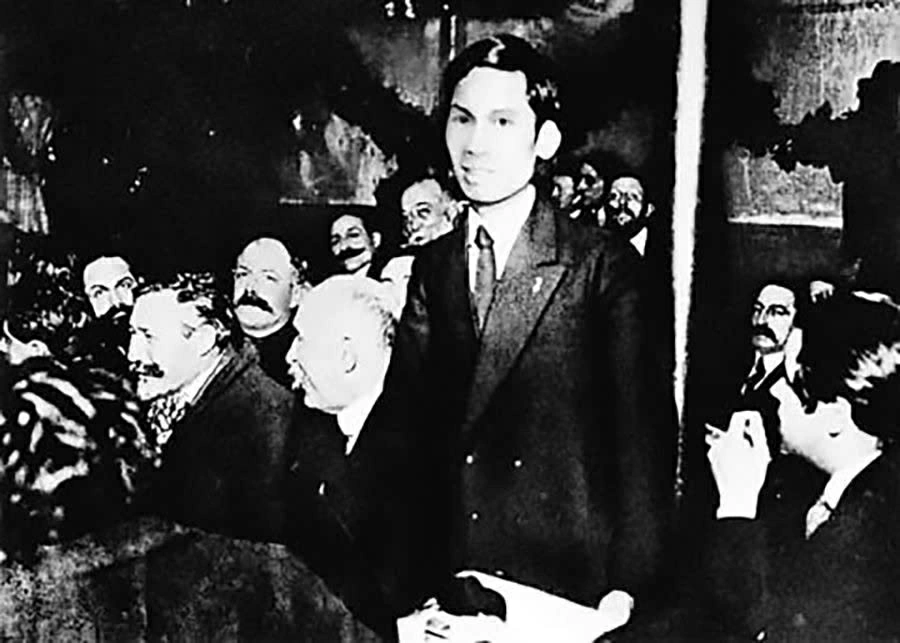 |
| From December 25 to 30, 1920, Nguyen Ai Quoc attended the 18th Congress of the French Socialist Party in Tours city as a delegate from Indochina. Photo: National Museum of History |
It was in this context that Nguyen Ai Quoc – the young patriot who left the country in 1911 to seek for a path to national salvation – brought the light of Marxism-Leninism to the Vietnamese revolution. With strategic vision and tireless preparation, he united the communist organizations and led the movement to a historic turning point.
February 3, 1930 marked the birth of CPV, ending the crisis of political line
In February 1930, under the authorization of the Communist International, Nguyen Ai Quoc convened and presided over a conference to unite Communist organizations in Kowloon (Hong Kong). With his his prestige, intelligence, and courage, he persuaded the delegates to put aside differences and unite under one party – the Communist Party of Vietnam (CPV) – on February 3, 1930. The conference passed the Party’s Brief Political Platform, Brief Policy and Brief Statutes, all drafted by Nguyen Ai Quoc and regarded as the Party’s first Political Platform. The documents defined a strategic goal: to overthrow French imperialism and feudalism, achieve complete independence, and advance toward socialism. Immediate tasks included confiscating land from imperialists and Vietnamese traitors to distribute to poor peasants; establishing an 8-hour working day; ensuring gender equality; and promoting universal education. The revolutionary forces were mainly rooted in workers and peasants, in alliance with the petty bourgeoisie, intellectuals, and middle peasants, while gaining support from rich peasants and national capitalists. The method of revolution was armed struggle led by the masses to seize power.
 |
| Duong Kach Menh (The Revolutionary Path) is a collection of lectures delivered by Nguyen Ai Quoc at the training courses for cadres of the Vietnam Revolutionary Youth Association, held in Guangzhou (China) in 1925–1927 period. Photo: VNA |
In the book “Political platform – Ideological and theoretical flag guide our revolution path” by Prof. Nguyen Phu Trong, it is affirmed that the first Political platform clearly defined the goals and direction of the Vietnamese revolution, combining national liberation with the role of workers and peasants. Thus, the conference in Hong Kong, China not only ended the prolonged ideological crisis in Vietnam’s patriotic movement but also opened up a new era in national history – the era of national liberation associated with socialism.
Ho Chi Minh’s thought – “Taking people as the root”
At the Congress on the CPV establishment, Nguyen Ai Quoc emphasized: “Revolution is a shared undertaking of the whole nation, not the work of one or two individuals.” This was not just a statement emphasizing the role of the masses, but also an organizational principle and a method of action. From then on, all Party strategies focused on awakening, organizing, uniting, and mobilizing the people's strength. That ideology has become the guiding principle from the August Revolutionary in 1945, to resistance war against French colonialists and American imperialists, to today’s renewal and integration.
 |
| The Congress on the CPV establishment was held on February 3, 1930. Photo of painting by Phi Hoanh displayed at National Museum of History. |
Throughout the process of building the Party and developing the revolutionary movement, Ho Chi Minh’s philosophy on the central role of the people served as a guiding principle behind all Party’s strategies to lead the revolution to success. Looking back at history, it was precisely through the consensus and active participation of the people that the Party could lead revolutionary movements successfully – from uprising to seize power in the August Revolution to the struggles against colonialism, imperialism, and feudalism. This thought has become a core principle in all the Party’s political, military, and social strategies.
The founding of the CPV and its first Political Platform marked a historic turning point, ending a crisis of political line and opening a new era of national liberation. Ho Chi Minh’s philosophy of “taking people as the root” laid the groundwork for the Party to rally forces and build a great national unity bloc. Cao Bang – a land rich in patriotic tradition – became a vital revolutionary base, where Ho Chi Minh directly led the movement and prepared for the general uprising to seize national independence.
More than 95 years later, that philosophy remains the guiding principle for the cause of national building and defense. The CPV continues to lead the country forward, safeguarding independence and sovereignty, and promoting sustainable development in the new era. The Political Platform of February 3, 1930, remains not only a historic legacy but an eternal source of inspiration, guiding today’s and future generations forward.
By: Truong Ha
Translated by: Thuc Oanh - Thu Ha


Thông tin bạn đọc
Đóng Lưu thông tin