
PART 4
DEVELOPING VIETNAM’S SOCIALIST MODEL
History’s lessons have always played a crucial role, yet, they only become truly invaluable when guided by a far-sighted strategic political vision. Otherwise, they risk turning into barriers, binding us when circumstances have already changed.
Studying history is not merely about remembrance, but more importantly, it is about recreating history and risng beyond it to move forward.
Drawing lessons from practice
The success of nearly 40 years of national renewal has proven that it is the natural outcome of solving the pressing tasks of the nation, steered by a practical political vision attuned to the contemporary world. At its core lies the protection of the country’s supreme interests, balanced with humanity’s timeless aspiration for peace and progress.
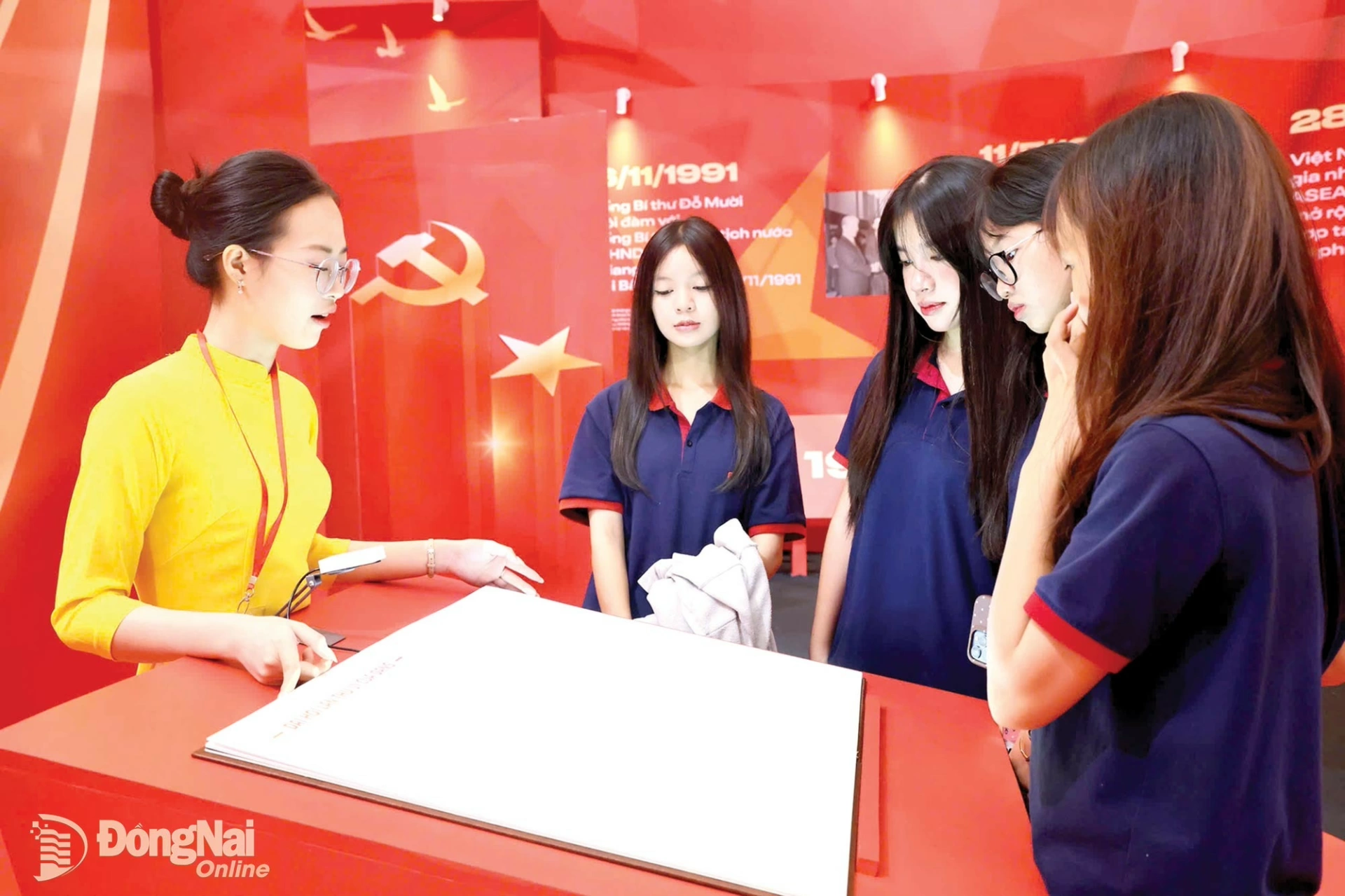 |
| Exhibition “95 Years of the Party Flag Lighting the Way” in the capital city of Hanoi. Photo: Cong Nghia |
Constant changes of worldview significance give rise to new disciplines and knowledge, as well as new concepts and ideas that necessitate changes in vision and decision-making, even at the strategic level, when concrete conditions and contexts of history have shifted, even becoming entirely different from before.
Theoretical development after nearly 40 years of national renewal
Rooted in our era, on Vietnamese soil, and especially from the achievements of almost 40 years of national renewal, we must continue addressing key following methodological issues.
“Focusing on building the Vietnam’s socialist model, with special emphasis on developing socialist people, thereby laying the foundation for constructing a socialist society as outlined in the Party Platform (prosperous people, strong nation, democracy, fairness, and civilization, under the people’s ownership, state management, and the leadership of the Communist Party.)”(1)
Party General Secretary To Lam
First, it’s necessary to provide a scientific argument on today’s era; on capitalism, and on the inevitability, practicality, and prospects of global socialism in the contemporary world context, driven by the momentum of the 4th Industrial Revolution.
Second, efforts should be made in studying and clarifying both the universal and the particular, the common and the specific, in the diverse paths toward socialism, followed by properly defining the model and pathway, identifying accurately the true driving forces, and logically outlining feasible stages and steps for advancing toward socialism, skipping the capitalist stage in Vietnam’s socialist construction.
Third, on the methodological level, it is necessary to develop a comprehensive and historical perspective; at the same time, to independently and creatively analyze concrete realities in specific historical situations regarding the entire theory, practice, and prospects of socialism, viewed within the organic and complex interconnections of today’s world. In particular, there’s a need to clarify the relationship of compatibility and relativity, unity and struggle, opposition and partnership… between socialism and capitalism, thereby refining the methodology for researching and developing the theory of renewal.
Fourth, it’s imperative to critically inherit the accumulated theoretical achievements while also assimilating global advances in political theory, with an open and receptive attitude, neither avoiding nor fearing them.
Fifth, it is a must to resolutely combat and eliminate subjectivism, voluntarism, dogmatism, and opportunism in theoretical research, organization, and practical review; while, on the other hand, rejecting all pragmatic or populist manipulations in political theory research, in order to build and develop the nation’s political line.
That is the responsibility of theoretical development after nearly 40 years of national renewal as we step into a new era. But what needs to be done, and how?
In particular, throughout the 20th century and the first 2 decades of the 21st century, the boom of scientific and technological revolutions, the development of the knowledge economy in its scale, nature, and depth, and the trend of globalization have upended the world, making these issues urgent tasks for the development of socialism in Vietnam. In other words, the boom of the digital age, artificial intelligence, the Internet of Things, and globalization driven by the knowledge economy – advancing at a pace “where one day equals a hundred years” – have been placing before our nation new responsibilities that are increasingly immense, complex, and challenging.
Therefore, in the future, it is essential to think and act independently in response to the call of sustainable and humane development, with science and technology – especially high technology – as the driving force. This requires us to master and harness it, to develop in a shortened, creative, and appropriate way. That is the challenge for theoretical development after nearly 40 years of national renewal.
(to be continued)
Dr. Nhi Le, former Deputy Editor-in-Chief of Communist Review
Translated by: Quynh Giao - Thu Ha


![[Photo series] Admiring the most beautiful riverside road in Dong Nai before its technical traffic opening](/file/e7837c02876411cd0187645a2551379f/012026/nen_20260114174655.jpg?width=500&height=-&type=resize)
Thông tin bạn đọc
Đóng Lưu thông tin