
Distorting the Party’s history is one of the psychological and ideological warfare activities frequently employed by hostile forces. Among their key tactics is revising and distorting the historical and epochal significance of the August Revolution 1945 in an attempt to downplay the stature and leadership role of the Party.
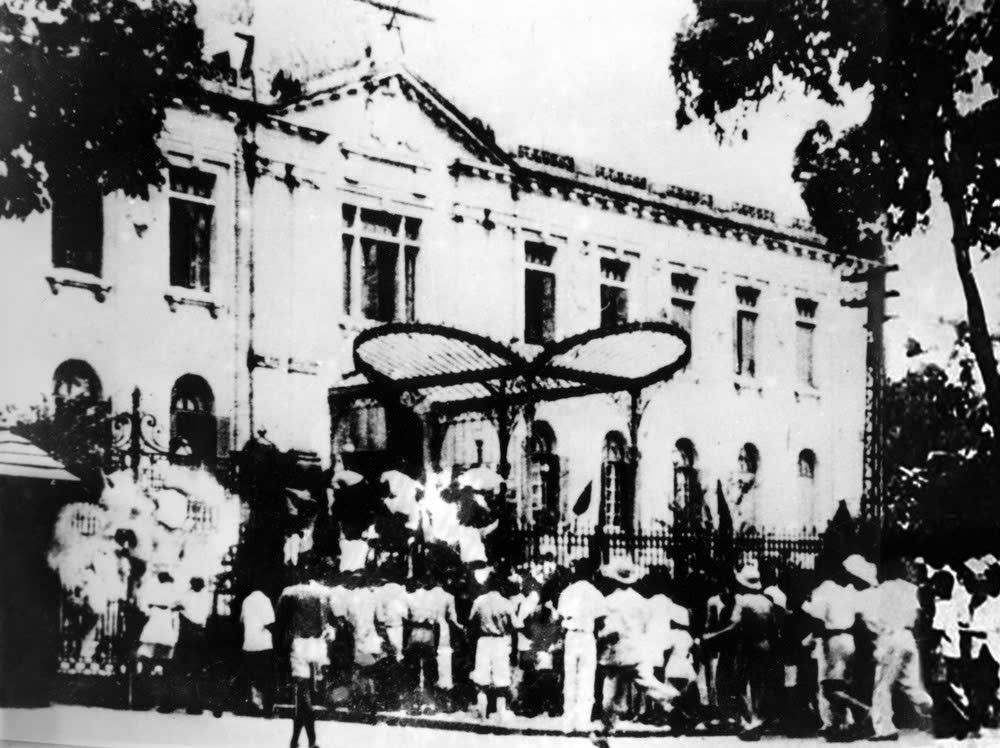 |
| On August 19, 1945, following a mass rally at the Hanoi Opera House Square, the people of the capital stormed the Bac Bo Palace, the headquarters of the French puppet government in the North. File photo: VNA |
Distorting the great achievements of the August Revolution 1945
A typical case can be found in the book “The Vietnamese Revolution of 1945 - Roosevelt, Ho Chi Minh and de Gaulle in a World at War” published in 1991, in which the author Stein Tonnesson argued: “By creating a power vacuum, the great powers overturned the entire situation and thereby invited the Viet Minh to seize power.”
Based on S.Tonnesson’s view, in recent years, forums of reactionary organizations inside and outside the country have repeatedly claimed that when Japan surrendered, France fled, and Allied troops had yet to enter Indochina, a so-called “power vacuum” was created, giving the Communist Party of Vietnam the opportunity to seize power. From that, they distortedly conclude that the August Revolution was merely a “mistake of history,” a success born of “luck” that established an unconstitutional, illegitimate government.
However, both theoretical and practical foundations demonstrate the correctness of the path and revolutionary methods chosen by President Ho Chi Minh and the Party, leading to the general uprising to seize power in 1945.
From a theoretical perspective, Marxism-Leninism laid out different methods for revolutionary struggles for class and national liberation. Karl Marx and Friedrich Engels wrote: “A people that wants to win its independence does not restrict itself to conventional methods of warfare. Mass uprisings, revolutionary wars, guerrilla forces everywhere – this is the only way by which a small nation can defeat a large one, a weaker army can confront a stronger and more organized one.” Building on these ideas in the era of imperialism, Lenin further clarified the issues of circumstances and timing for uprisings to seize power, as well as the combination of political and armed struggle.
Based on the law of class struggle and a correct assessment of the nature of the bourgeoisie, the classical Marxist-Leninist theorists have pointed out the path and methods for the proletariat and working people to rise and liberate themselves. That is the path of organized popular struggle through violence, combining political and armed struggle, progressing from uprisings to a general insurrection to seize revolutionary power into the hands of the workers and peasants.
Defining the path to national salvation and independence
Applying Marxist-Leninist thought to the context of a colonial country like Vietnam, leader Nguyen Ai Quoc early recognized the necessity of organizing the masses to struggle along the revolutionary path to ultimately to seize power. This view was formed as early as 1921 in his article Indochina for The Communist Magazine, in which leader Nguyen Ai Quoc affirmed that systematic poisoning by capitalism could not paralyze the revolutionary spirit of the Indochinese people. In other words, “The brutality of capitalism has prepared the ground; socialism now only has to sow the seeds of liberation.”
In The Revolutionary Path (1927), leader Nguyen Ai Quoc continued: “If Vietnamese workers know how to organize, the Red International will wholeheartedly help them make revolution. But before seeking help, we must help ourselves first” and “For liberation, nations can only rely on themselves, on their own strength.” As he stated: “A nation that does not stand on its own feet, that sits waiting for others’ help, is not worthy of independence.”
From a practical perspective, looking at historical reality since the French colonial invasion, it is clear that those relying on foreign assistance to seek power or independence failed. From Ton That Thuyet’s attempt to seek aid in China in 1886, to Phan Boi Chau, who went to Japan to seek both assistance and learning with the perspective that Vietnam and Japan “were of the same culture, race, and region”, and even figures like Luong Van Can and Phan Chau Trinh, who only requested the French to implement reforms, all ended up in failure. The failures of the aforementioned paths to national salvation revealed that national independence could not be achieved through peaceful means or by waiting for the enemy to “show mercy” and “grant independence.” It could only be realized by relying on our own strength and the power of the masses to wage the struggle through revolutionary violence.
Raising high the banner of national independence associated with socialism
On this theoretical and practical basis, in the Political Thesis of February 1930, leader Nguyen Ai Quoc and the Party raised the banner of national independence associated with socialism: “Carrying out the bourgeois-democratic revolution and the agrarian revolution to move toward a communist society”, by employing the method of uprisings to gradually progress to a general insurrection, a unique, creative, and practical path suited to Vietnam’s realities and the urgent demands of its people. From there, the Party united the nation, with the worker-peasant alliance as the driving force, to carry out a revolution against imperialism and feudalism, fulfilling the two strategic tasks of national independence and land for peasants, aiming toward a communist society, beginning with socialism.
Right after World War II broke out, at the 6th Plenum and 7th Plenum of the Party Central Committee in November 1939 and in November 1940 respectively, the Party analyzed domestic and international conditions, contradictions, and revolutionary tasks, adjusting its line and methods of struggle, prioritizing the mission of national liberation and focusing efforts on fighting imperialists and their collaborators.
After the 8th Plenum of the Party Central Committee in May 1941, efforts to build revolutionary forces, launch movements against the French and the Japanese, and prepare for an uprising to seize power took place vibrantly across the country. As the conditions for a general uprising were not yet ripe, the Party adopted the policy of liberating areas step by step, expanding base zones, sustaining and broadening guerrilla warfare, and vigorously launching the anti-Japanese, national salvation movement. One of the key tasks directed during this period was mobilizing the masses to “break open rice warehouses to fight famine.” This strategic decision was both practical and closely aligned with the urgent, legitimate aspirations of the people, serving as a catalyst to accelerate the revolutionary offensive when the opportune moment arrived.
Amid the rapid developments of the global and domestic situation, from August 13 to 15, 1945, in Tan Trao (Tuyen Quang), the Party decided to launch and lead a nationwide general uprising to seize power from the Japanese fascists before Allied troops entered Indochina. With firm determination, the Party declared: “Now the time is ripe, no matter how sacrifice we have to devote, even if we have to burn the whole Truong Son Mountain range, we must be determined to gain independence.” Responding to the call of the Party and Leader Nguyen Ai Quoc, the entire nation rose up to overthrow the Japanese fascists and their puppet regime.
The Party led the people through 15 years of struggle and three major revolutionary waves (1930–1931, 1936–1939, 1939–1945), enduring immense hardship and sacrifice to prepare in ideology, organization, and forces for seizing power.
The brilliant success of the August Revolution was thanks to the art of choosing the right method and the Party’s thorough preparation. The August Revolution stands as one of the greatest victories of the Vietnamese people under the Party’s leadership, an undeniable truth. Distortions and falsification of historical truth only serve to make the triumph of the August Revolution even more magnificent.
By: Minh Vuong – Phuong Tinh
Translated by: M.Nguyet-Thu Ha


Thông tin bạn đọc
Đóng Lưu thông tin