
In preparation for the Dong Nai Provincial Party Congress for 2025-2030 term, the Provincial Standing Party Committee has directed the drafting of the political report to be presented at the congress and organized the collection of public feedback on the draft document in accordance with regulations.
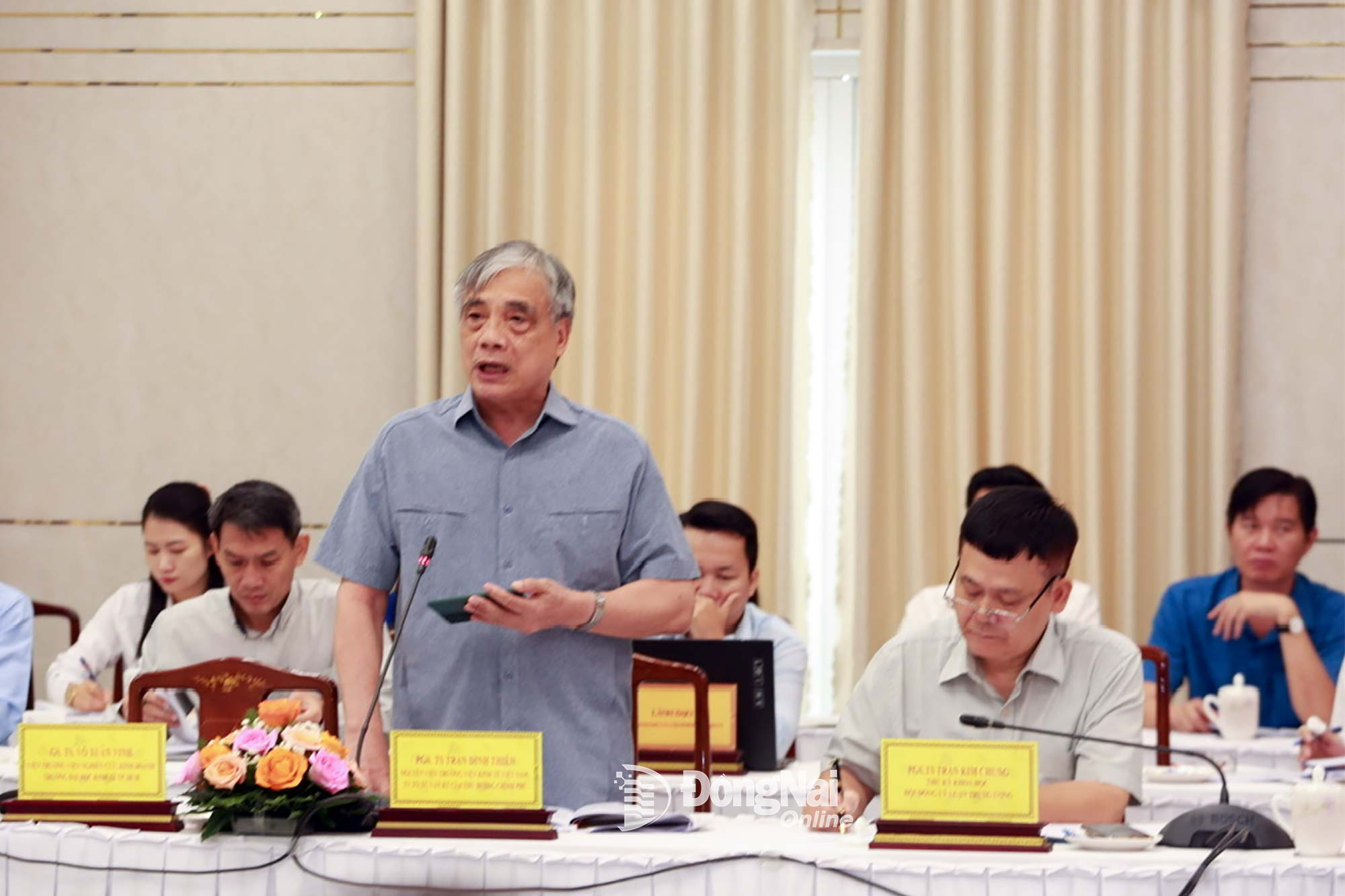 |
| Assoc. Prof. Dr. Tran Dinh Thien speaking at the scientific conference on socio-economic development orientation with the goal of double-digit growth, and contributing feedback to the draft political report for the Dong Nai Party Congress, 2025-2030 term. |
Speaking to Dong Nai Newspaper, Assoc. Prof. Dr. Tran Dinh Thien, former Director of the Vietnam Institute of Economics, member of the Prime Minister’s Policy Advisory Council, said the draft political report is concise, logically structured, and generally meets the requirements set for drafting documents presented at the 14th National Party Congress. However, he stressed that the report should go straight to the point and highlight unique characteristics so that when reading it, people immediately recognize it as Dong Nai’s report, one that cannot be mistaken for that of any other province.
Going straight to the point
Associate Professor Dr. Tran Dinh Thien, what is your assessment of the contents presented in the draft political report to be submitted to the Dong Nai Party Congress for 2025-2030 term?
The content and presentation of the draft generally reflect the province’s specific conditions, aspirations, reform momentum, and development trends, in line with and keeping pace with the overall transition of the country and the spirit of the current congress term. However, the writing should go straight to the point and carry a distinctive character so that, upon reading, it is immediately clear that the report belongs to Dong Nai, making it impossible to confuse with that of any other province.
The prevailing trend across the country is for reports to be concise and clear. The fifth draft of Dong Nai’s political report for the provincial Party Congress currently spans 42 pages. While certain sections cannot be elaborated in excessive detail, major issues concerning the province must be clearly defined. Clarifying these key matters will highlight Dong Nai’s distinctive characteristics.
The report must also highlight both the opportunities and challenges. For instance, Dong Nai’s opportunities in the recent past and the coming period include the imminent operation of Long Thanh International Airport; the network of expressways and ring roads passing through the province, linking with HCM City and the Southeastern region; the development of the Chon Thanh Industrial Park; the expanded economic scale following the merger of the former Dong Nai and former Binh Phuoc provinces; and the transformation of former Binh Phuoc’s reserve development zone into a regional growth driver for the new Dong Nai. These advantages will play a decisive role in shaping a new and distinctive position and momentum for Dong Nai’s development in the years ahead. They also provide critical data for defining the province’s development vision, restructuring economy, and making the right strategic priority choices.
As for challenges, achieving the double-digit economic growth target is not easy. Opportunities must be seized without delay, and challenges must be decisively overcome, or the province risks being left behind.
The draft political report for the 2025–2030 Dong Nai Party Congress sets a GRDP growth target of at least 10% per year and aims for the digital economy to account for over 30% of GRDP by 2030. In your view, what solutions does Dong Nai need to achieve these targets?
Achieving double-digit economic growth is a major challenge, as the combined average growth of both former Dong Nai and former Binh Phuoc in the 2020–2025 period was just over 6%. Now, with a target set at nearly twice that level, the draft political report must provide convincing arguments, grounded in new, unconventional, and sustainable foundations, resources, and drivers, to ensure the goal is attainable.
In recent years, the notion of double-digit growth has been discussed so often that it may seem easily attainable. However, the reality is that the likelihood of attaining such growth is very low unless there is a clear understanding of the opportunities and challenges, and of the differences between the previous period when the double-digit growth had not been reached yet and the current pursuit of it.
In my view, to build new capacity and momentum for growth, and create the potential for strong breakthroughs, it is essential to thoroughly resolve existing bottlenecks, develop unconventional resources and drivers, demonstrate exceptional strategic acumen, and make extraordinary efforts.
The most critical factor for growth is capital and resources.
Intelligence and unity
Cadres are considered “the the root of all work” and the decisive factor in the success or failure of any mission. What is your assessment of Dong Nai’s cadre contingent, sir?
The political tasks of both former Dong Nai and former Binh Phuoc provinces in recent years have faced various difficulties and challenges, yet the two provinces have managed to overcome and continue developing. This demonstrates the leadership capacity of the cadre teams in both provinces. Now that the two provinces have merged into one, they will integrate their leadership under a single roof, shaping a unified bloc of strength.
Dong Nai currently has a large economic scale, ranking fourth nationwide. Therefore, its leadership strategy in the coming period must be elevated to such a height that is capable of fostering great unity. With both intellect and solidarity, Dong Nai is hoped to maintain a well-structured administrative apparatus. At the same time, it must build a service-oriented government, a government that drives development, and one that is open to integration. If these goals are achieved, there would be no reason to claim that Dong Nai lacks the strength to lead or the capacity to guide.
From your perspective, what kind of strong policies are needed for Dong Nai to catch up with the level of development seen in Ho Chi Minh City or certain other provinces?
Dong Nai ranks among the leading provinces nationwide in terms of economic scale, population, and land area. It possesses all the key factors and substantial potential for developing sustainable industrial growth, high-tech agriculture, logistics, and modern service industries linked to Long Thanh International Airport, the seaport system, inland container depots (ICDs), and smart urban areas.
The central government has emphasized the policy of “promoting decentralization and delegation of authority” under the guiding principle of “localities deciding, localities acting, and taking responsibility.” On the foundation of the nation’s overarching mechanisms, if Dong Nai has yet to clearly define its positioning, it should invite experts for support. Currently, Dong Nai ranks just behind a few provinces and cities in terms of economic scale and budget revenue. This does not mean the province must merely strive to catch up with the country’s top performers, it has the potential to move ahead of them.
Thank you, sir!
By: Phuong Hang
Translated by: M.Nguyet - Thu Ha


Thông tin bạn đọc
Đóng Lưu thông tin