
During the official session of the 1st Dong Nai Provincial Women’s Congress held on the morning of November 12, delegates heard several thematic reports, including: promoting the role of female intellectuals in scientific research and innovation; implementing the emulation movement “Building the image of the modern Vietnamese women” in connection with studying and following the ideology, morality and style of President Ho Chi Minh in the new era; current situation and solutions for mobilizing members to participate in safeguarding border sovereignty and supporting women in border areas.
Enabling female intellectuals to maximize their potential
Presenting her report at the congress, Dr. Nguyen Thi Thu Lan, Chairwoman of the the Dong NaiIntellectual Women’s Association, affirmed that in the process of national development, the Vietnamese intellectual community, including female intellectuals, plays a key role in the fields of knowledge and innovation. The Central resolutions have consistently emphasized that fostering and promoting intellectual resources, especially highly qualified professionals and talents in science and technology, is a strategic driving force for rapid and sustainable national development.
 |
| Dr. Nguyen Thi Thu Lan, Chairwoman of the Dong Nai Intellectual Women’s Association, delivers remarks at the congress. Photo: Huy Anh |
In recent years, female intellectuals in Dong Nai have actively engaged in scientific research, with many members leading numerous provincial and grassroots-level projects. Their research findings have been transferred to enterprises and management agencies, making tangible contributions to socio-economic development, environmental protection, and public health. Many members have received provincial and national awards for scientific and technological innovation, with representatives presenting at the INWES-APNN Forum, helping raise the profile of Vietnamese female intellectuals internationally.
As Dong Nai and the rest of the country enter a new stage of development marked by both opportunities and challenges, the female intellectuals are increasingly aware of their roles, missions, and responsibilities. The Party’s policies on breakthroughs in science and technology, education and training, and digital transformation have created favorable conditions for them to unleash their potential. Dong Nai, as an industrial hub in the Southern Key Economic Region, with strengths in Long Thanh International Airport, logistics, high-tech agriculture, the digital economy, and the circular economy, will require stronger participation from female intellectuals in the future.
However, challenges remain significant: high demands for digital skills, foreign languages, and research skill; the rapid impacts of AI, Big Data, and automation; as well as the “double burden” of balancing work and family life. Therefore, to unleash female intellectuals’ full potential, appropriate support mechanisms are needed. The Dong Nai Intellectual Women’s Association hopes that the Provincial Party Committee, People’s Council, People’s Committee, Vietnam Fatherland Front (VFF) Committee, and the Provincial Women’s Union will strengthen policy support to enhance the association’s effectiveness.
Looking ahead, the association will focus on expanding its networks and interdisciplinary cooperation; promoting research, technology transfer, and innovation in practical fields; encouraging female intellectuals to improve their digital and language skills; honoring exemplary individuals; supporting young women in scientific research and tech startups; and actively contributing policy advice and feedback in science and technology, education, and gender equality.
Solutions to enhance the image of the modern Vietnamese women
Presenting her report, Nguyen Thi Hong Phuong, Vice Chairwoman of the VFF Committee and Chairwoman of the Women’s Union of Tran Bien Ward, said the emulation movement “Building the image of the modern Vietnamese women” focuses on four key qualities: knowledge, morality, health, and responsibility toward oneself, one’s family, society, and the nation.
 |
| Nguyen Thi Hong Phuong, Vice Chairwoman of the VFF Committee and Chairwoman of the Tran Bien Ward Women’s Union, delivers her report at the congress. Photo: Huy Anh |
In recent years, the Tran Bien Ward Women’s Union has integrated this movement into other local initiatives, using mass media and social networks to promote its goals. It has also guided its branches to develop activities tailored to different groups of women.
Among the four criteria, knowledge is considered the “key” that enables the women to be confident and adaptive in the digital era. The Union has therefore collaborated with partners to organize training sessions on digital skills, financial management, entrepreneurship, and business administration for members. It has also replicated models that encourage women’s participation in digital transformation.
Regarding the criterion on moral qualities, the Ward Women’s Union has directed all sub-unions to hold thematic meetings and storytelling sessions about President Ho Chi Minh, encouraging members to register for self-improvement under the moral standards of the modern Vietnamese women. The sub-unions have effectively maintained various models such as “Women living and working well”, “Building 5-no, 3-clean, 3-safe families”, and “Union with no members violating the law”,contributing to preserving a civilized lifestyle. In terms of the criterion on good health, in addition to promoting regular medical checkups and nutrition counseling, the sub-unions have established sports and dance clubs for women’s fitness.
To translate the criterion on responsibility toward oneself, family, society, and the nation, the Ward Women’s Union has launched many community initiatives, encouraging the women to take part in building a civilized urban environment, as well as in humanitarian and charitable activities.
To further deepen the emulation movement, the President of the Tran Bien Ward Women’s Union suggested intensifying communications on the four criteria, renewing the content and methods of the movement, placing members at the center, and using the outcomes of achieving the “knowledge–morality–health–responsibility” standards as the benchmarks. She also emphasized the need to promote digital transformation within the Union, enhance digital capacity for leaders and members, and highlight exemplary individuals and collectives to inspire broader participation.
Women join efforts to protect border sovereignty and security
Discussing the mobilization of women to participate in protecting border sovereignty and security and supporting women in border areas, Nong Thi Oanh, Vice Chairwoman of the VFF Committee and President of the Women’s Union of Thien Hung Commune, said that under the leadership of local Party committees and authorities, and under the guidance from higher-level unions, the commune’s Women’s Union has effectively implemented initiatives to protect border security through various practical activities. The Union has coordinated communication campaigns on laws related to crime prevention and social evils, mobilized border residents to help protect and manage border markers and patrol areas, and maintained self-managed models for border protection, contributing to political stability and public safety.
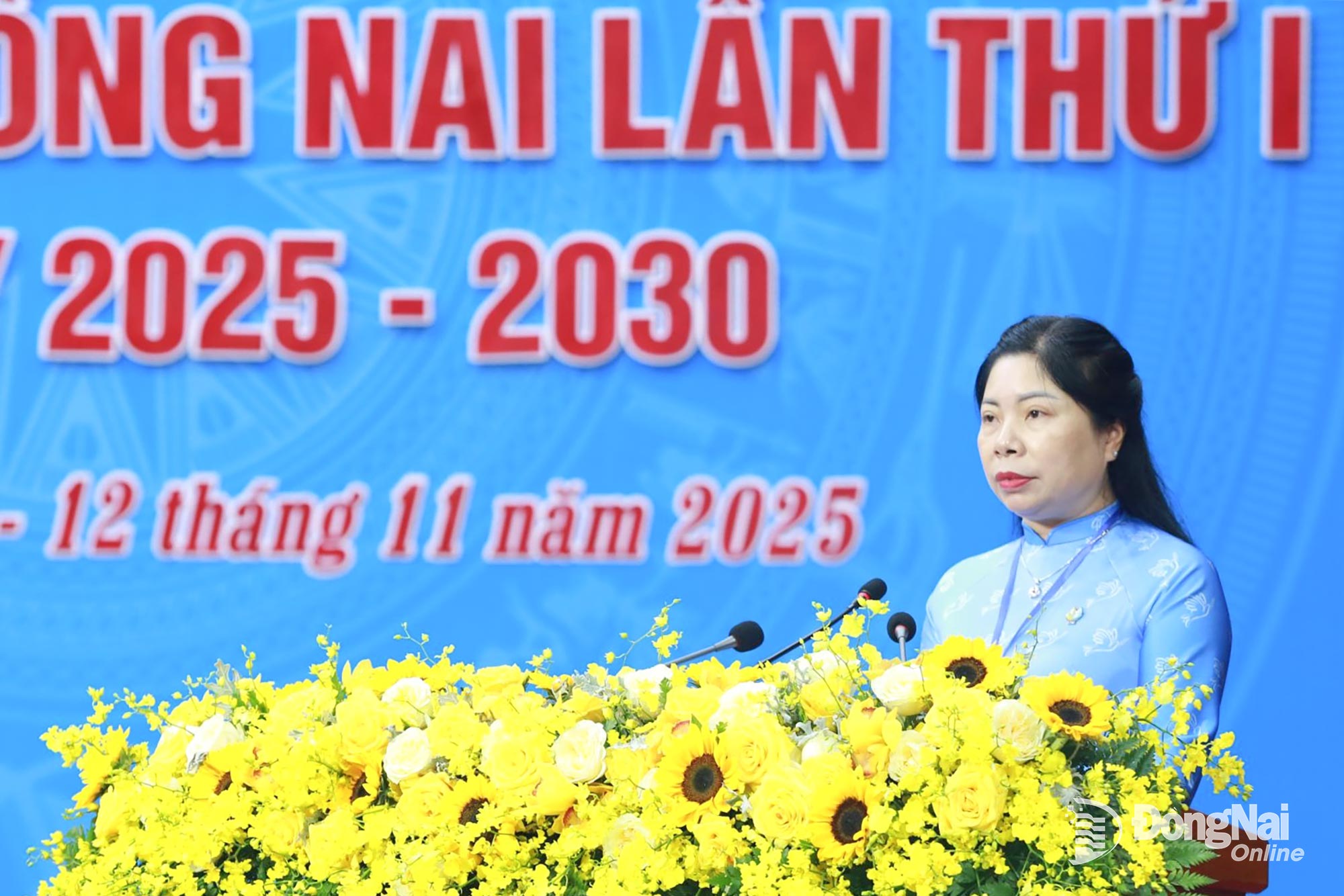 |
| Nong Thi Oanh, Vice Chairwoman of the VFF Committee and Chairwoman of the Thien Hung Commune Women’s Union, shares at the congress. Photo: Huy Anh |
It has also sustained and expanded models such as Bright border villages, Safe homes, Trusted community addresses, Law bookshelves, and Knowledge support for border security and economic development of ethnic minority women. Through these initiatives, members have gained better legal awareness and practical skills to prevent crime, especially in combating illegal border crossings, smuggling, and unauthorized immigration.
According to Oanh, to further strengthen border protection efforts, it is essential to continue promoting the Party’s policies and the State’s laws on border affairs; raise vigilance; and counter hostile “peaceful evolution” narratives.
The union will continue to strengthen grassroots mobilization in border areas, empower local residents, build core forces in border hamlets to detect and prevent violations, and enhance the capacity of union officials through training in grassroots engagement and communication. It will also mobilize social resources to help women improve their livelihoods and link national target programs with defense and security initiatives, contributing to better living standards for women and residents in border areas.
By Nga Son (compiled) – Translated Thuc Oanh, Thu Ha


Thông tin bạn đọc
Đóng Lưu thông tin