
With strong breakthroughs in mobilizing social resources for investment in healthcare, Dong Nai has not only eased the burden on the state budget but also provided local residents with high-quality preventive, diagnostic, and treatment services supported by modern technology.
This serves as an important lever for Dong Nai to move toward building a comprehensive, smart healthcare ecosystem that meets the needs of a young city with a population of nearly 4.5 million.
 |
| A doctor from Ai Nghia Medical System reads cancer screening results for a patient. Photo: Hanh Dung |
Robust private healthcare network
In recent years, the private healthcare system in Dong Nai has developed remarkably in both quantity and quality. The most prominent highlight in Dong Nai's healthcare socialization landscape is the presence of large-scale hospitals. A typical example is University Medical Shing Mark Hospital (in Long Hung ward). The hospital was established in September 2017 with a scale of 1,500 beds, a total investment of 300 million USD, and built on an area of 87,500 square meters. This was the first 100% foreign-invested private hospital in Dong Nai and also the largest foreign-invested private hospital project in Vietnam at that time.
Chao Chung Lee, founder of Shing Mark Group, shared that University Medical Shing Mark Hospital is a project for him to show gratitude to Vietnam in general and Dong Nai in particular. The hospital's goal is to become the top healthcare choice for people in the region.
With a team of doctors, specialists, and modern medical equipment, University Medical Shing Mark Hospital can diagnose, provide emergency care, and treat many difficult cases, including cancer treatment. The hospital has also invested in high-tech equipment such as: CT scanners, AI-powered MRI machines, spinal function measurement, electroencephalography, DSA angiography, 4D color ultrasound, color cardiac ultrasound, automatic biochemical analyzers, etc.
Established in 2012, and joining Hoan My Medical Group in 2017, Thuan My ITO Dong Nai Hospital (Tran Bien ward) has made steady progress in management and expertise. In 2025, the hospital was honored to be among the top 10 sustainable enterprises. Especially, the implementation of electronic medical records and attainment of international certification from the Australian Council on Healthcare Standards International (ACHSI) have marked an important step in the hospital's digital transformation and integration with international quality standards.
In the segment of specialized hospitals, in late 2024, the Hanoi - Dong Nai Eye Hospital (Tam Hiep ward) began operations and quickly became a trusted address for local residents seeking eye care. Recently, the hospital implemented modern surgical techniques for myopia treatment. The Saigon - Bien Hoa Eyes Hospital and the Saigon - Long Khanh Eyes Hospital, established later, have effectively met the demand for high-tech ophthalmological treatment for the people.
In the group of private general clinic systems, the rapid and sustainable development of Ai Nghia Medical System, Y Duc, Tam Phuoc General Clinic System, etc., has been noted.
Beyond treatment services, the preventive healthcare segment has also made its mark with the system of Vietnam Vaccine Joint Stock Company (VNVC). From the first facility opened in 2018 in Tam Hiep ward, VNVC Dong Nai has now expanded to 11 facilities across the city, owning a Good Storage Practice (GSP) cold storage of international standards and a modern Cold Chain, meeting the demand for high-quality vaccination for thousands of customers every day.
 |
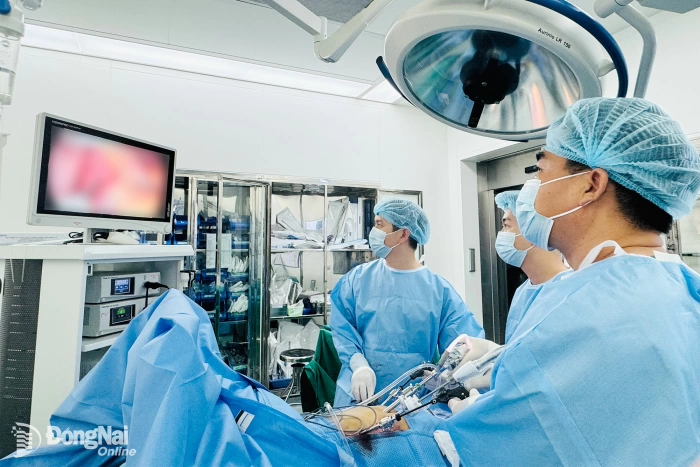
| An endoscopy procedure performed at University Medical Shing Mark Hospital. Photo: Hanh Dung |
Continued attraction of major healthcare projects
Tran The Thang, Director of Hanoi–Dong Nai Eye Hospital, noted that Dong Nai has become fertile ground for healthcare socialization due to its large population, significant number of migrant workers in industrial zones, and consistently high demand for healthcare services. Geographically, Dong Nai is located in the Southern Key Economic Region, adjacent to Ho Chi Minh City, with convenient transportation infrastructure, enabling local healthcare facilities to attract patients from neighboring areas. In addition, Dong Nai actively promotes investment and is committed to supporting businesses throughout project implementation. In reality, investment efficiency is a crucial factor driving private hospitals to continuously expand services, adopt advanced techniques, and upgrade equipment to meet growing healthcare demands.
Specialist Level II Doctor Do Thi Nguyen, Director of the Dong Nai Department of Health, said: The private healthcare sector has become an inseparable part of the city's overall healthcare network, helping people access many high-quality services right in their locality, reducing costs and time when having to travel to higher-level facilities. In particular, the private healthcare system has done a good job of "sharing the burden" with public hospitals, helping these hospitals avoid being overloaded as before.
Le Truong Son, Member of the Standing Board of the City Party Committee, Vice Chairman of the City People's Committee, emphasized that Dong Nai encourages and attracts investment in non-public healthcare, especially general hospitals, specialized hospitals, modern and high-quality medical centers, healthcare facilities at the commune and ward levels, and non-profit operating models.
Looking ahead, Dong Nai aims not only to develop individual healthcare facilities but also to build a complete healthcare ecosystem. Under the adjusted Dong Nai provincial master plan for 2021–2030 with a vision to 2050, the population is projected to reach 7 million, making the modernization of the healthcare system, with AI applications, a pressing requirement.
Therefore, Dong Nai prioritizes attracting new non-public healthcare projects, including: High-quality medical center (Dau Giay Ward); three general hospitals (Tran Bien Ward, Long Khanh Ward, Binh Long Ward); two international general hospitals with a scale of 500-1,000 beds; an Obstetrics and Gynecology Hospital with a scale of 100-500 beds; two Nursing and Rehabilitation Hospitals with a scale of 1-2 hectares per hospital; an Ear - Nose - Throat Hospital with a scale of 0.5-1ha; three Eye Hospitals; an Oncology Hospital with a scale of 100-300 beds; two regional general hospitals (Long Thanh urban area, Nhon Trach urban area) with a scale of 500-1,000 beds; an Infertility Center; a Nutrition Center; a Laboratory and Diagnostic Imaging Center...
In addition, Dong Nai also encourages and attracts other socialization projects including: Resort - healthcare facilities in potential areas; Institutes/Centers for nursing homes and elderly care; Specialized centers; high-quality medical centers; general hospitals; specialized hospitals; general clinics, specialized clinics.
With the right direction and strong ambition, Dong Nai’s healthcare sector is confidently asserting its position among the nation’s top performers. Continued promotion of healthcare socialization will be the key for Dong Nai to build an advanced, modern healthcare system, putting patients at the center and improving the quality of life for people from all social strata.
Dong Nai currently ranks just behind Ho Chi Minh City and Hanoi in attracting healthcare socialization. The entire city now has 12 private general and specialized hospitals, over 2,000 private general and specialized clinics, and over 4,000 pharmacies and healthcare service facilities.
By Hanh Dung -- Translated by Mai Nga, Thu Ha



Thông tin bạn đọc
Đóng Lưu thông tin