
According to Resolution No. 72-NQ/TW of the Politburo on breakthrough solutions to enhance the protection, care, and improvement of public health, individuals who regularly and directly perform medical duties at commune-level health stations and preventive health facilities will have their professional preferential allowance raised to a minimum of 70%. Doctors, preventive medicine doctors, and pharmacists will be placed at level 2 or higher of their appointed professional title salary scale.
These changes serve as a new "tonic," creating motivation for grassroots and preventive healthcare workers, the frontline force in community health care.
Increase allowance from 70% to 100%
One of the important contents in Resolution 72-NQ/TW of the Politburo on breakthrough solutions to strengthen the protection, care, and improvement of people's health is the special and superior preferential policy on professional allowances, helping to improve income and attract human resources.
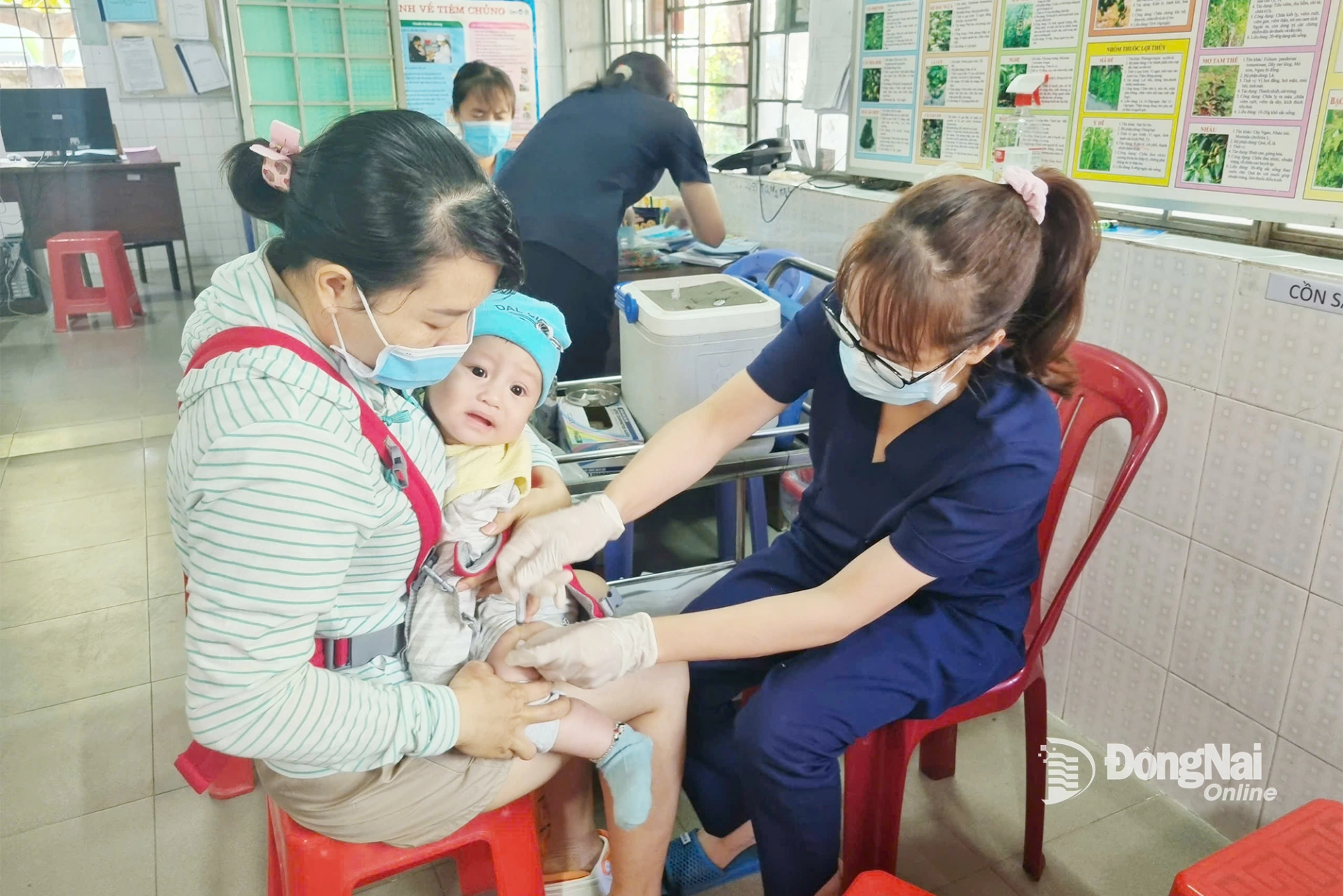 |
| According to Resolution 72 of the Politburo, individuals regularly and directly engaged in medical expertise at commune-level health stations and preventive health facilities will have their professional preferential allowance increased to a minimum of 70%. In the photo: Vaccinating children at Trang Dai Ward Health Station. Photo: Bich Nhan |
Accordingly, individuals regularly and directly engaged in medical expertise at commune-level health stations and preventive health facilities will have their professional preferential allowance increased to a minimum of 70%. Specifically, a 100% rate applies to those working at commune health stations and preventive health facilities in ethnic minority areas, mountainous areas, areas with difficult or extremely difficult socio-economic conditions, border areas, islands, as well as those working in psychiatry, forensic medicine, forensic psychiatry, emergency resuscitation, pathological anatomy, and other specific subjects suitable to socio-economic development conditions.
Despite working at a station, Dr. Le Thi Du has pursued a specialist level 1 degree to enhance her expertise. For 32 years, Dr. Du has been dedicated to Phu Dien Health Station, formerly Tan Phu district, Phu Dien Health Station Point, now under the Dinh Quan Regional Medical Center, Dong Nai province. At one point, the former Phu Dien Health Station received 60-80 patients a day. The reason was largely due to the presence of a specialist level 1 doctor and investment in equipment such as ultrasound machines, electrocardiograms, acupuncture tools, and more, which helped patients feel reassured. As a grassroots-level doctor, Du received a 40% professional allowance, along with several other supplements, bringing her total monthly income to 17 million VND.
According to Dr. Du, in addition to the professional allowance, for more than 2 years, she has also received additional provincial allowances under Resolution 34 (Resolution 34/2022/NQ-HDND regulating the support regime for medical human resources in Dong Nai province for the period 2023-2025), so her income has increased significantly. However, this allowance level is still not truly attractive in terms of attracting or retaining doctors at the station level.
"For doctors to be committed to working at the station, in addition to income, sufficient medicine, medical supplies, and investment in modern equipment and facilities are essential because the demand for medical examination and treatment from the people is increasing. Currently, almost only elderly people with underlying diseases who cannot travel far come to the health station," shared Dr. Du.
Specialist Level 2 Doctor Le Quang Trung, Deputy Director of the Dong Nai Provincial Department of Health, believes that the most difficult thing now is not building new health stations or buying modern equipment, but rather high-quality human resources. Resolution 72 of the Politburo is a timely solution in the context of increasing demand for primary healthcare, disease prevention, and chronic disease management.
In addition to the preferential policies from Resolution 72, the Deputy Director of the Department of Health hopes that the province will continue to maintain the implementation of Resolution 34/2022/NQ-HDND regulating the support for medical human resources in Dong Nai province for the period 2023-2025 in the coming period.
As a young doctor, Hoang Thi Xuan Thanh, from the Department of Disease Control, Bien Hoa Regional Medical Center, has been working in preventive medicine for 3 years. About 9 years ago, Dr. Xuan studied the "Medical University Student Training Program," officially trained at Can Tho University of Medicine and Pharmacy with a major in preventive medicine, funded by Dong Nai province.
Dr. Thanh shared: "When I was still in school, the preventive medicine field was quite new. But through practical work, I found my job quite interesting. This job means being a 'shield' for people's health. When doctors have expertise and do good preventive work, it will limit severe cases and reduce pressure on the treatment system."
Increasing remuneration, "revitalize" grassroots and preventive healthcare
Since her graduation, Dr. Thanh's main job has been in the preventive field: epidemic prevention and vaccination. Like many other professions, Dr. Thanh was ranked at salary level 1 and received 80% in the first year. Currently, Dr. Thanh only receives her main salary and does not work extra hours at clinics or open private practices like doctors in the treatment system. According to Dr. Thanh, this is also why many young people "prefer" to study the treatment system over preventive medicine.
 |
| A doctor examines a child before vaccination at Hung Loc Medical Station, Dau Giay commune. Photo: Bich Nhan |
However, with the new points of Resolution 72, doctors, preventive medicine doctors, and pharmacists will be ranked at salary level 2 immediately upon recruitment, instead of level 1 as currently. This change is considered a breakthrough to improve income and encourage medical and pharmaceutical students to work at the grassroots and preventive levels, where work pressure is high but remuneration is still limited.
"Considering that medical training takes six years, receiving level-2 salary upon graduation offers doctors a relatively more stable start. The increase isn't significant, but it does serve as motivation for young people," said Dr. Thanh.
According to Dr. Le Quang Trung, Specialist Level 2, Deputy Director of the Dong Nai Department of Health: Currently, Dong Nai's health sector still lacks doctors, especially preventive medicine doctors. In recent years, many factors have "hindered" doctors from studying preventive medicine or working at medical stations. The main reason is that doctors at the station level are quite disadvantaged because they are not allowed to "do" what they "have learned." Each station usually has only 1 doctor, so they have to take on all activities of the entire unit, which limits their time for studying and improving their expertise.
"The opportunities for doctors at the station level to study and improve their skills are limited because the list of drugs and techniques regulated by the Ministry of Health is only at the level of initial examination and treatment. Therefore, there will be many more shortages of equipment and drugs compared to medical centers and hospitals. Thus, doctors are also concerned about a decrease in professional qualifications, making it difficult to attract doctors to medical stations," Dr. Trung said.
In addition, specialized fields such as preventive medicine and nutrition currently still have few students, making it difficult for the health sector to recruit and always lacking preventive medicine doctors. But with the innovations of Resolution 72, the policy of increasing professional preferential allowances for medical personnel up to 100% for those directly working in difficult areas or in specific fields will help retain personnel and reduce the situation of resignation and rotation out of the grassroots level.
By Bich Nhan – Translated by Mai Nga, Minho


Thông tin bạn đọc
Đóng Lưu thông tin