
The Neonatal Intensive Care Unit of Dong Nai Children's Hospital is a place that receives and treats many severe and complicated cases in newborns, especially premature and low-birth-weight infants.
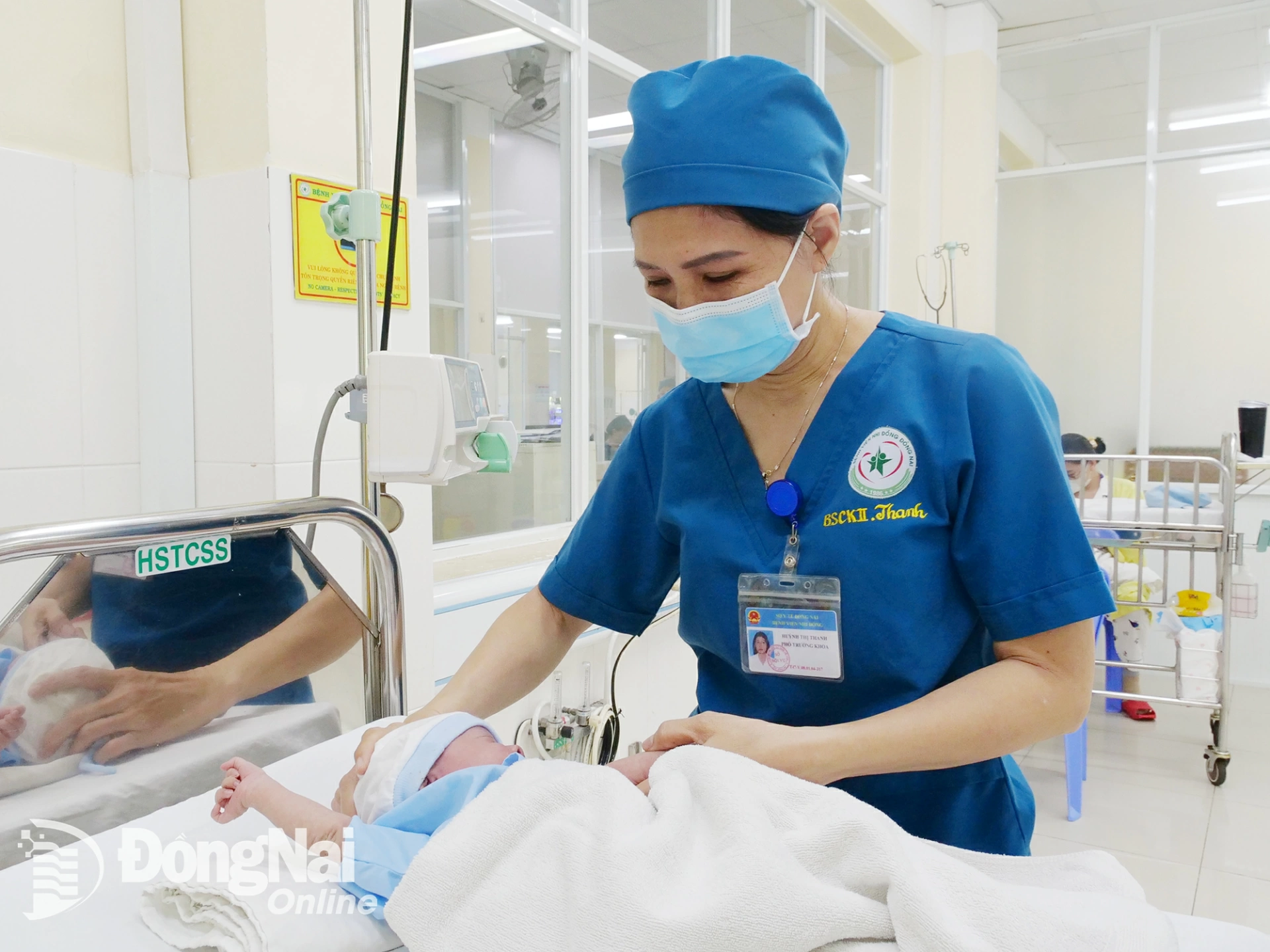 |
| A doctor from the Neonatal Intensive Care Unit, Dong Nai Children's Hospital, examines a newborn. Photo: Hanh Dung |
With a team of experienced specialist doctors and a modern equipment system, the department has implemented many new and high-tech techniques, contributing to saving thousands of children from their very first hours of life.
Implementing many specialized techniques
Dr. Huynh Thi Thanh, Specialist II, Head of the Neonatal Intensive Care Unit, said: Currently, the department has applied almost all modern resuscitation measures for children, except for some very specialized techniques such as ECMO (extracorporeal membrane oxygenation) or open-heart surgery.
Prominent techniques that the department has been and is implementing include: Various types of mechanical ventilation (from conventional mechanical ventilation, high-frequency mechanical ventilation to non-invasive mechanical ventilation) to support respiration for premature infants with severe respiratory failure.
The administration of pulmonary surfactant, a technique used for premature infants lacking the natural substance needed to expand the lungs, helps reduce the risk of acute respiratory failure. Controlled hypothermia (brain cooling) is applied to newborns with severe birth asphyxia to prevent irreversible brain damage. Another technique, blood exchange transfusion, is used to treat cases of severe neonatal jaundice or congenital hemolytic disease.
In addition, diagnostic and early screening techniques for metabolic diseases, hearing, neurological conditions, etc., are also implemented at the Neonatal Intensive Care Unit to detect and promptly treat congenital abnormalities in children.
According to Dr. Thanh, premature infants and critically ill newborns often face numerous risks, including respiratory failure, sepsis, severe jaundice, and brain injury. These pose significant challenges for neonatal intensive care specialists.
"Premature infants have very weak resistance and an incomplete immune system, while medical interventions can easily increase the risk of infection. Therefore, the department always strictly adheres to sterile procedures and aims for the principle of 'minimal intervention', meaning gentle support, minimizing invasiveness to protect the long-term health of children," Dr. Thanh shared.
Thanks to the skillful implementation of high-tech, specialized techniques and special care, the Neonatal Intensive Care Unit has saved many very severe cases recently. These include extremely premature infants born at a very low gestational age (nearly 26 weeks, weighing only 900g) or infants with severe neonatal tetanus.
To detect jaundice early in newborns, parents should observe their child in natural light, never in a dark room or under yellow lighting. They can gently press on the baby's skin and release it; if the area appears yellow instead of pink, it indicates jaundice.
Particular attention is needed if the yellowing spreads to the abdomen, arms, or legs, or is accompanied by poor feeding, excessive sleepiness, difficulty waking, high-pitched crying, or episodes of apnea. In such cases, the infant must be taken to the hospital immediately. Delayed treatment can lead to serious complications, including death.
Patients’ families are happy
While caring for her son in the Neonatal Intensive Care Unit, Trinh Thi Quynh, a resident of Nam Cat Tien Commune, Dong Nai Province, shared:
"I gave birth to my fourth son in early August 2025. He was full-term and weighed 2.5 kilograms. In the first few days after birth, he nursed normally. I noticed his skin was slightly yellow, but I assumed it was physiological jaundice, so I didn't take him to the doctor right away.
Nearly a week later, he began feeding less and showed signs of worsening jaundice, lethargy, and spitting up milk with traces of blood. My husband and I rushed him to the emergency department at Tan Phu Regional Medical Center. The doctor determined that his condition was critical and transferred him to a higher-level hospital for treatment."
At Dinh Quan Regional General Hospital, Quynh's son was breathing slowly and suffering from severe oxygen deprivation. He was intubated, manually ventilated with a resuscitation bag, and transferred to Dong Nai Children's Hospital.
There, the baby showed signs of drowsiness, body stiffness, and worsening jaundice. Doctors in the Emergency Department quickly initiated treatment for shock, administered intravenous fluids and vasopressors, and then transferred the infant to the Neonatal Intensive Care Unit.
Test results showed that the bilirubin causing jaundice in the patient's blood was extremely high, exceeding the threshold for brain complications. This issue was extremely dangerous because high free bilirubin would penetrate the blood-brain barrier, bind to brain cells, causing loss of function and necrosis of nerve cells.
Doctors in the Neonatal Intensive Care Unit performed a blood exchange technique to remove excess bilirubin from the blood, reducing neurotoxic complications. Blood exchange is a high-level technique, strictly calculated, tightly controlled, and absolutely sterile. After 3 hours of continuous blood exchange, combined with intensive phototherapy, the baby's jaundice decreased to a safe level. The baby was then weaned off the ventilator, began breastfeeding and bottle-feeding, gradually recovered, the jaundice disappeared, and the weight also increased.
Seeing her son getting healthier every day, Quynh confided, "When we entered the hospital, the doctors continuously encouraged my husband and me, saying 'where there's life, there's hope,' and then meticulously and devotedly cared for our child. On the 17th day, when our child was stable, my family was allowed to come in and care for him. My family is very grateful to the doctors and nurses of the hospital."
By: Hanh Dung
Translated by: Mai Nga - Minho


Thông tin bạn đọc
Đóng Lưu thông tin