
 |
| A corner of Tan Khai commune’s new-style rural area from above. Photo: Thanh Lam |
Entering the 2021-2025 period, with a spirit of proactiveness, creativity, and high determination, the face of Dong Nai’s rural areas has undergone a profound transformation.
In the border commune of Loc Tan, residents’ joy remains undiminished as a 3.6km road connecting to National Highway 13 has finally been completed after years of waiting. Once dusty in the dry season and muddy in the rains, the road is now smoothly paved, 7 meters wide, winding through green hills.
Nguyen Van Tien, Head of hamlet K54, Loc Tan commune, shared: “Our hamlet has received significant investment. More than 5km of asphalt roads, another 21km of concrete branch roads, and street lighting covering 95% of the area. People’s living standards have clearly improved, and residents are excited and confident in the new-style rural program.”
 |
| A cultural and sports facility built in the border commune of Loc Tan. Photo: Thanh Lam |
Within just five years, from 2020 to 2025, Loc Tan commune mobilized more than VND 64 billion to invest in 150 infrastructure projects. These not only transformed the appearance of the borderland but also contributed to strengthening national defense and security, raising the per capita income to over VND 76 million per year.
Not only Loc Tan, but Xuan Loc commune has also undergone a comprehensive infrastructure transformation. The commune invested in 41 transport projects worth approximately VND 258 billion, resulting in 100% of local roads being paved with asphalt or concrete.
During the past term, a total of tens of trillions of dong was mobilized for the new-style rural development program, drawn from state budgets, private sector investment, and community contributions. Thanks to this, transportation infrastructure, urban amenities, and services have made significant breakthroughs.
Particular attention was given to developing rural transport networks, especially roads connecting communes, hamlets, and concentrated production areas. Infrastructure supporting production, such as in-field roads, rural electricity networks, irrigation canals, and dams, was also comprehensively invested in.
Currently, 100% of households have access to electricity, and over 91% have access to hygienic water. Notably, many model roads that are bright, green, clean, and beautiful have been built and maintained by the local people themselves.
Nguyen Thi Cat Tien, Party Secretary and Chairwoman of the People’s Council of Xuan Loc commune, emphasized: “In the next term, the commune aims for a modernized new-style rural, both in infrastructure and in agriculture applying high technology, forming specialized cultivation zones.”
In Ta Lai commune, irrigation works and pumping stations have sparked a “revolution” in agricultural production. From producing only one rice crop per year, farmers can now cultivate three crops, tripling productivity.
Nguyen Pham Tuyen, Vice Chairman of the Ta Lai commune People’s Committee, stated that rural roads connecting communes and hamlets have been developed synchronously, facilitating travel and trade. Schools and health stations have also been newly built, better meeting educational and healthcare needs.
According to Tuyen, in future development planning, the Ta Lai commune Party Congress has set directions to continue comprehensive planning, promoting strengths in agriculture linked with eco-tourism and community tourism. The top priority is to continue improving the quality of new-style rural criteria, aiming to build advanced and modern new-style rural communes. Among these efforts, the focus is on improving both the material and spiritual lives of the people, while also enhancing the appearance of rural areas to be increasingly spacious, clean, and modern, yet still preserving traditional cultural identity. Notably, Ta Lai commune will allocate resources to develop a synchronized system of essential infrastructure, particularly transport networks, to ensure smooth connectivity between hamlets, production areas, and the commune center, thereby driving trade and socio-economic development. In parallel, the locality also emphasizes the development of digital infrastructure, applying information technology to management and administration, moving toward administrative reforms that are transparent, public, efficient, and designed to serve the needs of residents and businesses in the best possible way.
In Phu Hoa commune, the “Three cleans” movement, clean homes, clean alleys, and clean kitchens, has become more than a slogan, turning into a daily lifestyle. Families keep their living spaces tidy, alleys neat, and kitchens clean. Consequently, the rural scenery has become brighter, greener, and more beautiful, creating a healthier and more civilized environment. At the same time, socialized infrastructure investment has shown strong results. Residents actively contributed alongside the state to build and upgrade roads, electricity and water systems, schools, and cultural centers. Thanks to this collective effort, Phu Hoa now boasts a much more modern look compared to just a few years ago. These efforts have directly improved livelihoods. If per capita income was VND 47 million in 2020, it has now doubled to more than VND 90 million. Beyond economic growth, the environment has improved, social order stabilized, and people feel secure in their community.
People joining hands and working in unity
If infrastructure is the “backbone,” then the people’s participation is the “heart” of the new-style rural development movement. Dong Nai’s greatest success lies in fostering unity and consensus among the people.
In Phu Rieng commune, the movement “Big or small, if the people care, it gets done” has spread widely. In just a few years, more than 742 households voluntarily donated over 596,000 square meters of land for road construction, with some donating as much as 4,500 square meters.
Dinh Van Ly, a resident of Phu Tan hamlet, Phu Rieng commune, shared: “When local authorities explained the collective benefits, we understood and were willing to donate land. The new road benefits the whole community, eases transportation, and increases economic value.”
Thanks to this consensus, Phu Rieng commune constructed 72km of roads, three new bridges, two schools, and eight hamlet cultural houses, with a total investment exceeding VND 500 billion. To date, six residential areas have met model criteria.
Across the province, the movement “The state and the people work together” has been strongly promoted. Local agencies, associations, and political organizations actively implemented policies and solutions to accelerate the development of new-style rural construction. Particularly, the provincial Farmers’ Union mobilized nearly VND 9.9 billion, 3,600 working days, 11,400 square meters of land, and 4,200 cubic meters of soil and stone to build 59 kilometers of roads, 2 kilometers of canals, install 14 kilometers of lighting, and repair or upgrade 11 bridges and culverts.
“Every working day contributed, every square meter of land donated, every streetlight, every flower planted along the road is proof of the bond between the Party’s will and the people’s hearts.”
Nguyen Van Giang, Vice Chairman of Dong Nai Farmers’ Union
Particularly, many model residential areas in Dong Nai were created from this spirit of unity. Residents willingly donated land and funds, actively engaging in tasks such as planting roadside flowers, installing security cameras, caring for greenery, and maintaining a clean environment. Thanks to these contributions, the province now has 100 model residential areas that are neat, bright, green, clean, and beautiful, serving as highlights of the new-style rural development movement and affirming the central role of the people in every achievement.
Rural economies are undergoing a strong shift toward increasing shares of industry and services. Although the share of agriculture is declining, average production value continues to rise, contributing significantly to rural incomes.
The “One Commune, One Product” (OCOP) program and rural tourism have become key highlights driving rural economic development. The province currently has 481 OCOP products, including 11 that are rated five stars and 25% that are rated four stars. Many of these products have successfully leveraged value chains and improved quality, gradually forming OCOP product ecosystems.
Vocational training for rural workers has created a skilled labor force, enhancing the competitiveness of rural production facilities and enabling them to better adapt to integration.
Hieu Le, Deputy Director of Nga Bien Co., Ltd. in Xuan Loc commune, Dong Nai Province, stated that the company had recently earned five-star OCOP recognition for four of its products. This undertaking confirms our reputation for prestige, quality, and ongoing innovation in product diversification. Today, in addition to serving the domestic market, our Nga Bien-branded products are exported to numerous countries, including the UK, Germany, and China, thereby elevating the international value of Vietnamese cashews.
Electricity, roads, schools, and clinics in the communes have reshaped the face of Dong Nai’s countryside, underscoring its progress in new-style rural development.
Over the past term, the province has consistently focused on directing production development closely linked with increasing residents’ incomes, both improving material living standards and creating stable resources to support investment in building new rural areas. Key crops and livestock have been planned into concentrated, specialized production zones, associated with economically valuable products that have export potential and are suited to local natural conditions. The application of high-tech solutions, organic agriculture, and scientific and technical advancements has yielded many positive results. Simultaneously, the sectoral restructuring process has promoted the development of agriculture, industry, handicrafts, trade, and services, generating spillover effects that support rural areas and commercial promotion activities. Alongside economic growth, national defense and security tasks have always been emphasized, linked with the establishment of models and exemplary initiatives in the “All people protect the nation’s security” movement. This initiative has made a significant contribution to preventing, detecting, and combating various types of crime, thereby ensuring security and stability in the local community. These achievements form a solid foundation for Dong Nai to enter a new phase.
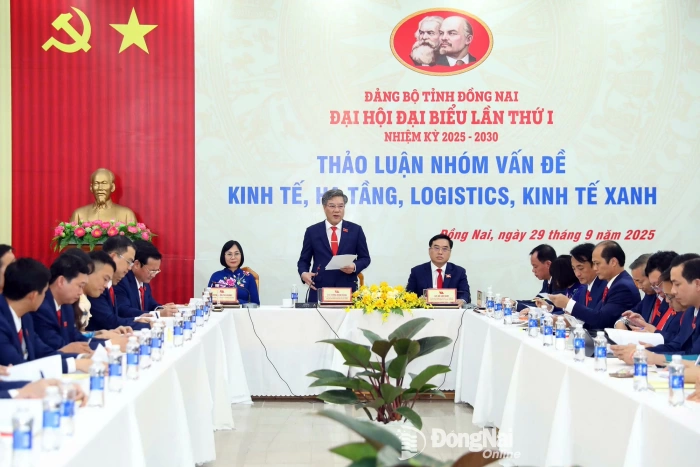
According to the draft Political Report of the first Provincial Party Congress for the 2025–2030 term, Dong Nai aims to have 70% of its communes meet new-style rural standards by 2030, with at least 10% achieving modern new-style rural status.
To achieve these goals, the province has outlined solutions to promote agricultural development and sustain progress in building new-style rural areas. These include restructuring the agricultural sector, developing high-quality farming zones, expanding large-scale and modern livestock areas, and fostering rural industries and specialized farming regions.
The achievements of the past term serve as a springboard for meeting the new targets. Over the last term, Dong Nai’s rural development journey has painted a vibrant picture: from brightly lit concrete roads and heavy rice fields to model residential areas and the smiles of residents in the locality, each of which is a testament to the unity between the Party’s will and the people’s support.
With strong political resolve, public consensus, and sound direction, Dong Nai is firmly positioned to maintain its momentum, affirming its role as a national leader in building new-style rural areas and advancing toward modern, civilized, and sustainable rural development.
By L.T, T.L – Translated by M.Nguyet, Minho



Thông tin bạn đọc
Đóng Lưu thông tin