
PART 4
FOCUSING ON COMMUNE-LEVEL GOVERNMENT
With as many as 95 commune-level administrative units and a vast area, the operation of the two-tier local government model (provincial and communal levels) in Dong Nai has faced no shortage of difficulties. However, since its inception, the commune-level local government apparatus in Dong Nai has consistently received timely direction and support from the provincial level, ensuring that activities in wards and communes have proceeded smoothly.
Dong Nai has always regarded the commune-level government apparatus as a focal point for investment, consolidation, and special support, particularly in disadvantaged areas, in order to ensure rapid stabilization and effective operation.
Close to the grassroots, listening to the people
Since the early days of implementing the two-tier local government model, the Dong Nai Party Committee assigned members of the Provincial Party Committee’s Standing Board, members of the Provincial Standing Party Committee and the Provincial Party Executive Committee to directly oversee and guide commune and ward Party organizations. The aim was to promptly detect and resolve emerging challenges in the political system at the grassroots level as well as improve coordination between the two tiers of government. The Provincial Party Committee also emphasized that supervision and guidance must be comprehensive and provide maximum support so that commune and ward Party organizations can carry out their tasks effectively and with high quality.
 |
|
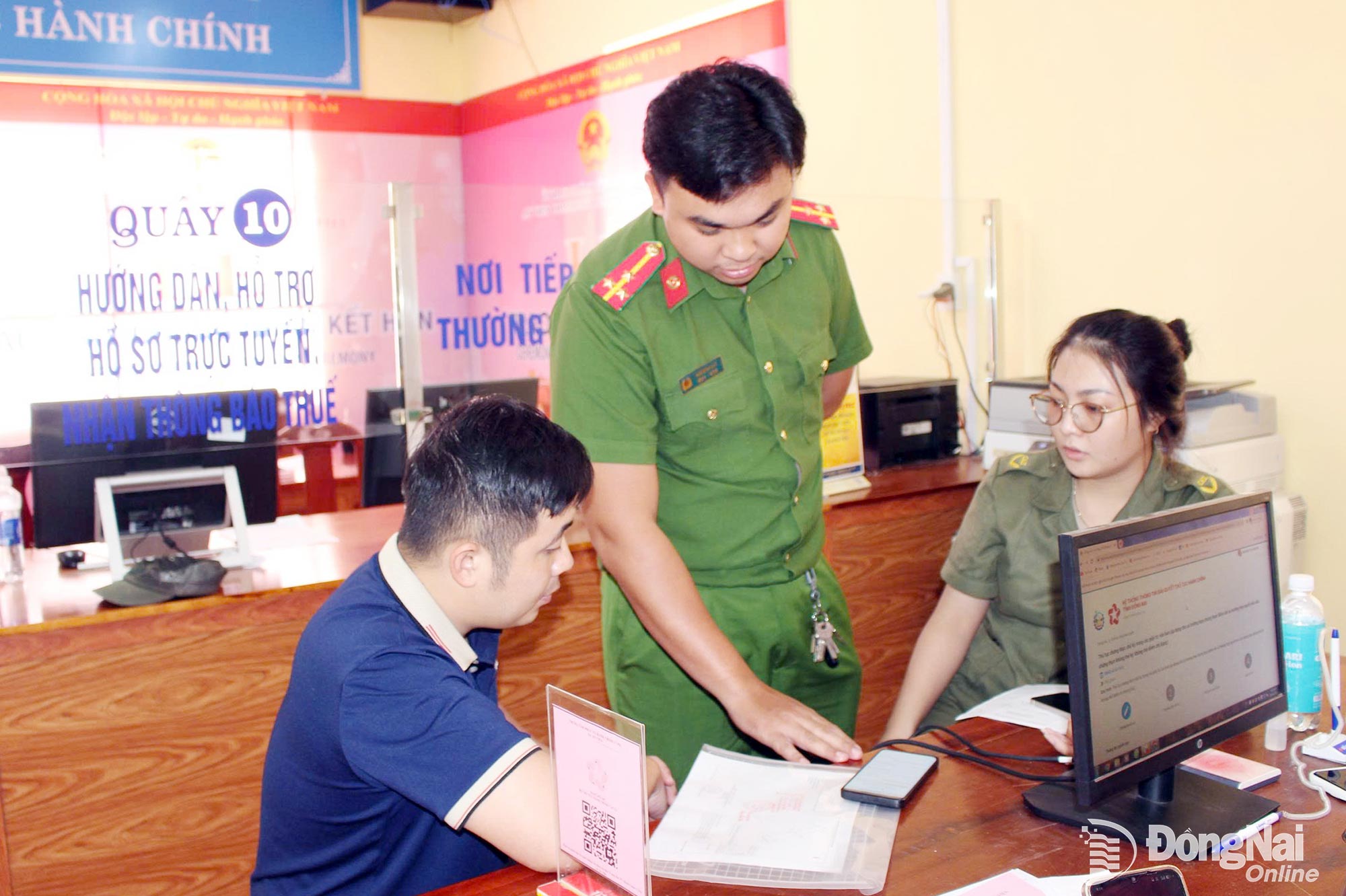
Citizens receiving dedicated guidance when handling administrative procedures at An Vien commune Public Administration Service Center. Photo: H. Thao |
Implementing that directive, members of the Provincial Party Committee’s Standing Board, members of the Provincial Standing Party Committee and the Provincial Party Executive Committee, along with leaders of departments and sectors, have regularly visited and worked with the communes and wards under their supervision. Thanks to these efforts, emerging difficulties and obstacles, as well as proposals and solutions, have been promptly acknowledged.
On August 9, during a fact-finding trip to eight border communes, namely Bu Gia Map, Dak O, Hung Phuoc, Thien Hung, Tan Tien, Loc Tan, Loc Thanh and Loc Thanh, Deputy Secretary of the Provincial Party Committee and Chairman of Dong Nai People’s Committee, Vo Tan Duc listened to local proposals related to telecommunications, mobile and radio and television broadcast signals, as well as infrastructure and equipment serving the new government model. Comrade Vo Tan Duc directed relevant departments and sectors, the provincial People’s Committee Office to take note and advise the provincial leadership on swift solutions.
As for Xuan Loc and Xuan Hoa communes, during her visits to these communes, Ton Ngoc Hanh, Alternate Member of the Party Central Committee, Standing Deputy Secretary of the Provincial Party Committee, and Chairwoman of Dong Nai People’s Council, received local proposals concerning personnel issues and the operation of public administration service centers.
Party Committees and Heads of agencies are required to thoroughly grasp the spirit of Resolution No. 18-NQ/TW dated October 25, 2017, on continuing to streamline the organizational apparatus of the political system for greater efficiency and effectiveness, as well as the Party Central Committee’s policies on the merger of provinces, cities, communes, and the abolishment of district-level administration. This task must be carried out before, during, and after the restructuring process, with unity in both thought and action.
If the streamlining of the political apparatus is viewed as a revolution, then its success will inevitably require sacrifices and strong determination. It is therefore essential to raise awareness, foster unity, and build consensus, with each individual ready to adapt to changes. At the same time, appropriate regimes and policies must be in place to ensure that cadres and civil servants feel secure, committed, and united in shouldering shared responsibilities for the common goal. Public assets after the merger must be managed properly to avoid waste and to maximize resources through well-defined roadmaps. Particularly, power must be effectively controlled after the restructuring to prevent parochial or local interests from arising. At the commune level, the organizational structure will no longer remain as before; departments and divisions will be broader and more complex. However, digital transformation will help bridge these gaps. Hence, alongside the implementation of the new local government model, the digital revolution must be carried out at an early stage.
Assoc. Prof. Dr. Nguyen Quoc Dung, Director of the Ho Chi Minh City Region II Academy of Politics
Similarly, during meetings with Tri An and Tan An communes, Thai Bao, Deputy Secretary of the Dong Nai Party Committee and Head of the Provincial Party Party Committee's Organization Commission, Secretary of the provincial Party agencies’ Party Committee received additional proposals on training and professional development for commune-level officials following administrative mergers. Localities emphasized that workloads had grown significantly in scale and complexity, requiring additional training for commune officials to meet the requirements of tasks in the new context
At working sessions with Dau Giay and Thong Nhat communes, Huynh Thi Hang, Deputy Secretary of the Provincial Party Committee and Chairwoman of Dong Nai Fatherland Front Committee, heard proposals on improving software stability and simplifying administrative procedures.
Timely support to resolve difficulties
At the recent Conference to review one month of implementing the two-tier local government model, Comrade Vu Hong Van, Secretary of the Provincial Party Committee and Head of the Provincial National Assembly Delegation, emphasized that the Provincial Standing Party Committee shares the difficulties and acknowledges all proposals and recommendations from agencies and localities. All difficulties and obstacles, as well as good practices and effective models, must be regularly updated and reported on a daily basis, rather than waiting until review meetings to bring them up for discussion and evaluation, so that the Provincial Party Committee can monitor and provide timely guidance. From that spirit, Provincial leaders have issued resolute and concrete instructions for all levels, sectors, agencies, and localities to effectively implement the two-tier local government model.
Delivering his guidance at a working session with eight border communes of the province, Chairman of the Provincial People’s Committee Vo Tan Duc emphasized that after more than one month of operating under the new local government model, all localities have made strong efforts to fulfill their assigned tasks. However, it must be acknowledged that compared with the province’s overall development level, the eight border communes still face numerous difficulties. Therefore, greater focus is required on removing obstacles, particularly in issues directly related to local people such as social welfare, access to clean water, and environmental sanitation.
Comrade Vo Tan Duc urged local leaders to draw up monthly and quarterly plans, assign responsibilities under the “six- clear” principle (clear person, clear task, clear time, clear responsibility, clear outcome, clear authority), and use these as a basis for year-end performance evaluations. He also highlighted the need for strict land management, forest protection, planning, and prevention of encroachment and illegal land use. The Chairman of the Provincial People’s Committee assigned the Department of Home Affairs to review and consolidate data on the shortage of qualified civil servants. The department is tasked with advising the Provincial People’s Committee on plans for the reassignment and rotation of civil servants among communes and wards in order to balance human resources and fill vacant positions. It was also requested to study and propose policies to support officials, civil servants, and public employees who are reassigned to work in localities located 15 kilometers or more from their homes.
Meanwhile, during working sessions with the communes of Xuan Loc and Xuan Hoa on July 12, in addition to directing the settlement of local petitions, Alternate Member of the Party Central Committee, Standing Deputy Secretary of the Provincial Party Committee, and Chairwoman of the Dong Nai People’s Council Ton Ngoc Hanh also emphasized the need for localities to continue reviewing redundant facilities so as to develop plans for functional conversion and more effective use, such as community cultural houses, schools, and public activity venues.
The directives of the provincial leadership aimed at supporting localities that have been and are being actively implemented by departments and sectors through concrete solutions.
In their grassroots-level engagement, provincial leaders consistently devoted time to grasp the situation and provide timely instructions regarding preparations for the Congresses of Party Organizations of communes and wards for the 2025–2030 tenure. From developing plans for organizing the Congresses, establishing subcommittees to serve the Congresses, gathering feedback on draft Congress documents, to preparing the contents and programs of the Congresses, all tasks have been closely monitored.
Along with that, recognizing the special importance of Congress documents, the Provincial Standing Party Committee has set up appraisal teams to review draft documents of Party Congresses at grassroots Party organizations for the 2025–2030 tenure. Thanks to the close and timely direction, recent Congresses of commune- and ward-level Party organizations across the province have achieved notable success, contributing to strengthening the leadership capacity and combat strength of Party organizations. This has created momentum for sustainable socio-economic development, national defense and security, and the building of the Party and political system at the grassroots level.
By: Ho Thao-Nguyet Ha
Translated by: M.Nguyet-Thu Ha


Thông tin bạn đọc
Đóng Lưu thông tin