
The nationwide implementation of the two‑tier local government model marks a bold, synchronized, and necessary transformation of Vietnam’s political system, positioning the country to confidently step into a new era. This revolutionary initiative of the Party, aligned with public sentiment and fitting the nation’s current conditions, has earned widespread domestic support and international endorsement.
Following the initial but extremely important and meaningful results that the entire political system has achieved over the past month in implementing the two-tier local government model, hostile and politically opportunistic forces have ramped up their sabotage efforts by continuously spreading distorted information and blatantly denying the revolutionary achievements made by our Party, State, and people.
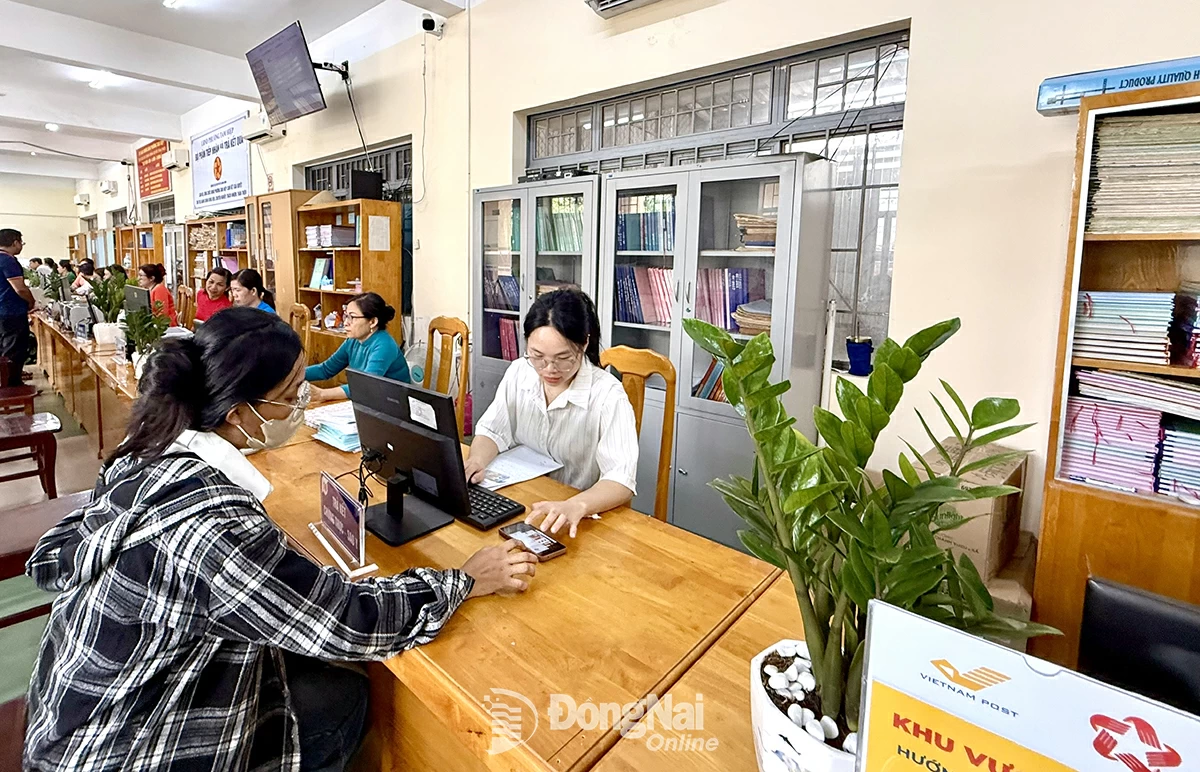 |
| Residents receive guidance on administrative procedures at Public Administration Service Center in Tam Hiep Ward, Dong Nai Province. |
The two-tier local government apparatus initially operates in a stable and smooth manner
Over the past years, under the leadership of the Party, the governance of the State, and the unity of the people, Vietnam has made remarkable progress across all sectors. The Resolution of the 13th National Party Congress noted: “Our country has never before had such stature, potential, international standing, and credibility as it does today.” However, in order for the nation to have sufficient strength and capacity to enter a new era of prosperous and robust development, it is essential to streamline and restructure the political system’s organizational apparatus to ensure its high-performing, effective, and efficient performance.
July 1, 2025 marked a significant milestone for Vietnam, as the country embarked on a historic “reorganization of the nation”, reducing the number of provinces and centrally governed cities from 63 to 34, and officially implementing the two-tier local government model. Driven by the consistent policy direction and the strong leadership and guidance of the Politburo, the Party Central Secretariat, and the Prime Minister, along with the proactive efforts of local authorities and, most importantly, the support and consensus of the people, the two-tier local government apparatus has initially operated in a stable and seamless manner, ensuring no vacuum in governance and providing better public services.
Speaking at the conference held on July 28 to evaluate administrative restructuring and review the one-month operation of the two-tier local government model, Prime Minister Pham Minh Chinh summarized: “ Overall, the Party’s will and the people's aspirations have aligned in the transition from a passive, management-heavy administrative government to a proactive, service-oriented and development-facilitating government. At the same time, this shift has helped reduce compliance time and costs for both citizens and businesses."
Perhaps never before has a sense of urgency, positivity, and proactiveness spread so strongly throughout the political system at all levels as it has in recent times, especially at the commune level, which is the closest to the people. In response to the people's expectations and aspirations for a “service-oriented government,” commune-level officials and civil servants have made great efforts to overcome early challenges, ensuring that no disruptions affect citizens or businesses. This spirit has spread to 32 provincial public administrative service centers and 3,127 commune-level public administrative centers nationwide. In Hanoi and Quang Ninh in particular, service delivery is organized through single-tier centers with multiple administrative service branches or satellite points.
One of the most notable outcomes in the initial operation of the two-tier local government model is the uninterrupted provision of public administrative services, ensuring continuity throughout the transition process. The National Public Service Portal was upgraded and integrated with all 34 provincial administrative systems, and provincial portal interfaces were closed as from July 1, 2025. The The National Public Service Portal meets demand for concurrently serving 120,000 users, and since July 1, 2025, the system has recorded a peak of approximately 50,000 concurrent users, about 41.6% of its capacity.
Build on what works; fix what doesn’t without delay
The statistical results presented at central and provincial meetings evaluating the implementation of organizational and administrative restructuring, as well as the preliminary review of the one month operation of the two-tier local government model, together with public satisfaction, have demonstrated the early success of this major initiative. These outcomes also serve as solid grounds to robustly counter erroneous and baseless claims that seek to completely deny the revolutionary achievements of our Party, State, and people in implementing the two-tier local government model.
Pham Quang Tuan from Tam Hiep ward shared that when he visited the Tam Hiep Public Administrative Service Center to apply for his mother’s social assistance benefits, he was greatly satisfied with the extremely dedicated and helpful officials and staff in supporting him and other citizens seeking assistance.
Alongside positive assessments of the 'service-oriented government', what citizens appreciate most is the effectiveness in resolving public affairs.
Nguyen Thi Mai Lien, a resident of Tam Hiep ward, shared: “I’m truly pleased that the country has made very positive changes since July 1, 2025. Previously, I struggled for a long time with paperwork related to land and housing due to the complexity of the documents. The process was prolonged and required contacting many different offices. Since the two-tier local government model was introduced, with the guiding principles of 'being close to the people, serving the people', and 'clear responsibilities, clear tasks', I was able to contact the local authorities, who provided thorough guidance and resolved my family's land documents efficiently. This level of effectiveness is exactly what citizens have been hoping for, and it strengthens our trust in the Party and the State.”
After one month of operating the two-tier local government model, in addition to the advantages and results already proven in practice, relevant authorities have also identified challenges and difficulties in order to devise clear solutions and show determination in addressing them. At the conference held on July 28 to evaluate the organizational restructuring of administrative units and preliminarily review one month of implementing the two-tier local government model, Prime Minister Pham Minh Chinh reaffirmed the Government’s commitment: “The Government will hold weekly meetings on this matter and report in a timely manner to competent authorities until the new administrative apparatus operates smoothly, efficiently, and comprehensively.
The Prime Minister affirmed: “What has been done well must be done even better; what has not yet been achieved must be addressed with greater effort. Obstacles must be promptly removed, and newly arising issues require appropriate and immediate solutions."
No matter how sound a policy or directive may be, its implementation in practice will inevitably encounter difficulties and inadequacies, especially when it involves this fundamentally transformative, unprecedented task of historical significance for the nation. A great number of tasks have been carried out urgently and continuously in recent times with strong political will. The endeavor to “reorganize the nation” has overcome early obstacles to take shape not only in the spatial and territorial structure of the country but also in the hearts of the people. Ultimately, behind all the determination, efforts, and resolute actions is a government that is closer, more responsive, and more citizen‑centered.
Solidarity, unity, and coherence in will and action
After one month of operating the two-tier local government model, all levels and sectors have identified the difficulties, challenges, and practical lessons. In Dong Nai, one of the localities with the largest population and land area in the country, and with significant potential and advantages for future development, the timely assessment and resolution of emerging obstacles and inadequacies in the implementation of the two-tier local government model have received special attention from provincial leaders.
A key lesson learned during the implementation of the two-tier local government model—as well as the developmental goal and orientation in the new phase is the power of unity, clarity of purpose, and alignment in action across the entire Party, army, and population, all working toward achieving ambitious development goals and contributing significantly to a prosperous, happy, and strong Vietnam in this new era.
As in other localities across the country, Dong Nai still faces numerous tasks and goals ahead, both in terms of long-term vision and immediate priorities. In addition to effectively implementing the identified solutions with the highest determination, it is essential to strengthen efforts to identify and counter hostile plots and distorted narratives propagated by reactionary and politically opportunistic forces. Only by doing so can the strength of national solidarity be further consolidated, the ideological foundation be safeguarded, and meaningful contributions be made toward the successful realization of the Party and State’s major policy on restructuring and streamlining the political system's organizational apparatus, thereby unlocking new opportunities and development spaces for the nation."
By Lam Vien - Nhat Ha
Translated by Minh Nguyet- Thu Ha


Thông tin bạn đọc
Đóng Lưu thông tin