
PART 4
THE POWER OF SOLIDARITY AND THE SPIRIT OF SELF-RELIANCE AND RESILIENCE
The successful August Revolution liberated the country from nearly 100 years of colonial oppression, completely abolished the feudal regime, and established the Democratic Republic of Vietnam. However, shortly after its birth, the young nation was besieged and fiercely opposed by imperialist forces and reactionaries, posing a grave threat to the survival of the revolutionary government.
Drawing on the lessons of the August Revolution, the Party led the people to overcome difficulties by building a revolutionary government, consolidating armed forces, developing the economy, addressing social issues, and especially dealing with both “internal enemies and external invaders” to safeguard revolutionary achievements and continue the path of nation-building and development.
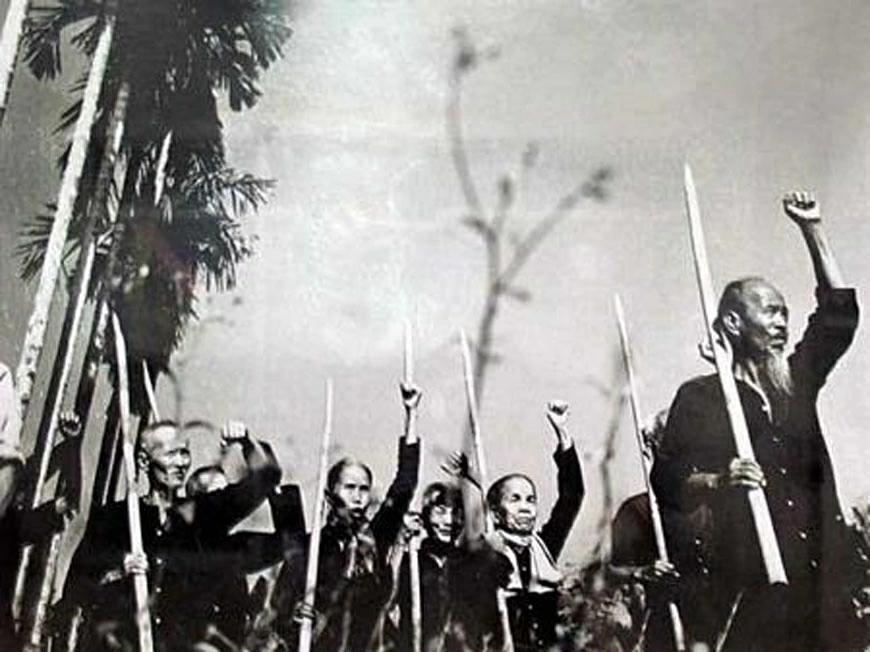 |
| Southern people rise up in resistance against the French colonialists. |
Building and consolidating the revolutionary government
Amidst pressing challenges, on November 25, 1945, the Party Central Committee issued an important directive, “Resistance and Nation-building,” identifying strategic and immediate tasks as well as major policies to guide the actions of the entire Party and people in safeguarding independence, freedom, and the new regime.
Dr. Ngo Minh Vuong, Deputy Head of the Party Building Faculty at Dong Nai School of Politics, noted: “The directive analyzed fundamental changes in both the domestic and international situation after the war, from which it determined urgent tasks such as consolidating the revolutionary government, resisting French colonialists, eliminating internal reactionary forces, and improving people’s living conditions. Among these, protecting and strengthening the revolutionary government was the overarching, most difficult, and heavy task, requiring the Party to strengthen and expand the great national unity bloc, promote reconciliation, and consolidate the nation across all aspects.”
Implementing the mottos “The nation above all” and “The Fatherland above all,” the Party advocated establishing the National United Front against French colonialists, expanding the Viet Minh Front to mobilize people from all walks of life, including even landlords, feudalists, Catholic compatriots, and newly formed patriotic organizations. At the same time, the Party focused on consolidating state apparatus from central to local levels to protect revolutionary gains and independence.
The spirit of the August Revolution, forged by self-reliance, resilience and the power of national unity, led the resistance war against the French to glorious victory with the Dien Bien Phu Campaign in 1954. The triumph, hailed as “resounding across five continents and shaking the globe,” not only forced France to sign the Geneva Accords recognizing Vietnam’s independence and sovereignty, but also reaffirmed a universal truth: when the entire nation unites, no invading force can ever subjugate the Vietnamese people.
Facing severe economic difficulties, particularly the aftermath of widespread famine, the Government launched campaigns against “the hunger enemy” by promoting agricultural production, practicing thrift, organizing rice-saving jars, the “Golden Week” campaign, and raising funds such as the Independence Fund, National Defense Fund, Southern Fund, and Resistance Fund. It also abolished unjust taxes inherited from the old regime and implemented a 25% rent reduction.
To overcome the consequences of the French colonial rule’s “ignorance policy” that left more than 90% of the population illiterate, President Ho Chi Minh initiated a nationwide literacy campaign. The “Mass Education Movement” spread rapidly, helping to gradually push back “the enemy of hunger” and “the enemy of ignorance”. These achievements laid a solid foundation for fighting and defeating both and external invaders and internal enemies, enabling the nation to overcome perilous circumstances.
“The South was the first to rise up, yet the last to be liberated”
Back then in Bien Hoa province covering Dong Nai province, parts of former Binh Phuoc and Binh Duong provinces, efforts to build and consolidate the revolutionary government began early.
 |
| Responding to President Ho Chi Minh’s call, people nationwide contribute rice to aid famine victims. |
According to Assoc. Prof. Tran Quang Toai, Chairman of the Dong Nai Association of Historical Sciences, the Bien Hoa Provincial Cadres’ Conference held on September 23, 1945, made several major decisions, including consolidating the revolutionary government, stabilizing people’s livelihoods, expanding the Viet Minh Front, and preparing forces and bases for resistance in anticipation of the French return. The Provincial People’s Committee also issued policies to stabilize people’s lives such as abolishing unreasonable taxes, confiscating lands of reactionary landlords and absentee owners to redistribute to farmers, reducing taxes and rents, and encouraging agricultural production.
Especially, before the French colonialists opened fire in Bien Hoa, the Provincial Party Committee and People’s Committee prepared resistance plans: launching the “Golden Week” among local people to raise funds for weapons, dismantling factory machinery to move into forests for arms production, and establishing the Vinh Cuu Guerrilla Training Camp to train both politically and militarily, participating in combined attacks against the enemy when they intend to expand, encroach, or conduct reconnaissance on the Dong Nai River. Most of trainees later became excellent commanders of armed units across the Southeast region, playing a key role in building local guerrilla movements.
According to Assoc. Prof. Tran Quang Toai, despite our preparation, on October 25, 1945, French colonial forces still launched an attack to seize Bien Hoa province. They then deployed troops to occupy key transportation hubs, government offices, and public agencies while establishing a puppet administration. Faced with that situation, the Bien Hoa Provincial People’s Committee decided to relocate its leadership agencies to Tan Uyen. The Vinh Cuu Guerrilla Training Camp was also moved to Tan Uyen, where it continued building and consolidating its forces. At that time, Bien Hoa had many armed units, but their coordination was weak and lacked unified command. To bring these forces together, the Commander of Zone 7, Nguyen Binh, who was based in Lac An (Tan Uyen), decided to mobilize them by organizing a raid on Bien Hoa provincial capital.
On December 25, 1945, with support from British troops, French forces launched a two-pronged attack into the former Binh Phuoc area but were met with fierce resistance from local people and forced to retreat several times to regroup. Under Party leadership, the army and people of Bien Hoa tenaciously overcame hardships, sustained and strengthened the resistance against the French, contributing to the ultimate victory of the protracted war to defend the August Revolution, affirming the strength and self-reliant spirit of the Vietnamese nation.
On January 6, 1946, the first General Election was held vibrantly nationwide. In many localities, especially in the South, despite enemy occupation, voters enthusiastically participated in the event. Nearly 90% of voters cast their ballots, electing 333 deputies to the first National Assembly of the Democratic Republic of Vietnam.
Though facing enormous challenges after the August Revolution, Vietnam learned invaluable lessons, particularly in building people’s trust, fostering a capable cadre corps, seizing opportunities, and organizing forces.
By Nga Sơn
Translated by M.Nguyet – Thu Ha


Thông tin bạn đọc
Đóng Lưu thông tin