
On July 17, the Government issued Decree No. 205/2025/ND-CP amending and supplementing several articles of Decree No. 111/2015/ND-CP on the development of supporting industries (referred to as Decree No. 205), which will take effect from September 1, 2025. Accordingly, Decree No. 205 introduces a series of support policies for the supporting industries in terms of technology, human resources, environment, legal frameworks, and investment incentives.
According to experts and businesses, Decree No. 205 expands incentives related to capital, technology, human resources, and market access. This is considered a strategic push to help Vietnam's supporting industries accelerate in the near future.
 |
|
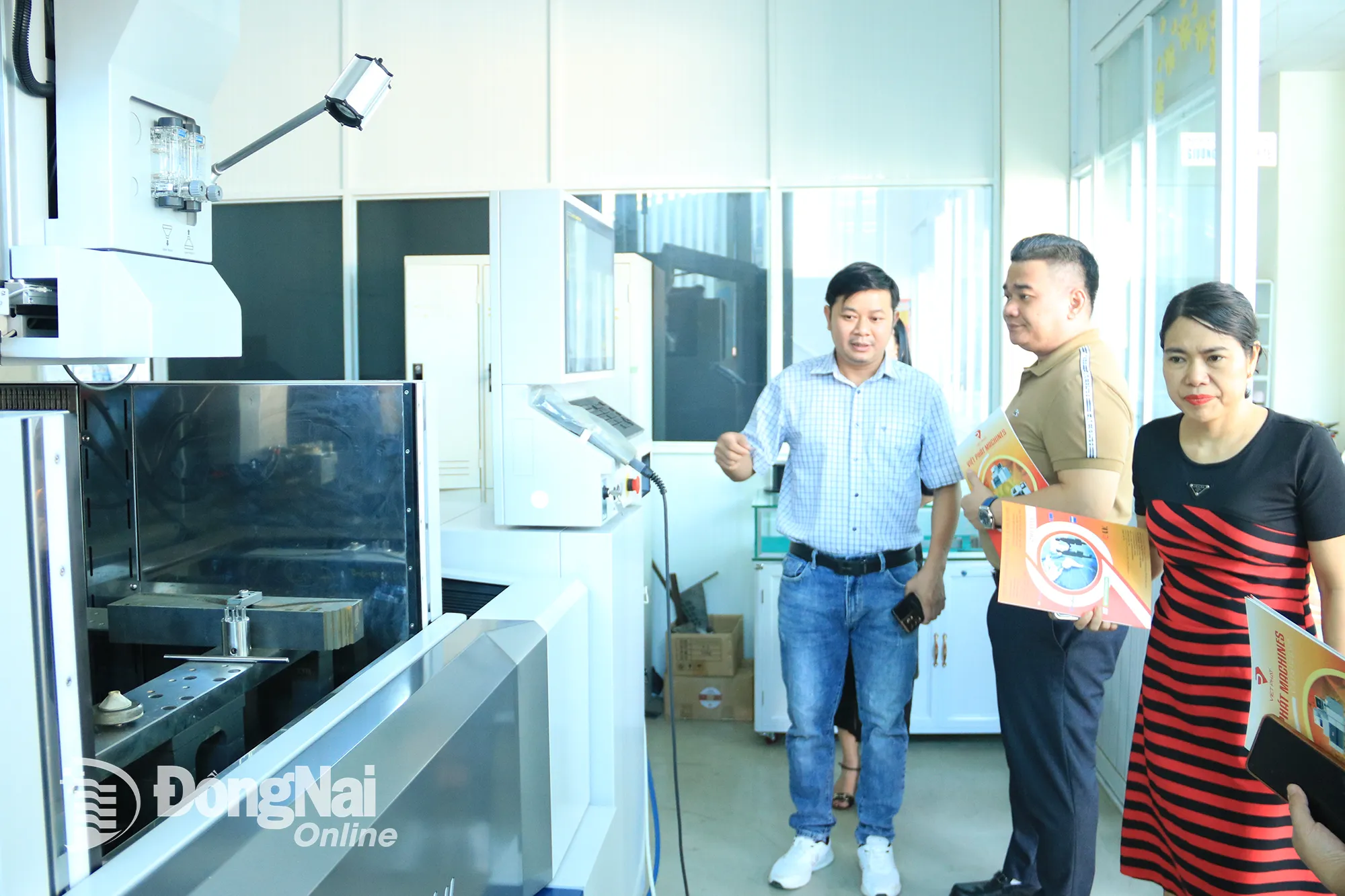
Representative of VPIC Viet Phat Medical Mechanical Tool Co., Ltd in Ho Nai ward introduces the company's product samples. |
Unlocking policies
One of the notable new regulations in Decree No. 205 is the emphasis on activities such as research, product development, technology transfer, and the enhancement of workforce quality—areas regarded as the foundation of processing and manufacturing industries. When enterprises cooperate with research institutes or universities to develop supporting industrial products, they are eligible for support covering up to 50% of costs in categories such as machinery procurement, product design, specialized software, expert consulting services, patent fees, or product certification.
Moreover, funding sources from the National Technology Innovation Fund, the National Science and Technology Development Fund, and current high-tech development programs serve as effective channels for enterprises to access and participate in innovation. Businesses are also entitled to support in areas such as environmental compliance, legal frameworks, and quality inspection. Projects that produce prioritized supporting industrial products can enjoy exemptions or reductions in land and water surface rental fees, as well as tax incentives and investment policies under existing legal provisions.
These new policies are expected to help enterprises, especially small and medium-sized ones, access advanced technologies, thereby improving product quality and enhancing competitiveness in the international market. However, to fully leverage these policies, businesses need to strengthen their technical and financial capacity. Alongside this, the State must continue ensuring transparent allocation of resources to avoid misdirected support and to deliver practical impacts to the supporting industries.
Director Ngo Thanh Binh of Quyet Thang Trading Service Production Company in Tran Bien ward, a company specializing in the supply of automatic vibrating part feeders, shared that small and medium-sized enterprises (SMEs) face a multitude of challenges. Among these are issues like access to land, preferential credit loans, and investment in machinery and technology, persistent barriers to their growth. Though SMEs often possess strong enthusiasm, they can lag behind due to such hurdles. Therefore, it is essential that these policies be implemented effectively and practically for businesses to truly benefit.
The ongoing shift in global supply chains presents an opportunity for Vietnam and domestic enterprises to engage in collaboration and expand their products globally. To seize this chance, businesses must proactively innovate and upgrade their capabilities, complemented by continued government support policies.
Businesses striving to assert themselves
Nhat Tin An Packaging Co., Ltd. in Bien Hoa 2 IP specializes in the production of various types of carton packaging. The company supplies a wide range of carton paper packaging to industrial manufacturers both within and outside the province. As a supporting industrial enterprise, Nhat Tin An is eager to expand its customer base and sales volume.
According to Director Nguyen Huyen Trang of Nhat Tin An, the company's clients are mainly wood manufacturers in Dong Nai and HCM city. The firm is currently expanding its market to international destinations, with approximately 20% of its output consumed overseas. The enterprise hopes to continue collaborating with more wood industry partners in the province to diversify its offerings and broaden market reach while boosting brand recognition.
“As a Dong Nai-based enterprise, we are striving to assert ourselves and actively connect with the local wood industry to supply supporting products,” Trang shared.
Meanwhile, Trang Dai ward-based Vinastar Technical Plastic Manufacturing and Trading Company is one of the few enterprises capable of providing customers with comprehensive solutions through a closed-loop process, ranging from mold design, mold production, product sampling, to plastic production using injection or blow molding technologies, as well as printing and labeling. This capability is largely the result of the company’s involvement in the project "Enhancing productivity and quality models in industrial and commercial enterprises," implemented by the Vietnam Productivity Institute. Through this initiative, Vinastar has adopted modern technologies, engaged in digital transformation for warehouse operations, and cultivated a corporate culture. These efforts have boosted productivity, reduced costs, and moved the company closer to becoming a smart factory aligned with modern production trends.
Director Mai Khanh of Vinastar affirmed that despite encountering many challenges and obstacles, the company has consistently worked to refine its strategic direction. The company’s core strategy centers on developing human resources and continuously innovating production technologies to create products that better meet partner expectations.
Reported by V.Gia



Thông tin bạn đọc
Đóng Lưu thông tin