
Every city can build more skyscrapers, open up more grand boulevards and invest in modern infrastructure, but not every city can establish and preserve its own identity. As Dong Nai embarks on its journey toward becoming a megacity, the challenge is not only to develop rapidly but also to preserve the cultural and historical values that have shaped a land with nearly 330 years of history.
Therefore, preserving, restoring and promoting the historical and traditional cultural values of the Bien Hoa-Dong Nai region is both an immediate task and a foundation for building a modern, distinctive and sustainable city.
A rich and diverse cultural identity
For many people, what leaves the strongest impression when they visit major cities is not necessarily their skyscrapers, large airports or modern underground metro systems, but the cultural values built up over generations.
 |
| Tran Bien Temple of Literature, the first temple of literature in Southern Vietnam and an important historical and cultural site in Dong Nai. Photo: Cong Nghia |
In fact, many major cities around the world have shown that heritage preservation does not hinder development. Instead, it can strengthen a city's identity and create a distinct competitive advantage. Kyoto (Japan), for example, has preserved its old streets, temples and pagodas alongside modern urban development. Singapore has devoted substantial resources to preserving Chinatown, Little India and Boat Quay as part of efforts to retain its urban heritage. Hanoi, Vietnam's capital city with a thousand years of cultural heritage, has likewise preserved its Old Quarter. Such heritage has become an important part of the identity and appeal of these cities.
Dong Nai has advantages that few other cities possess: the population and land area of a major industrial center, combined with a history spanning nearly 330 years. A prominent symbol of this historical depth is Tran Bien Temple of Literature, the first temple of literature in Southern Vietnam, built in 1715. After undergoing numerous historical changes, the site was restored and has become an important cultural institution and a symbol of the scholarly tradition of the Bien Hoa-Dong Nai region. Its value lies not simply in its age, but in the fact that it remains a living cultural space where the tradition of learning continues to flourish in the heart of an industrial city.
For many people, Dong Nai is closely associated with the Dong Nai River, the longest river flowing entirely within Vietnam. The river has sustained generations of residents and witnessed the settlement, exploration and development of the region. Its waters and alluvial deposits have nourished the land and supported communities, while the river itself has become closely intertwined with the memories, cultural values and way of life of millions of people living along its banks and downstream areas.
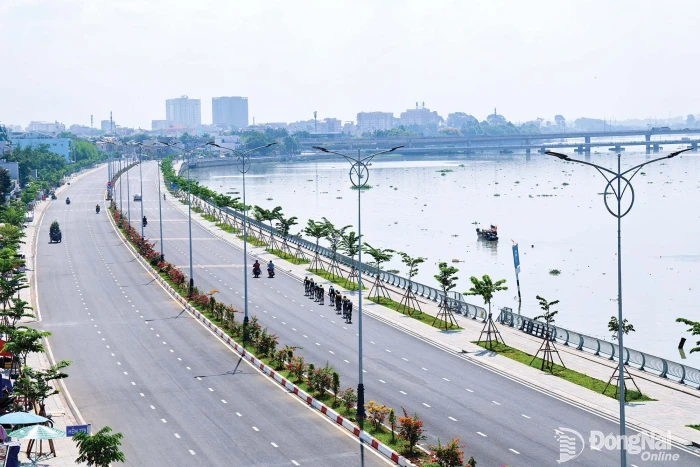
In the future, Dong Nai City plans to expand urban development toward the river. Alongside tapping into its economic potential, the city has identified the need to preserve the river's landscape, ecosystem and cultural spaces. Protecting the Dong Nai River is therefore an important part of preserving the identity of a city that bears its name.
Natural heritage is another important part of Dong Nai's identity. National parks, nature reserves and biosphere reserves, with their vast areas of primeval forest, serve as the “green lungs” of the Southeastern region. Their protection reflects Dong Nai's approach of pursuing urban development alongside nature conservation, rather than sacrificing the ecological environment for economic growth.
Today's Dong Nai City is home not only to industrial parks, an airport, seaports and modern urban areas, but also to traditional crafts, pagodas, festivals and cultural values passed down through generations. Accordingly, black-clay pottery is a distinctive feature of the city. Vuong Khieng of the Dong Nai Fine Arts Pottery Association said each black-clay pottery product reflects the skill, diligence and creativity of its maker. The black-clay pottery craft is being preserved and linked with experiential tourism, creating a new avenue for promoting the city's cultural heritage.
In the Northern part of the city, the presence of various ethnic minority communities has created a rich cultural space featuring festivals, gong cultural practices, customs and traditional crafts, adding to the diversity of Dong Nai's cultural heritage. One of the most prominent sites is the national historical relic of Bom Bo hamlet, a source of pride for the S’tieng ethnic community and the southeastern region. These cultural values are being preserved and promoted as part of the city's broader urban development strategy.
Turning heritage into a development resource
Dong Nai is moving toward building a civilized, modern and happy city, with people considered as the centre, subject, resource, goal, and beneficiaries of development. In the cultural sphere, this requires the preservation, restoration and promotion of the region's historical and traditional cultural values.
 |
| Festival activities at Tan Lan Communal House in Tran Bien ward. |
Notably, the city's planning and development strategies increasingly integrate cultural heritage into the urban development process. From Tran Bien Temple of Literature, Bien Hoa Ancient Citadel and Tan Hiep Prison to traditional crafts, the Dong Nai River and everyday cultural activities, these values are being incorporated into efforts to preserve and sustainably promote the city's cultural heritage.
A small but telling example is Dong Nai City's decision to adjust the alignment of a riverside road to preserve Ha Thanh Ancient House rather than demolish it. The decision goes beyond the scope of a transport project. It reflects a choice between maintaining the original technical plan and making adjustments to preserve a cultural heritage site. The authorities' decision to listen to residents and experts demonstrates a new development mindset that places cultural values alongside infrastructure requirements. Changing the design to preserve an old house is ultimately a way of protecting part of the city's collective memory.
Dong Nai City will certainly have more new roads, urban areas and modern transport infrastructure in the future. Yet what will make residents proud and encourage visitors to return is the presence of the tranquil Dong Nai River, the sound of gongs in ethnic minority communities, and the enduring presence of temples of literature, shrines, ancient citadels and historic prisons.
As Nguyen Van Ut, Deputy Secretary of the City Party Committee and Chairman of Dong Nai People's Committee, has emphasized, Dong Nai possesses advantages that many other localities do not: a history spanning more than three centuries; a position as one of the country's most dynamic industrial centers; and remaining areas of primeval forest, major rivers and a diverse cultural landscape shaped by numerous ethnic communities. Under the city's development strategy, economic growth must go hand in hand with the preservation of cultural identity, while culture serves as both a spiritual foundation and an endogenous resource for development.
The elements that embody Dong Nai's identity include Tran Bien Temple of Literature, Bien Hoa Ancient Citadel and Tan Hiep Prison; the Dong Nai River and Dong Nai Biosphere Reserve; gong cultural spaces and traditional festivals of ethnic minority communities; and traditional crafts such as pottery, brocade weaving and basketry.
As metro lines are extended, Long Thanh International Airport comes into operation and new urban areas continue to take shape, Dong Nai's distinct identity will still be found in the river that bears its name, Tran Bien Temple of Literature, the sound of gongs echoing through the forests, traditional craft villages and preserved old houses. Preserving the soul of Dong Nai today is not merely about safeguarding the memories of a historic region. It is also about preserving the appeal, identity and competitiveness of a megacity Dong Nai aspires to become.
By B.Mai – Translated by M.Nguyet, Thu Ha


Thông tin bạn đọc
Đóng Lưu thông tin