
The traditional craft of brocade weaving is a distinctive cultural practice that shapes the identity of the Ma ethnic group and also serves a practical role, providing goods for exchange and daily life in Ta Lai commune, Dong Nai province. For Ma women, brocade is more than just fabric, as it is a vessel for emotion, a place where memories are woven, and where love for family, the mountains, and the community is expressed. Each piece of cloth thus becomes a symbol of cultural identity and a source of profound pride.
 |
| Craftswoman Ka Rin demonstrates traditional brocade weaving techniques to her daughter, Ka Huong, and granddaughter. Photo courtesy of the museum |
The story of traditional brocade weaving by Ma ethnic women in Ta Lai commune is being showcased through a special thematic exhibition at the Southern Women’s Museum in Ho Chi Minh City.
Bearing the nation's love and spirit
In a small yet cozy space within a bustling urban museum, the traditional attire of the Ma ethnic community from Ta Lai commune captivates visitors passionate about cultural heritage. The exhibition showcases not only the Ma people’s traditional garments, such as loincloths, shirts, skirts, decorative cloths, scarves, and baby carriers, but also tourism-oriented products, such as bags and bracelets. Beyond simple display, the exhibition invites visitors to journey along the Dong Nai River back to Ta Lai village, where they can explore the origins of these crafts and the process of creating handwoven textiles.
It is a scene of women like artisans Ka Rin and Ka Huong, absorbed at their looms, meticulously completing every step to produce a piece of cloth imbued with both love and the cultural soul of their community. These diligent women, passing down their skills from one generation to the next, play a crucial role in preserving the community’s invaluable heritage, especially at a time when traditional crafts are at risk of fading amid rapid societal change.
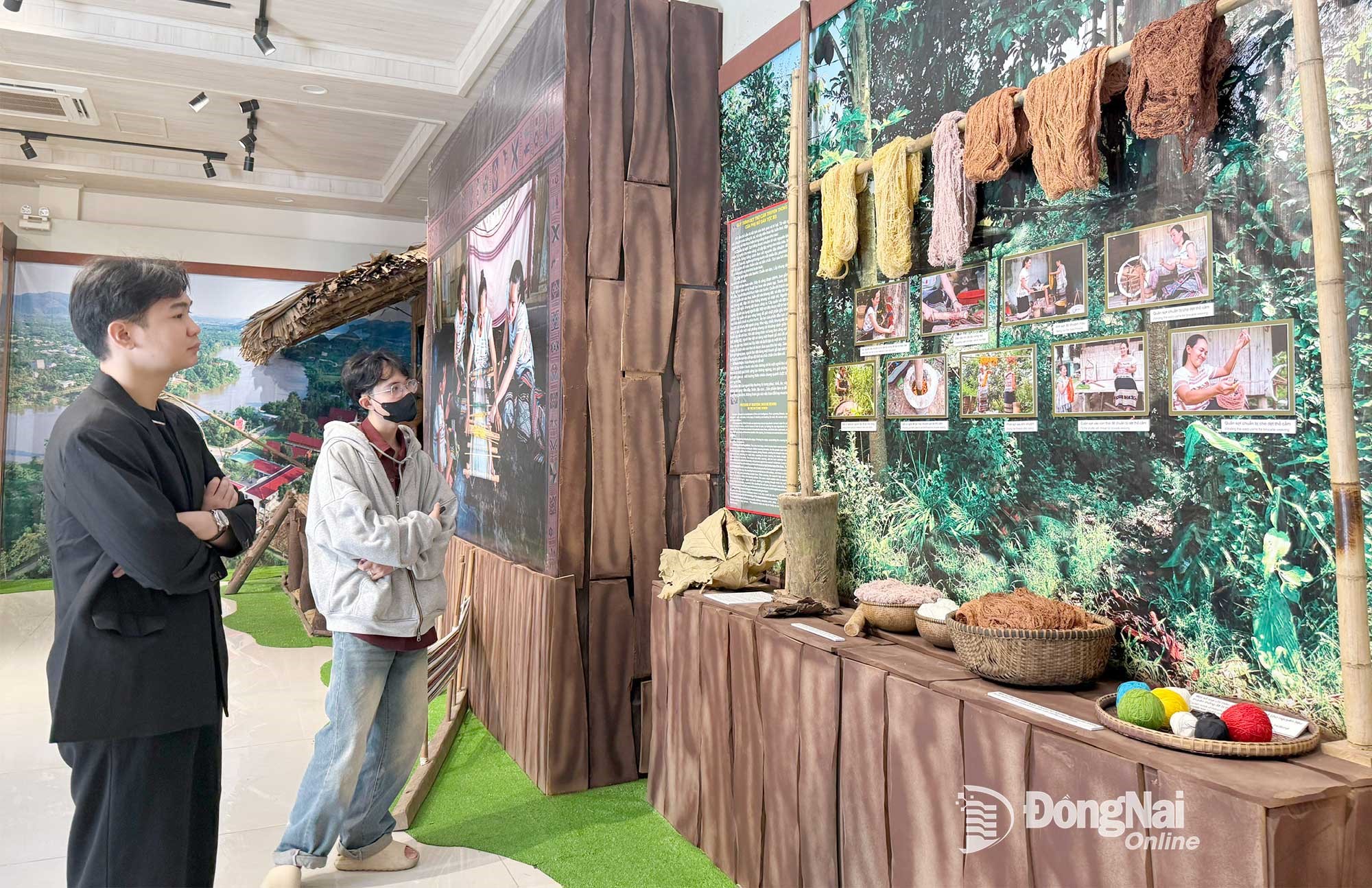 |
| Visitors explore the traditional weaving process of Ma ethnic women on display at the museum. Photo: Nhat Ha |
“Through visiting and exploring the thematic exhibition, as well as the artifacts and documents on this traditional craft, I could clearly feel the cultural identity and creative spirit of Ma women,” shared Nguyen Thi Hoa from Ho Chi Minh City.
At ages 8 to 9, Ma girls begin learning their first weaving techniques from their grandmothers and mothers. This process of transmission involves not only technical skills and patience, but also an immersion in the community's culture. A meticulously crafted handwoven cloth embodies the pride, talent, and dexterity of Ma women, reflecting both their social stature and aesthetic values within the community.
To revitalize traditional textiles in modern society, these products have been creatively adapted for tourism purposes. This change not only helps preserve traditional techniques and patterns but also affirms the importance of cultural heritage in the context of modern integration.
Crystallizing identity and pride
To create intricate and beautiful traditional handwoven textiles, Ma women carefully spin threads, dye colors with leaves, roots, and tree bark, and skillfully operate the shuttle and loom. This detailed process captures the spirit of the forest, the skill of women’s hands, and the natural hues of the environment.
White threads are dyed with natural materials, such as turmeric for yellow, the bark of hill-lotus trees for brown, and giay ty leaves for pink. The indigo color (dark blue) was traditionally obtained from indigo leaves; however, this source has now been lost, and dark blue, blue, and green threads are replaced with synthetic dyes. Similarly, the red pigment, once made from ant-wing leaves, has also disappeared.
Ta Lai commune was formed by merging the three communes of Ta Lai, Phu Thinh, and Phu Lap. The area is renowned for its natural beauty and the cultural identity of its ethnic minorities, particularly the Ma and S’tieng ethnic groups. Among them, the Ma community has created a distinctive cultural space, with traditional handwoven textiles recognized as an important intangible cultural heritage. This craft deeply reflects the community’s worldview and spiritual beliefs.
Dyeing materials are first boiled to extract their essence, and the threads are repeatedly soaked in the resulting liquid, drying after each immersion to ensure deep, lasting color. After dyeing, the threads are thoroughly washed and completely dried. The threads are then wound lengthwise and set up on the loom.
The final stage, weaving and pattern creation, is the centerpiece of the craft, combining basic weaving techniques with intricate pattern-making methods. Once the loom is dismantled, the fabric is carefully straightened. Each piece of cloth, shaped by delicate, continually evolving designs, reflects the intelligence, aesthetic sense, and accumulated folk knowledge of the Ma people, while also capturing the natural environment that surrounds their daily lives.
By Nhat Ha – Translated by Hong Van, Minho


Thông tin bạn đọc
Đóng Lưu thông tin