
Amidst the rhythm of modern life, in Doan Ket hamlet, Bu Dang commune, Dong Nai province, the sound of rice-pounding pestle still echoes beneath the stilt houses of the S’tieng people. This rustic sound once set the tempo for the “pounding rice to support soldiers” movement during the resistance war and inspired musician Xuan Hong to compose the immortal song “The sound of rice-pounding pestle in Bom Bo Hamlet.”
 |
| Residents of Doan Ket hamlet, Bu Dang commune, continue to practise traditional rice-pounding by hand in their communal life. Photo: Tu Huy |
Today, the S’tieng people take even greater pride as their traditional rice-pounding custom has been inscribed by the Ministry of Culture, Sports and Tourism onto the List of National Intangible Cultural Heritage, a vivid testament to the endurance of culture and the pride of a people through the passage of time.
A custom of everyday life – the breath of culture
On June 27, 2025, the Ministry of Culture, Sports and Tourism officially included “The custom of pounding rice by hand of the S’tieng and M’nong ethnic groups” in the List of National Intangible Cultural Heritage. The official announcement ceremony will be held on November 21, 2025, by Dong Nai’s Department of Culture, Sports and Tourism at the S'tieng Ethnic Culture Preservation Area in Bom Bo hamlet, together with the recognition of Bom Bo Hamlet as a national historical site. This is a significant cultural event that both honours traditional values and opens a new direction for preserving and promoting the heritage of ethnic minorities across the province.
For the S’tieng and M’nong peoples, pounding rice by hand is an essential part of daily life. Each beat of the pestle not only produces rice for family meals but also prepares for festivals, welcomes guests, or makes can wine (fermented rice wine). This flavour is indispensable to communal gatherings.
Doan Ket hamlet is home to 180 households representing six ethnic groups, with the S’tieng forming the majority. Although processed rice is widely available, seventy S’tieng households still keep their mortars, pestles, and winnowing trays. These are also ancestral heirlooms, serving as a way to preserve the memory of their homeland amid the rhythm of modern life.
Dieu Huon, a resident of Doan Ket, shared: “Every household keeps a set of mortar, pestle, and winnowing tray to occasionally pound rice. A productive harvest yields about twelve sacks per rod (local unit), but despite the availability of rice mills, we still prefer to pound rice by hand, preparing just enough for several days.”
Thi Mum, now in her sixties, recalled: "I learned to pound rice when I was thirteen. After working in the fields during the day, everyone gathered in the evening to pound rice together – it was fun, lively. Our rice, dried and pounded by hand, is fragrant and sticky, something one never tires of eating."
Preserving the craft – preserving the spirit of the hamlet
According to surveys by the Dong Nai Department of Culture, Sports and Tourism, among the 67 areas where S’tieng and M’nong communities live in the province, only Doan Ket hamlet continues the traditional rice-pounding practice. The hamlet currently has around 25 hectares of wet rice fields, with one or two annual crops. The harvest not only sustains daily food supplies but also provides grain for communal pounding events.
Dieu Krang, head of the hamlet’s Vietnam Fatherland Front Committee, said: “Whenever there is a festival, everyone gathers to pound rice. It’s a way to preserve our tradition and teach the younger generation about our identity. Today, the mortars and pestles are also used to pound flour for canh boi (a local dish), make yeast for can wine, and prepare cakes – all traditional foods and drinks deeply tied to our cultural life.”
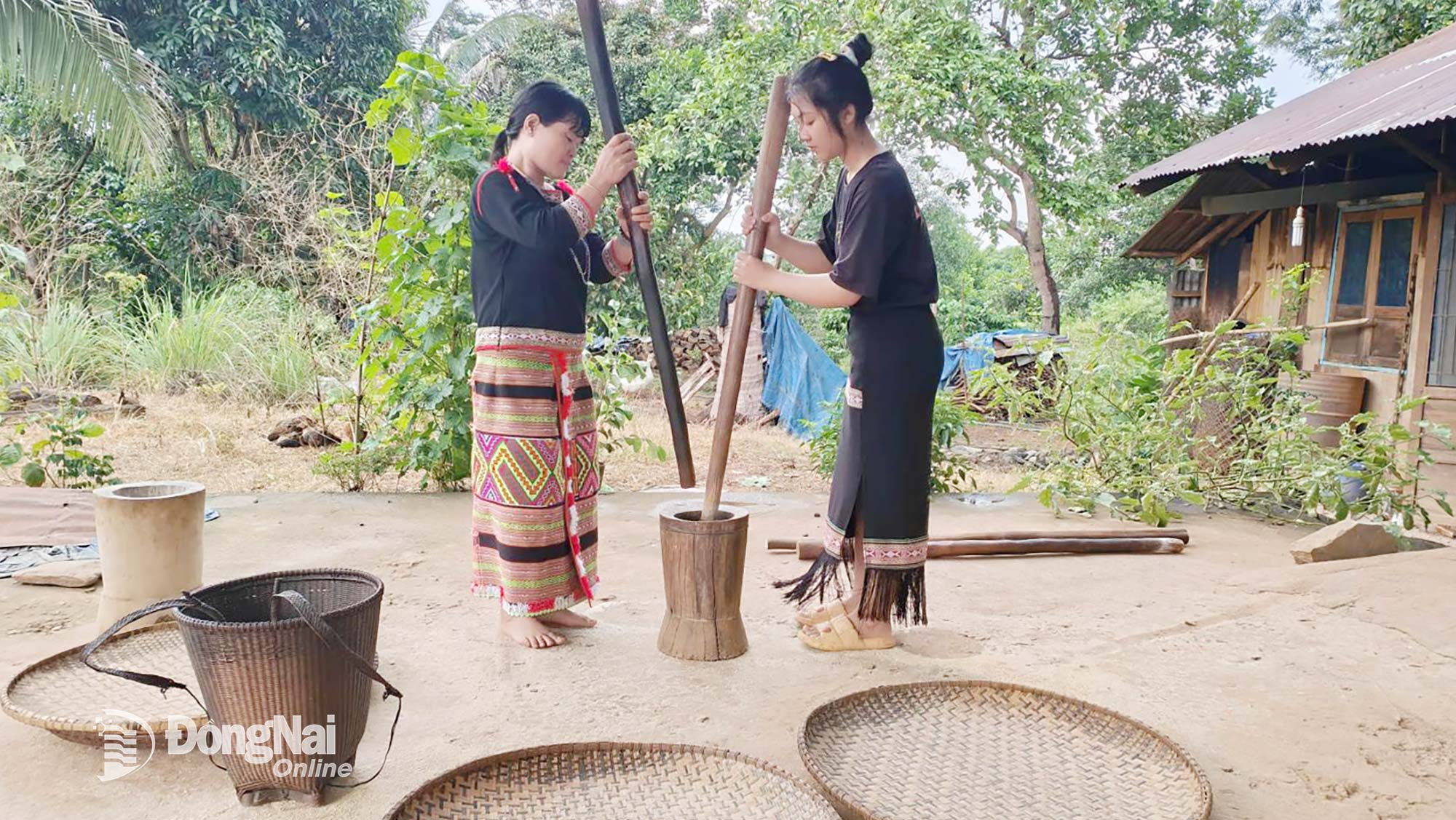 |
| Young people carry on the rice-pounding tradition of their ancestors. Photo: Tu Huy |
Amidst the pace of modern life, the people’s continued practice of pounding rice by hand stands as a living testament to their cultural resilience and self-awareness in safeguarding heritage.
Ngo Hoang Vu, Party Secretary and Head of Doan Ket hamlet, shared: “Every year, the Great National Solidarity Day includes demonstrations of the rice-pounding tradition, offering an opportunity to promote and teach young people about the cultural values of their ethnic group.”
Beyond daily life, the rice-pounding tradition has also been revived and showcased at the S'tieng Ethnic Culture Preservation Area in Bom Bo hamlet. Located on a historical site spanning over 17,000 square metres – once the heart of the “pounding rice to support soldiers” movement during the resistance – it now serves as a living museum of traditional culture. Visitors can don ethnic costumes and join in pounding rice alongside the locals, an experience both engaging and rich in historical meaning.
Do Van Tien Thanh from Dong Xoai ward, Dong Nai province, shared his impressions: “Wearing the traditional attire of the S’tieng people and pounding rice for the first time felt both joyful and fascinating. It allowed me to imagine the spirit and atmosphere of those bygone days when the people pounded rice to support soldiers during the resistance.”
From heritage to community livelihood
Including “the custom of pounding rice by hand” into the National Intangible Cultural Heritage list not only recognizes its cultural value but also provides a legal framework for its preservation and promotion within the community.
“The rice-pounding custom of the S’tieng people has existed for generations, closely linked with the revolutionary spirit. At its height in 1965, only 30 households (about 80 people) pounded five tonnes of rice in three days and nights to support the Dong Xoai – Phuoc Long campaign. Because of this significance, we decided to restore and introduce this activity to visitors right where our ancestors once worked for the resistance, helping everyone better understand that heroic era.”
Pham Anh Tuan, Director of Bom Bo Commune Integrated Service Centre, Dong Nai province
Nguyen Ngoc Yen, Director of Dong Nai Museum, said: “Alongside traditional crafts such as brocade weaving, basketry, and can wine brewing, the custom of pounding rice by hand will be incorporated into our programmes for cultural education and experiential tourism. The heritage announcement ceremony will also help promote Bom Bo hamlet – the land immortalised in Xuan Hong’s song ‘The sound of rice-pounding pestle in Bom Bo hamlet’. Many have heard the song, yet few have visited this place. We hope the event will attract visitors to learn more about the culture of the S’tieng and M’nong ethnic peoples.”
 |
| Through many stages, including pounding, winnowing, and sieving, the pure white grains of rice emerge. Photo: Tu Huy |
When recognized as a national intangible cultural heritage, the custom of pounding rice by hand not only fills the people of Dong Nai with pride but also opens opportunities to link the tradition with eco-cultural tourism, creating livelihoods that sustain both heritage and local economies. More than a labour practice, the practice of pounding rice by hand symbolises community spirit, unity, and perseverance. Each sound of the pestle connects past and present, ancestral memory and today’s aspirations.
By preserving their craft of pounding rice by hand, the S’tieng and M’nong people of Dong Nai are keeping alive not just a method of labour, but the very essence of their communal spirit, faith, and cultural identity. The recognition of this custom as a national intangible cultural heritage is a tribute to the past and a source of vitality, ensuring that these cultural values continue to thrive in the modern world.
By Ly Na – Translated by My Le, Thu Ha


Thông tin bạn đọc
Đóng Lưu thông tin