The Trang An Scenic Landscape Complex located in the northern province of Ninh Binh has been recognized as a world heritage site. The recognition makes Trang An the first heritage site of its kind in Vietnam.
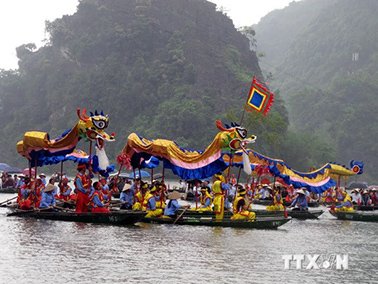 |
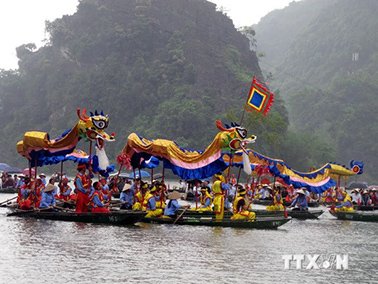
| A ceremony to worship the dragon at Trang An Scenic Landscape Complex in Ninh Binh Province |
The Trang An Scenic Landscape Complex located in the northern province of Ninh Binh has been recognized as a world heritage site. The recognition makes Trang An the first heritage site of its kind in Vietnam.
The acknowledgement of the Trang An complex is based on the principles of the Convention on the Protection of World Cultural and Natural Heritages including cultural, aesthetical, geological values, and the preservation of heritage. The result was unveiled at the 38th session of the World Heritage Committee in Doha, Qatar from June 15 to 25.
The Trang An complex has become Vietnam’s 8th cultural and natural heritage site recognized by the UNESCO.
The heritage site covers a large area of around 10,000 hectares, and is made up of three components within a single buffer zone, including the Trang An Ecological Area, the Tam Coc-Bich Dong River Landscape, and the Hoa Lu Ancient Citadel. The three areas share a common geological and ecological environment characterized by dramatic limestone karsts, permeated with a network of caves, and bound together by flooded inland waterways of high biological diversity.
The 4,000-hectare Trang An ecological tourist attraction is the entire Trang An limestone area that is surrounded by 8,000ha, mostly consisting of rice fields. The site dates back some 250 million years and has hundreds of valleys and caves.
Vietnam has five cultural heritage sites recognized by UNESCO including Hue Monuments Conservation Center, Hoi An Ancient Town, My Son Sanctuary, Thang Long Imperial Citadel and Citadel of Ho Dynasty. Moreover, the nation has two world natural heritage sites including Ha Long Bay and Phong Nha-Ke Bang National Park.
UNESCO has also awarded intangible heritage certificates to Vietnam’s Hue nha nhac (royal music), the space of gong culture in Central Highlands, quan ho (love duet) in Bac Giang and Bac Ninh, the art of ca tru, Giong Festival in Phu Dong and Soc temples, the art xoan singing, the worship of Hung Kings and don ca tai tu Nam Bo (Southern opera singing).
(Source:SGT)