
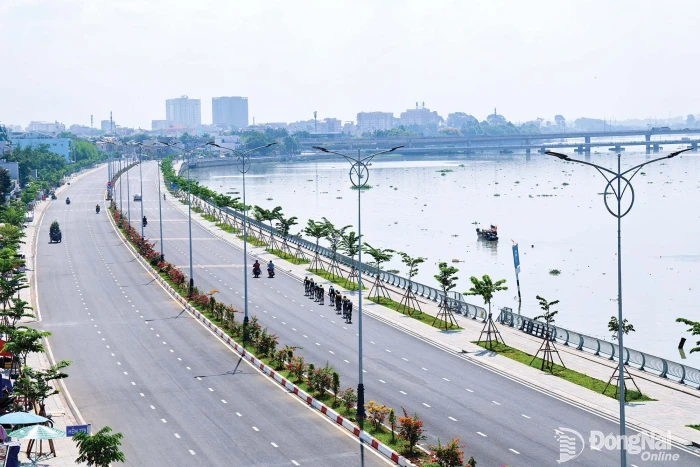
The Dong Nai River has been identified as the principal urban landscape axis of Dong Nai City. As part of its long-term development strategy, the city plans to transform the riverfront into a distinctive ecological, scenic, and economic corridor.
 |
| The Dong Nai River is regarded as a natural treasure flowing through the heart of Dong Nai City. |
Stretching 586 kilometers in total, the Dong Nai River runs for more than 234 kilometers through Dong Nai City. For the city, the river is a valuable natural asset with significant economic, cultural, historical, and landscape value—an advantage few urban centers possess. Beyond its roles in agriculture, industry, inland waterway transportation, and eco-tourism, the river has also shaped the city’s riverside urban identity.
A natural treasure in the heart of the city
According to Ho Van Ha, Member of the City Party Committee and Vice Chairman of the Dong Nai City People’s Committee, despite being one of Vietnam’s most dynamic industrial and urbanizing regions, Dong Nai still enjoys the rare advantage of a vast river landscape, particularly in urban areas and zones designated for urban development such as Bien Hoa, Long Thanh, and Nhon Trach.
Although widely considered a natural treasure with enormous potential to drive economic and urban growth, the Dong Nai River has yet to be fully utilized. Authorities acknowledge that development along the riverfront has been slow and lacks a comprehensive master plan. Technical infrastructure remains incomplete, architectural development lacks cohesion, and cultural facilities serving the public have yet to be established along the river.
The importance of the river corridor was also highlighted in Conclusion No. 69 issued by the Office of the Party Central Committee following Party General Secretary, State President To Lam’s working session with the Standing Board of the Dong Nai City Party Committee. The document identified the reorganization of urban space into a multi-centered development model as a key priority, with Bien Hoa, Long Thanh International Airport, Nhon Trach, Trang Bom, Dong Xoai, regional transportation corridors, and particularly the Dong Nai River corridor serving as major growth engines.
Nguyen Van Ut, Deputy Secretary of the City Party Committee, Chairman of the Dong Nai City People’s Committee, noted that spontaneous development, illegal construction, inefficient land use, and inadequate landscape management remain common along the river corridor. These issues have diminished the value of the city’s riverfront areas.
In reality, many sections of the riverbank are still occupied by warehouses, small ports, temporary structures, and industrial facilities established in previous development phases. These uses occupy valuable waterfront land, hinder urban redevelopment, and create environmental concerns.
Building a distinctive ecological and economic river corridor
Since April 30, 2026, Dong Nai has officially become Vietnam’s seventh city. According to architect Khuong Nguyen Duc Chuong, Chairman of the Dong Nai City Architects Association, becoming a city is not merely a matter of administrative restructuring or improved road infrastructure—it represents an opportunity to elevate residents’ quality of life while preserving the region’s natural and cultural heritage. In urban space, the development process must go hand in hand with preserving traditional values. “Heritage should never be viewed as a burden,” Chuong emphasized.
 |
| Dong Nai City plans to redevelop the riverfront along Dong Nai River into a distinctive ecological, scenic, and economic corridor. |
From this perspective, Chuong believes that historical sites and traditional craft villages along the Dong Nai River should form the backbone of the city’s identity. Urban planning around these heritage sites should include buffer zones and cultural plazas that allow residents and visitors to engage with local history and culture. He also stressed that the Dong Nai River should become the city’s “front façade.” Rather than serving solely as a water source, the river should evolve into the city’s primary landscape and economic axis.
Sharing his vision for the riverfront, Chuong advocated for an open-planning approach that prioritizes continuous riverside parks and public spaces. Such green corridors, he noted, provide one of the most effective natural solutions for climate change adaptation. He further proposed leveraging the river’s urban value by developing waterway tourism routes connecting Bien Hoa with Cat Tien to the north and Nhon Trach to the south. Plans should include marinas, cultural centers, and public amenities to ensure that the river becomes an active part of daily urban life. “Dong Nai needs riverside cultural centers and yacht harbors so that the river can truly live alongside its people,” architect Khuong Nguyen Duc Chuong shared.
Recognizing current challenges and opportunities, Dong Nai City has identified the redevelopment of the Dong Nai River waterfront as a breakthrough task with strategic significance for its next stage of development.
According to City People's Committee Chairman Nguyen Van Ut, the city will focus on transforming the riverfront along Dong Nai River into a continuous ecological, landscape, and economic corridor. Key priorities include reviewing and adjusting urban plans to expand uninterrupted public riverfront spaces. The city also intends to restructure land use along the river, relocating outdated industrial facilities, warehouses, and ports that are no longer appropriate or that contribute to environmental pollution. These sites will be converted to higher-value uses that better align with sustainable urban development goals.
Dong Nai city will also strengthen control over construction order, put an end to spontaneous development, and at the same time promote investment attraction in riverside projects to create new momentum for sustainable urban development in the coming period.
By Pham Tung-Translated by Mai Nga, Minho


Thông tin bạn đọc
Đóng Lưu thông tin