
Dong Nai City is set to break ground on three major transport infrastructure projects on June 30, in a move expected to strengthen both urban and regional connectivity while supporting its ambition to become one of Vietnam's new growth poles.
 |
| Rendering of the 13-km elevated section under Component Project 1, stretching from Ma Da Bridge to Ba Hao Junction as part of the road linking Ma Da Bridge with Ho Chi Minh City Ring Road 4. |
Region's largest road project to link cities and industrial zones
Ho Chi Minh City Ring Road 4 will span more than 200 kilometers, including nearly 160 kilometers of newly built roadway approved by the National Assembly (NA), making it the largest road infrastructure project ever undertaken in Vietnam's Southeast Region. The route will run through Dong Nai City, Ho Chi Minh City and Tay Ninh province.
 |
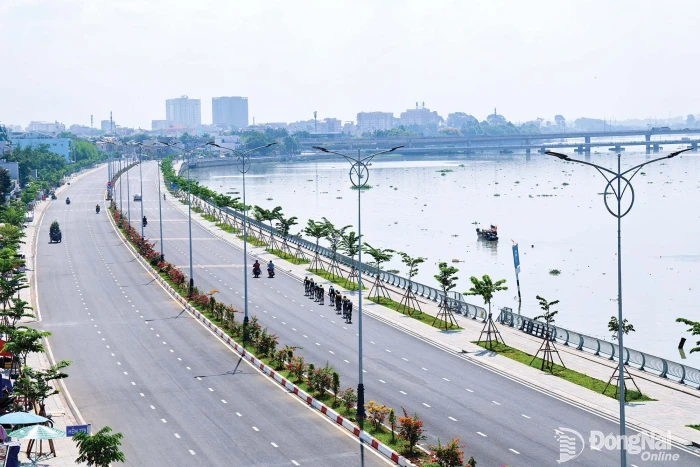
| Nguyen Huu Canh Boulevard, once fully completed, will create an additional transport corridor linking Dong Nai City with Ho Chi Minh City via the Ho Chi Minh City–Long Thanh–Dau Giay Expressway. Photo: Pham Tung |
The section passing through Dong Nai City extends more than 46 kilometers. It begins at Km18+480 in Xuan Duong commune, connecting with the endpoint of Component Project 2-1, and ends at Km64+630 in Thuong Tan commune, Ho Chi Minh City, including Thu Bien Bridge, where it links with the Ring Road 4 section running from Thu Bien Bridge to the Saigon River.
Under the NA's resolution, the project is divided into ten component projects, with each locality responsible for implementing the section within its jurisdiction.
According to the schedule, Dong Nai will officially launch construction on the morning of June 30 for the collector roads and side roads under Component Project 1-2, which covers land acquisition, compensation, resettlement and the construction of auxiliary road systems within the city's section of Ho Chi Minh City Ring Road 4.
According to the Dong Nai Construction Investment Project Management Board, after breaking ground on Component Project 1-2, the board will continue with the necessary procedures for Component Project 2-2, covering the expressway section from Chau Duc Bridge to Thu Bien Bridge under the public-private partnership (PPP) model, with construction expected to begin in September 2026.
Deputy Secretary of the City Party Committee and Chairman of the Dong Nai People's Committee Nguyen Van Ut said that Ho Chi Minh City Ring Road 4 is a nationally significant project subject to several special policy mechanisms to accelerate implementation and ensure timely completion.
As the largest road infrastructure project ever developed in the Southeast region, Ring Road 4 is expected to become a strategic transport corridor linking the Southeast, the Mekong Delta and the Central Highlands. The route will facilitate the movement of goods between industrial parks, urban areas, seaports and airports, helping to improve regional logistics and supply chain connectivity.
The project will also improve links between urban centers and industrial zones, strengthen regional integration and support socio-economic development across the Southern Key Economic Region. In addition, it is expected to ease traffic congestion in urban areas while opening up new space for urban expansion and more efficient land use.
For Dong Nai in particular, Ring Road 4 will provide a strategic transport link connecting industrial parks and urban areas with Long Thanh International Airport and the Cai Mep–Thi Vai deep-water port complex, while creating new development opportunities for localities along the route.
New projects to improve north-south connectivity
Also scheduled to commence on June 30 are Component Project 1, covering the section from Ma Da Bridge to Ba Hao Junction under the road linking Ma Da Bridge with Ho Chi Minh City Ring Road 4, and Nguyen Huu Canh Boulevard Section 2.
 |
| Artist's impression of Ho Chi Minh City Ring Road 4 passing through Dong Nai City. Photo: Pham Tung |
Nguyen Huu Canh Boulevard Section 2 will complete the corridor linking National Highway 51 with the Ho Chi Minh City–Long Thanh–Dau Giay Expressway. The route is expected to provide an additional connection between Dong Nai City and Ho Chi Minh City, easing pressure on National Highway 51 while encouraging the development of riverside urban areas along the Dong Nai River.
Meanwhile, Component Project 1, extending from Ma Da Bridge to Ba Hao Junction, is one section of the road linking Ma Da Bridge with Ho Chi Minh City Ring Road 4. The 13-kilometer section passes through the Dong Nai Nature and Culture Reserve and will be developed under the PPP model.
The road linking Ma Da Bridge with Ho Chi Minh City Ring Road 4 is regarded as one of Dong Nai City's most important transport infrastructure projects, creating a continuous north-south transport axis across the city.
According to Ho Van Ha, Vice Chairman of the Dong Nai City People's Committee, the project is intended to establish a strategic transport corridor connecting the northern and southern areas of Dong Nai City. Once completed, the route will improve transport links between the Central Highlands and northern Dong Nai, as well as to Long Thanh International Airport and the Cai Mep–Thi Vai port complex.
By P. Tung – Translated by M.Nguyet, Minho


Thông tin bạn đọc
Đóng Lưu thông tin