
Dong Nai City has been one of Vietnam’s key industrial hubs for decades. Throughout its development journey, the city has gradually improved the quality of investment attraction, shifted its strategic direction, and prioritized modern industrial sectors to ensure sustainable growth.
 |
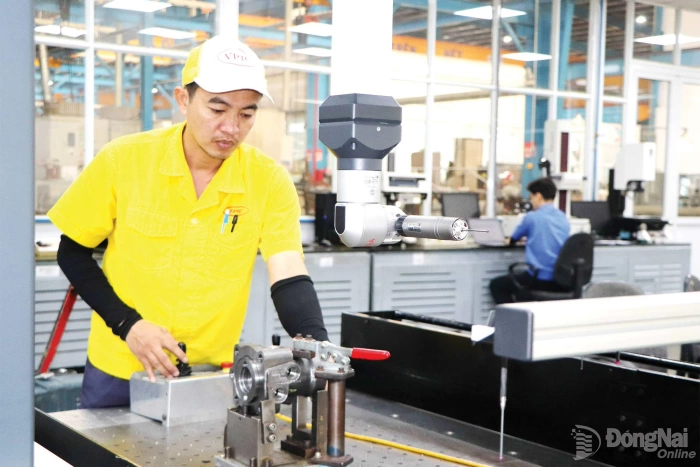
| Production at Global Powersports Manufacturing Incorporation in Giang Dien Industrial Park. |
In the new era, especially after Dong Nai officially became a city, development based on higher standards has become an inevitable requirement. This reality is both a challenge and a major opportunity for the locality and investors to shape a modern industrial landscape in Dong Nai.
Expanding investment and developing new industrial land funds
Dong Nai is entering a particularly important development phase as a series of strategic infrastructure projects are being implemented simultaneously, including Long Thanh International Airport, regional expressways, and ring road systems connecting neighboring areas. In this context, developing industrial parks is no longer simply a long-term option but an urgent necessity for the city to seize new growth opportunities.
The strong global shift in supply chains is also an opportunity for Dong Nai to get ahead of a new phase of development. Many foreign corporations are continuing to seek investment locations in Vietnam, especially in the southern region. With the advantage of being located at the center of the country’s largest economic hub, Dong Nai has become a destination that has drawn the interest of many businesses. However, without a ready supply of industrial land, its opportunities to attract investment will be limited.
In reality, Dong Nai’s existing industrial land reserves are gradually reaching full occupancy. Major industrial parks in the Southern part of the city already have high occupancy rates, while businesses’ demand for production expansion continues to rise. Currently, the city has 89 planned industrial parks covering more than 39,000 hectares. Of these figures, 58 industrial parks have been established, with 44 already operational, for an occupancy rate of 76%. Investors from 51 countries and territories have invested in Dong Nai, with total registered capital exceeding USD 45 billion.
This situation has placed significant pressure on the locality to prepare new industrial land reserves. As a result, Dong Nai is accelerating the development of additional industrial parks to create more space for domestic and foreign investors. The city is currently seeking investment in 14 infrastructure projects for industrial parks, digital industrial parks, and high-tech zones.
At the end of April, Dong Nai officially broke ground on the Long Duc 3 Industrial Park project in Binh An Commune. The project covers 244 hectares with a total investment capital of approximately VND1.8 trillion. In addition, two very large-scale industrial parks, Bau Can - Tan Hiep and Xuan Que - Song Nhan, each spanning about 1,000 hectares, are expected to begin construction this year. Once completed in 2027, these projects will provide substantial industrial land reserves to attract investors to areas surrounding Long Thanh International Airport.
According to Nguyen Van Ut, Deputy Secretary of the City Party Committee and Chairman of the Dong Nai City People’s Committee, industrial park projects such as Long Duc 3, Bau Can - Tan Hiep (Phase 1), and Xuan Que - Song Nhan (Phase 1), together with their connecting infrastructure systems, will play a crucial role in expanding space for industrial development, attracting investment, promoting growth, and restructuring Dong Nai’s economy during the 2026-2030 period.
In the future, with a series of key regional and national infrastructure projects completed and operational, experts say Dong Nai will hold strong appeal for businesses investing in the locality. Therefore, this is a promising field for businesses and industrial park infrastructure investors to tap into, as it meets strong demand for land leases from secondary businesses in the manufacturing sector.
Industrial parks and economic zones in Dong Nai currently contribute more than 40% of the city’s annual budget revenue and account for over 80% of total industrial production value, helping position Dong Nai among the country’s leading economic growth centers.
High-tech industry as the core investment attraction strategy
Alongside expanding industrial land reserves, one of Dong Nai’s key priorities is building a strategy for modern industrial development. The city is focusing on green industrial development and attracting next-generation industries to ensure sustainable growth, especially now that Dong Nai has gained city status with higher development goals.
Accordingly, Dong Nai aims to position its industrial parks and economic zones toward a modern, eco-friendly model deeply integrated into global value chains. Specifically, the city prioritizes the development of certain key industries, new technologies, and high technologies. The city plans to develop specialized industrial parks, high-tech industrial parks, eco-industrial parks, industrial support services, research and development centers, science parks, vocational training centers, innovation hubs, and startup incubators.
Dong Nai aims to have at least two industrial parks certified as eco-industrial parks under national standards by 2030. At the same time, 100% of industrial park infrastructure developers and businesses operating in industrial parks are expected to be trained and informed about eco-industrial park transformation based on science, technology, and innovation.
The city is also improving the quality of investment attraction by prioritizing high-tech projects, processing and manufacturing industries, supporting industries, and environmentally friendly sectors. Development will follow green economy and circular economy principles while targeting net-zero emissions. Dong Nai has identified three strategic industrial product groups: the aviation industry; semiconductors, chip manufacturing, and artificial intelligence (AI); and automation equipment and information technology devices.
Pham Viet Phuong, Deputy Head in charge of the Dong Nai Economic and Industrial Zones Authority, said the locality is working to improve the quality of foreign direct investment (FDI) and shift its labor structure toward high-skilled sectors. To achieve the goal of becoming a high-tech industrial and modern logistics center of the Southern Key Economic Region, Dong Nai will develop a system of modern, green, and smart industrial parks, thereby strengthening competitiveness and sustainable development.
Assessing Dong Nai’s opportunities, Assoc. Prof. Dr. Nguyen Hoang Phuong, Deputy Dean of the Faculty of Socio-Economics and Environment, Ho Chi Minh National Academy of Politics (Region II), noted that the core challenge is transitioning from a labor-intensive processing model to high-tech, high-value-added industries. Dong Nai should prioritize strategic sectors such as aviation, semiconductors, AI, and automation, while modernizing industrial parks toward ecological, smart, and innovation-linked models. If the city effectively leverages its existing strengths and successfully repositions itself, Dong Nai can transform from a traditional industrial hub into an internationally competitive logistics and high-tech center.
By Vuong The – Translated by Mai Nga, Minho


Thông tin bạn đọc
Đóng Lưu thông tin