
According to the Dong Nai Statistics Office, the province’s gross regional domestic product (GRDP) in the first quarter of 2026 is estimated to have grown 9.76% year on year compared with the same period in 2025, at 2020 constant prices. With this growth rate, Dong Nai ranked seventh nationwide and highest in the Southern region.
This result was achieved through the decisive and unified leadership and direction of the Provincial Party Committee, People’s Council, and People’s Committee, as well as the coordinated efforts of departments and agencies. It also reflects proactive efforts to propose solutions, remove obstacles for businesses, improve the investment and business climate, and accelerate administrative reform and digital transformation, thereby reinforcing business confidence and creating momentum for growth.
Strong performance across key sectors
As 2026 begins, Dong Nai is regarded as one of the localities with the largest economic scale in the country. Its economic structure is shifting in a modern direction, with industry, construction, and services accounting for the dominant share.
In the first quarter of 2026, the province's economic growth remained high, with GRDP up 9.76%. Growth continued to be driven by the industry and construction sector, which expanded 11.78%, surpassing the province's growth scenario. Major sectors and fields also continued to record solid growth, with the industrial production index rising 13.66% year over year in the first quarter. Industrial production has recovered, as many enterprises proactively sought markets, signed new orders, and quickly restored production capacity immediately after the Lunar New Year holiday, helping the sector maintain stable growth momentum.
 |
| Vo Tan Duc, Deputy Secretary of the Provincial Party Committee, and Nguyen Kim Long, Standing Vice Chairman of the Provincial People’s Committee, present investment certificates to projects. Photo: Ngoc Lien. |
Domestic investment attraction continued to deliver positive results, reaching over VND15.5 trillion, while foreign direct investment (FDI) totaled US$757 million. Compared to the same period in 2025, the economic structure has shifted toward a lower share of agriculture, forestry, and fisheries, and a higher share of industry–construction, while services and product taxes remained relatively stable.
The business environment has continued to improve. By the end of March 2026, nearly 1,900 new enterprises had been established, with total registered capital exceeding VND12.3 trillion. This accomplishment provides an important foundation for growth in the coming quarters.
State budget revenue also recorded encouraging results. As of March 30, total revenue reached nearly VND31 trillion, equivalent to 31% of the estimates assigned by the Prime Minister and the Provincial People’s Council. Of this, domestic revenue accounted for nearly VND25 trillion (32% of the estimate), while customs revenue exceeded VND5.9 trillion (25% of the estimate).
 |
| A modern production line at Vietnam Precision Industrial Joint Stock Company in Ho Nai Industrial Park, Ho Nai ward, Dong Nai province. Photo: Ngoc Lien |
During the quarter, the province accelerated the implementation of several key projects. Social housing development was stepped up, with six projects launched, providing more than 4,800 units.
Cultural and social welfare activities were carried out in a coordinated manner. Education quality continued to improve, with stable teaching and learning conditions, and the rate of schools meeting national standards reached 79.3%. Disease prevention and control remained effective, with no major outbreaks recorded.
Cultural, festival, and entertainment activities were vibrant, while social welfare policies were fully implemented and promptly. During the Lunar New Year (Tet), the province organized visits and provided gifts to tens of thousands of policy beneficiaries. The labor market also recovered positively, with around 98% of workers returning to work after the holiday.
Growth drivers linked to infrastructure and strategic projects
Building on these results, Dong Nai continues to affirm its position as a key industrial–service hub and one of the localities with strong adaptability and rapid economic recovery.
In the current development context, the province is well-positioned for a breakthrough, gradually reinforcing its role as a dynamic growth center at both the regional and national levels. These strengths lay the groundwork for its goal of becoming a centrally governed city in the coming years.
 |
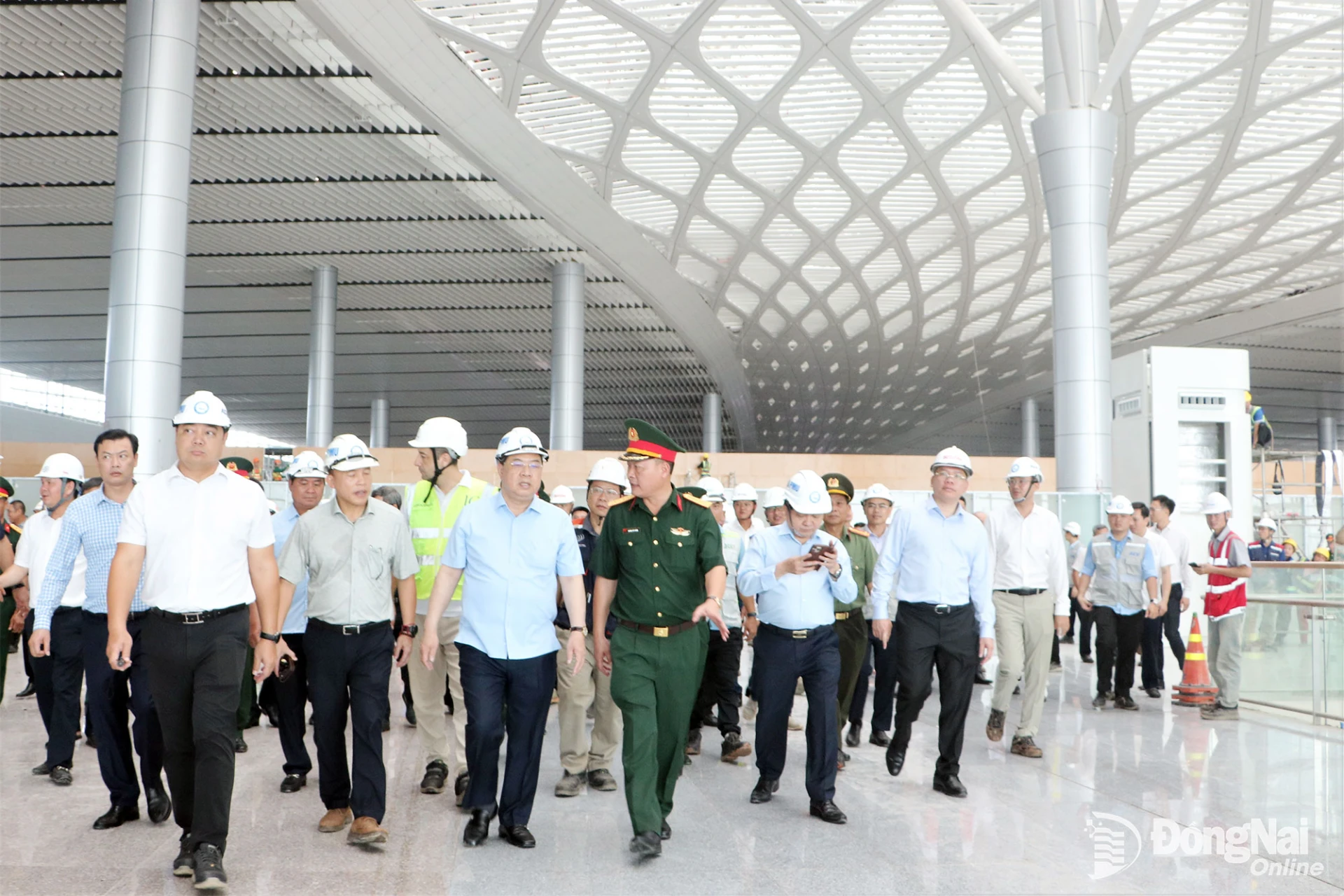
| The Long Thanh International Airport project is under construction in Long Thanh area. |
Speaking at a working session with heads of Viet Nam’s overseas representative agencies, Truong Thi Huong Binh, Director of the Department of Finance, noted that Dong Nai is among the few localities with a fully integrated transport system, encompassing all five modes: road, air, rail, maritime, and inland waterways.
Notably, Long Thanh International Airport is a large-scale national key infrastructure project of regional significance. It is expected to become an international aviation hub and a new growth engine for the province, with a designed capacity of up to 100 million passengers and 5 million tons of cargo annually.
According to Binh, the airport will not only provide a significant advantage in global connectivity but also drive the development of an aviation-based economic ecosystem, logistics, and modern services, thereby positioning Dong Nai as a major logistics center in Southeast Asia.
Alongside the airport, the province’s strategic transport infrastructure network is being developed in a coordinated and modern manner. The system of expressways and ring roads, totaling around 400 km, will connect Dong Nai with major economic centers, international seaports, and key growth regions nationwide. Key expressways include Ho Chi Minh City – Long Thanh – Dau Giay, Phan Thiet – Dau Giay, Bien Hoa – Vung Tau, Ben Luc – Long Thanh, Gia Nghia – Chon Thanh, and Dau Giay – Lien Khuong, together with Ring Roads No. 3 and No. 4, which are gradually forming an inter-regional high-speed transport network.
 |
| Phuoc An Port is expected to play a key role in developing trade, services, and logistics in Dong Nai. Photo: Ngoc Lien. |
In addition, inland waterway ports, seaports, and inland container depots are being further upgraded in combination with Hoa Lu Border Gate Economic Zone, forming an integrated logistics network linking border gates with seaports and airports. This connectivity underscores Dong Nai’s role as a large-scale cargo transit hub, increasingly integrated into regional and global supply chains.
Looking ahead, the province has identified new growth drivers tied to strategic projects, infrastructure, and modern urban development spaces. Two key areas have been designated as new development engines: the Long Thanh airport urban zone, envisioned as an airport city and a regional hub for services, logistics, and transit in Southeast Asia; and the Dong Nai River corridor, which is set to become a dynamic economic axis of the province.
With these orientations, Dong Nai is expected to evolve into a modern, livable urban center and an attractive destination for investors in the years to come.
By Ngoc Lien – Translated by M.Nguyet, Minho


Thông tin bạn đọc
Đóng Lưu thông tin